
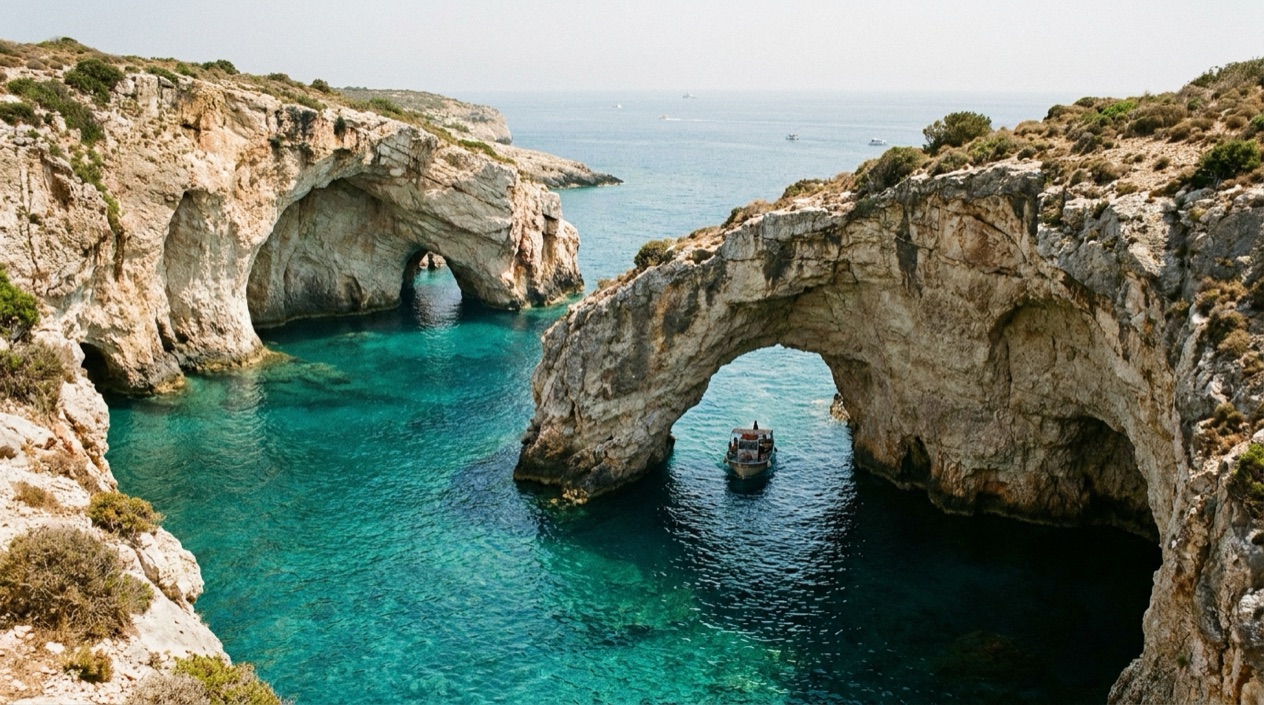
The boat slows beneath the cliffs near Cape Skinari, the engine drops to a murmur, and the rock opens into arches where the water turns a glowing, unlikely blue. Sunlight bounces off the sea floor and up into the hollows, so the ceilings of the caves ripple with light. It is a visit made entirely from the water, a floating look at the rugged northern tip of Zakynthos.
Is visiting the Blue Caves of Zakynthos worth it?
Yes, if you want to see Zakynthos from the sea and enjoy the color of the water up close, and it suits anyone comfortable on a small boat. The caves are reached only by small boats, so the whole experience is built around floating beneath the rock rather than walking to a viewpoint.
What sets the caves apart from other sights on the island is the contrast they offer. Much of Zakynthos is about long sandy beaches on the northern and eastern shores, and about the nightlife of Laganas, a resort that has drawn young crowds since the mid-1980s.
The Blue Caves belong to another side of the island, the one where sandy beaches and tranquil coves give way to rugged coastline, marine caves and a rich underwater realm. Here the cliffs do the talking, and the sea beneath them is the show.
They also make a natural companion to Navagio, one of the most photographed beaches in Greece, which is likewise reachable only by boat. Seeing both gives you a picture of the island’s wild edge, far from the umbrellas and sunbeds of the resort strips. If you picture a long day of swimming and sunbathing, this is a different pleasure: looking, drifting, taking photographs, and listening to the water slap inside the rock.
What to see at the Blue Caves of Zakynthos
The visit is a slow passage along the cliffs at the northern tip of the island, where wind and waves have carved the limestone into hollows, arches and narrow openings. Each stop shows the same water in a different light.
The caves and the color of the water
The caves lie near Cape Skinari, and from the boat you glide into the openings one after another. Inside, the water shifts between turquoise, cobalt and a pale electric blue, depending on how the light enters and how deep the floor lies. Look at the ceilings as well as the sea, because the reflections dance across the stone and make the walls seem to move.
The effect comes from sunlight entering through the openings and bouncing off the bright sea floor, which lights the water from below. That is why the caves look their most intense when the sky is clear. Bring a camera that copes with strong contrast, since the dark rock and glowing water can fool a phone.
The cliffs and arches of the northern coast
Between the caves, the boat follows a coastline that is far wilder than the sandy beaches elsewhere on the island. Pale cliffs drop straight into the sea, and natural arches frame patches of open water and sky. Pines and scrub cling to the tops, and the whole shoreline feels like a different island from the resorts to the south.
Watch the waterline for the layers of rock, smoothed and scalloped by the sea, and for the clear shallows where the sea floor shows through. This is the part of the trip to slow down and simply look.
Navagio beach nearby
Navagio is accessible only by boat, just like the caves, and it is one of the most photographed beaches in Greece. Many boat outings pair the two, so you see a beach hemmed in by cliffs as well as the caves carved into them. From the water you take in the sweep of rock around the cove and the color of the sea below.
How to get to the Blue Caves of Zakynthos
You reach the Blue Caves by small boat, because they near Cape Skinari are accessible only that way. There is no path or road down to them, so the journey is by sea from the island.
Zakynthos itself is a Greek island in the Ionian Sea, around 12 miles west of the Peloponnese mainland. From the main port of Zakynthos town, a ferry connects to the port of Kyllini on the mainland, which is how travelers arrive from the Peloponnese. A second ferry link runs from the port of Agios Nikolaos on Zakynthos to the island of Kefalonia, useful if you are island-hopping through the Ionian.
Once on Zakynthos, the caves are the final leg: a small boat takes you along the northern tip of the island and into the openings in the cliffs. The same type of boat reaches Navagio beach, so the two sights are often linked in one outing. Cape Skinari gives you the point of reference for the caves on the map, at the island’s rugged northern end.
Zakynthos town, with its main port and the Museum of Solomos and Eminent Zakynthians on St Mark’s plaza, is a natural base for the ferry arrival and for evenings ashore. The resort of Laganas lies in a different part of the island, known for its bars and clubs, and its bay is also the prime nesting area for loggerhead sea turtles in the Mediterranean.
When to visit the Blue Caves of Zakynthos
March through May is a particularly rewarding stretch on Zakynthos, with relatively few tourists, the Easter parade and blooming flowers. The sea is not yet at its warmest, but the island looks green and the crowds of high summer have not arrived.
Summer is the season of the sandy beaches on the northern and eastern shores, and July is hot and almost entirely dry, which suits a day on the water. Autumn brings a change: October still has warm afternoons, but it is one of the wetter months, so a rain jacket belongs in the bag. In January the island turns cool and rainy, with many wet days, and it is the least natural time for a boat outing.
| Month | Average high (°F) | Average low (°F) | Precipitation (in) | Days with rain |
|---|---|---|---|---|
| January | 57.7 | 44.6 | 5.69 | 13.1 |
| April | 67.5 | 50.9 | 1.64 | 6.4 |
| July | 90.7 | 68.7 | 0.19 | 0.4 |
| October | 75.0 | 59.2 | 4.43 | 8.5 |
Spring suits visitors who like green hillsides and a quieter island, and the Easter parade adds a cultural note to the trip. July suits those who want heat and a dry sky, with the sea to match. October keeps the warmth but brings more rain, so plan around the weather rather than against it.
Tips for your visit
Pack for the water. Sun protection matters in July, when the average high is above 90°F, and a rain jacket matters in October and January, when many days bring rain. A camera or phone with a secure strap is worth having in a small boat, and so is a bag you do not mind getting splashed.
Back on land, the northern and eastern shores have wide sandy beaches for the rest of the day, and Zakynthos town offers the Museum of Solomos and Eminent Zakynthians, with local art from the 18th and 19th centuries.
For a quieter contrast to the coast, remember that the island rises to Vrachionas, its highest point at 2,487 feet, and that the landscape alternates between beaches, coves and rugged cliffs. The earthquake of 1953 destroyed much of the Venetian architecture in the town, so the old streets are not what they once were, but the island’s character on the water has not changed.
Laganas, with its nightlife, and the turtle nesting bay are separate parts of the island, and they make a very different afternoon from the cliffs of the north.
Good to know before you go
Zakynthos is the third largest of the Ionian Islands after Corfu and Kefalonia, and it is also known as Zante. The Blue Caves are one stop among many on an island that offers sandy beaches, coves, marine caves and a rich underwater realm, so it rewards a stay of several days rather than a single outing. Zakynthos lies in a region touched by earthquakes, as the events of 1953 remind visitors, and its strongest summer heat arrives in July, so plan your time on the water with the weather in mind.
Sources
- Wikipedia, Zakynthos (https://en.wikipedia.org/wiki/Zakynthos), checked October 12, 2026
- Visit Greece (GNTO), Zakynthos (https://www.visitgreece.gr/islands/ionian-islands/zakynthos/), checked October 12, 2026
- Wikivoyage, Zakynthos (https://en.wikivoyage.org/wiki/Zakynthos), checked October 12, 2026
- Hellenic National Meteorological Service (HNMS), climatological normals 1991-2020 for Zakynthos station (https://www.emy.gr/climatic-data), monthly mean daily maximum and minimum; rain from the ECMWF ERA5 reanalysis, 1991-2020, grid cell of Zakynthos (Open-Meteo), checked October 12, 2026
- ECMWF ERA5 reanalysis 1991-2020, grid cell of Zakynthos (Open-Meteo), checked October 12, 2026
To plan your stay
- Best Time to Visit Greece: September and Late May to Early June
- Arachova: Parnassus Mountain Town, Formaela Cheese, Ski Season and Saint George's Day
- American Airlines Flights to Greece: U.S. Cities, Athens Arrivals and Onward Island Flights
- Greece on a Budget: Cash Machines, Cards, Beaches and Ferries