
Ruins of an ancient healing sanctuary lie on Kos, and the place stays in the mind because of its link to Hippocrates, the physician the island claims as its own. Stone terraces, broken walls and the town’s plane tree keep that story close. This is a visit built around medicine, myth and the island’s long layers of history.
Is visiting the Asklepieion of Kos worth it?
Yes, if the story of medicine appeals to you or if you like ruins that tell you something about how people lived and thought. The Asklepieion is where Herodicus taught Hippocrates medicine, and Kos is the birthplace of Hippocrates, often called the father of medicine. For anyone curious about where Western medicine began, standing here carries real weight.
A place built for healing is a different thing from a palace or a fortress, and walking its ruins makes you think about illness, care and belief in a way that a museum label cannot.
What sets it apart from other sights on the island is its subject. Kos has a fortress at the harbor entrance built by the Knights Hospitaller, another fortress from the Byzantine period at Antimachia, an ancient market place considered one of the biggest in the ancient world, and a synagogue in the historic center.
The whole island resembles an open-air museum, yet the Asklepieion is the one that speaks directly to the name Kos is known by. Travelers who prefer beaches to stones will find the island offers plenty of those too, and the ruins fit neatly beside a seaside stay.
What to see at the Asklepieion of Kos
The sanctuary ruins
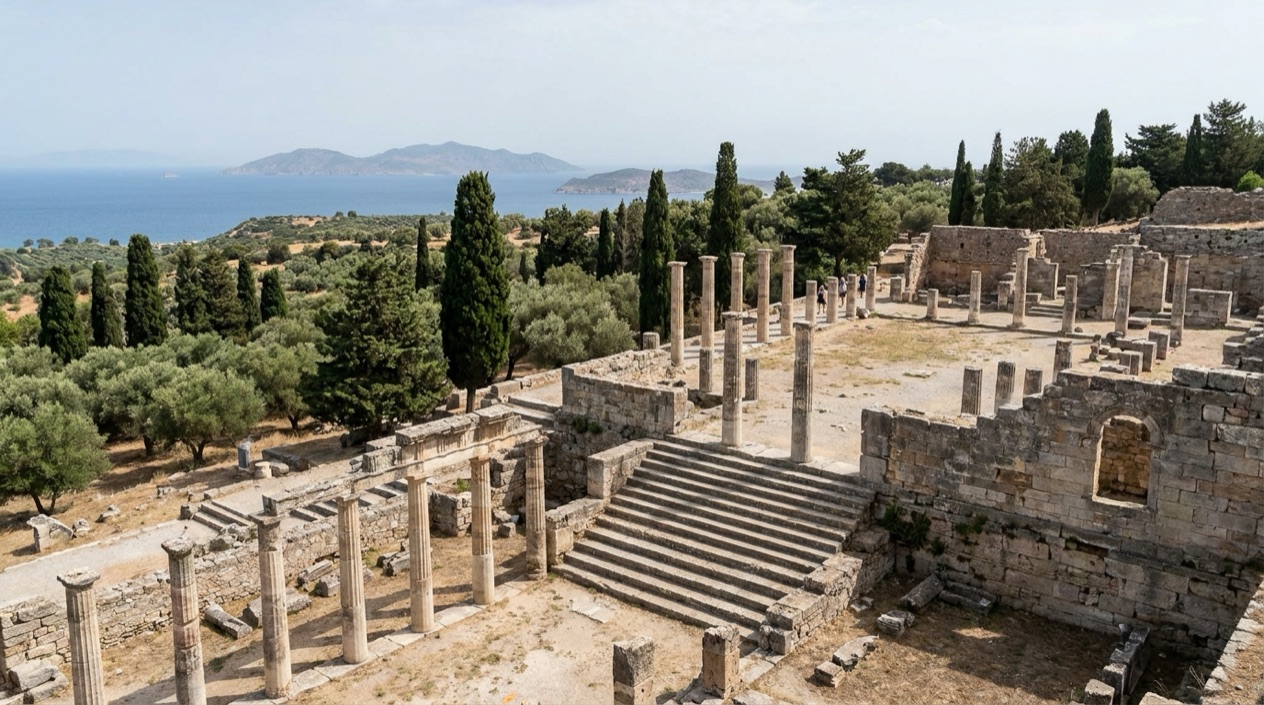
The ruins of the Asklepieion are the heart of the visit. They stand near the institute on Kos, and they are the remains of the place where Herodicus taught Hippocrates medicine. What you see are the foundations, walls and levels of a sanctuary that served as both a place of worship and a place of care.
Look at how the site is laid out in stages, with different areas set at different heights. That arrangement tells you the sanctuary was designed as a sequence, a place where a visitor moved from one space to another with a purpose. Take time to read the stones rather than rush through them.
The story of Hippocrates
Hippocrates is the figure that gives the site its meaning. Kos is his birthplace, and tradition holds that he learned medicine here under Herodicus. The ruins are the physical setting for that story, and it helps to arrive with it in mind.
Visitors find the idea of a physician who treated the body as a matter of observation, rather than only of ritual, the most striking part of the tale. Standing among the ruins, you can picture a teacher and a student working in the open air, which is how the old accounts imagine it.
The Plane Tree of Hippocrates
In the center of the town of Kos stands the Plane Tree of Hippocrates, where the ancient physician is traditionally supposed to have taught. It is not part of the sanctuary, but it belongs to the same story, and it makes a natural companion to the ruins.
The word to hold on to is traditionally. Nobody claims proof, yet the tree carries the legend with a calm authority. A short look under its broad canopy completes the picture of Kos as the island of Hippocrates.
How to get to the Asklepieion of Kos
The Asklepieion lies on the island of Kos, a Greek island in the Dodecanese in the south-eastern Aegean Sea near the Turkish coast. The base for the visit is Kos town, the main port and population center of the island, and also its tourist and cultural center. The ruins stand near the institute, which is the landmark that places them on the map.
Kos town is where the Plane Tree of Hippocrates, the ancient market place and the harbor fortress are found, so a stay there puts the Asklepieion in the same area as the island’s other historic sights. Visitors staying elsewhere, such as the seaside village of Kardamena, a resort popular with young holidaymakers from the United Kingdom and Scandinavia, would first head for Kos town.
The island measures 26 by 7 miles, with a coastline of 70 miles, so it is a place you can understand as a whole. The details of any particular bus, taxi or rental car are not something to assume, and the only firm point is the one that matters: aim for Kos town and look for the institute near the ruins.
When to visit the Asklepieion of Kos
The climate of Kos shapes how the ruins feel, because this is an open site with stone underfoot. July is the hot month, with an average high of 87.6°F and a low of 72.9°F, and almost no rain. Under that sun, the ruins ask for sun protection and a steady pace.
| Month | Average high (°F) | Average low (°F) | Precipitation (in) | Days with rain |
|---|---|---|---|---|
| January | 56.7 | 48.2 | 6.38 | 12.3 |
| April | 66.6 | 55.2 | 1.53 | 6.0 |
| July | 87.6 | 72.9 | 0.01 | 0.1 |
| October | 74.5 | 63.5 | 2.36 | 5.1 |
April and October sit between the extremes. April has a high in the mid-60s and a modest amount of rain, while October is warmer, with a high in the mid-70s and rain on a handful of days. Both months suit a walk among ruins, and a light rain jacket is enough for the occasional wet day.
January is the wet month in this set, with rain on many days and highs in the mid-50s. A rain jacket and warm layers make sense then, and the ruins take on a different mood, with damp stone and a more inward feel. Whichever month you choose, the site itself is the same place of memory and story.
Tips for your visit
Bring sun protection if you come in the warmer months, since the ruins are an outdoor site and July highs reach the upper 80s. In the cooler, wetter months, a rain jacket and warm layers are the sensible choice. Comfortable shoes suit uneven ancient ground.
Pair the ruins with the other sights of Kos town. The Plane Tree of Hippocrates stands in the center of town, and the ancient market place, once the commercial and commanding center of the ancient city, belongs to the same urban landscape. The fortress at the harbor entrance, erected in 1315 by the Knights Hospitaller, adds a medieval chapter to the same day out.
For a longer look at the island’s history, the synagogue Kahal Shalom, built in 1935 on Alexandrou Diakou street in the historic city center, shows another side of Kos. The Byzantine fortress at Antimachia offers a different period again. When the sightseeing is done, the island’s beaches are close, and a swim or a seaside meal rounds off the stay.
Good to know before you go
The euro is the money of Greece, and the Asklepieion fits easily into a stay built around the sea and the old town. Take the heat seriously in high summer, since the site is open ground, and keep water and a hat in mind. In the rainier months, damp stone calls for careful footing.
Sources
- Wikipedia, Kos (https://en.wikipedia.org/wiki/Kos), checked October 12, 2026
- Visit Greece (GNTO), Kos (https://www.visitgreece.gr/islands/dodecanese/kos/), checked October 12, 2026
- Wikivoyage, Kos (https://en.wikivoyage.org/wiki/Kos), checked October 12, 2026
- Hellenic National Meteorological Service (HNMS), climatological normals 1991-2020 for Kos station (https://www.emy.gr/climatic-data), monthly mean daily maximum and minimum; rain from the ECMWF ERA5 reanalysis, 1991-2020, grid cell of Kos (Open-Meteo), checked October 12, 2026
- ECMWF ERA5 reanalysis 1991-2020, grid cell of Kos (Open-Meteo), checked October 12, 2026
To plan your stay
- Best Time to Visit Greece: September and Late May to Early June
- Arachova: Parnassus Mountain Town, Formaela Cheese, Ski Season and Saint George's Day
- American Airlines Flights to Greece: U.S. Cities, Athens Arrivals and Onward Island Flights
- Greece on a Budget: Cash Machines, Cards, Beaches and Ferries