
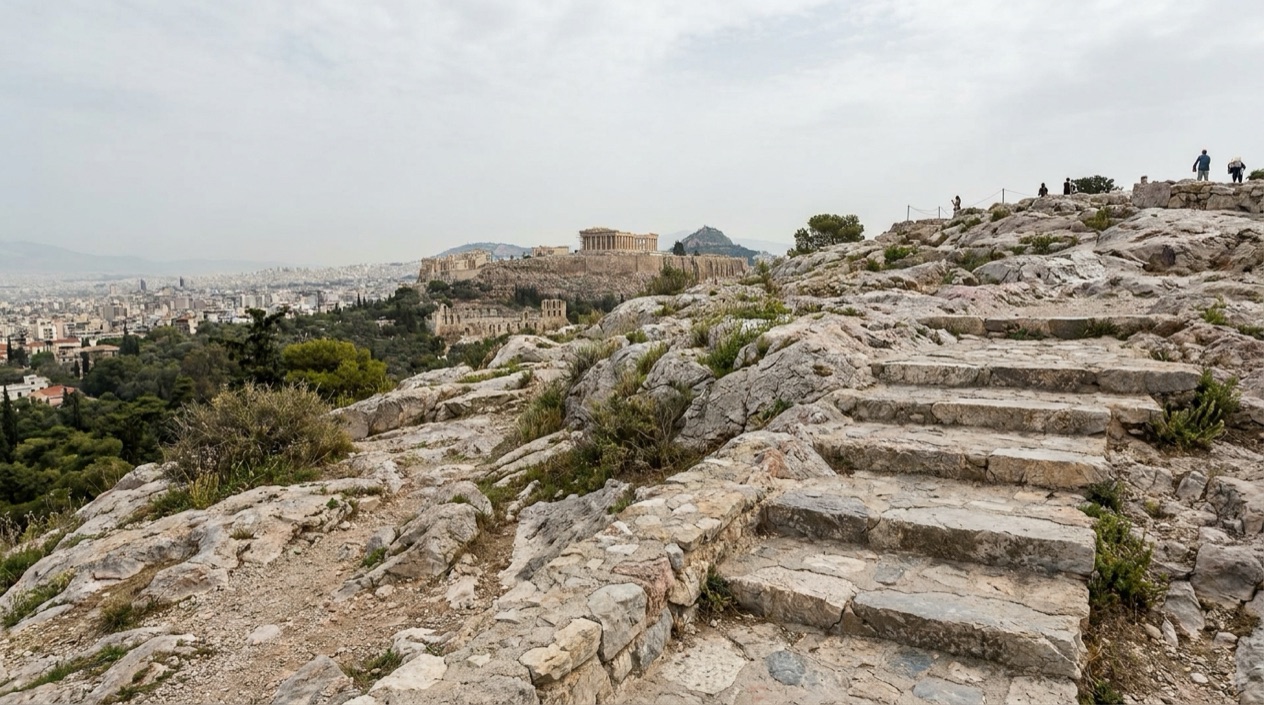
A bare gray-white rock rises beside the Acropolis, and the first thing you notice from its top is how much of Athens spreads out around you: rooftops, church domes, and the great citadel itself standing close by. Voices of other visitors drift across the stone while the city hums below.
Is visiting Areopagus Hill worth it?
It is a rocky outcrop called the Hill of Ares, northwest of the Acropolis, and it rewards curiosity more than it rewards a checklist.
What sets it apart from the monuments around it is that there are no columns to admire and no reconstructed halls. The Acropolis shows you what the ancient city built. The Areopagus shows you where the ancient city argued, judged and listened. The name comes from the Greek Areios Pagos, the Hill of Ares, because Ares was supposedly tried here for the murder of Poseidon’s son, and that tale of a god in the dock gives the rock its character.
The hill also carries two later layers. For Christians it is the setting of the Apostle Paul’s sermon in Acts, a passage visitors know well. For Greeks the word Areopagus lives on in the judicial body of aristocratic origin that later became the higher court of modern Greece. A traveler who arrives knowing any of these threads will find the rock far more eloquent than it first appears.
It also fits easily into a wider day among Athens’ ancient sites and neighborhoods. The Plaka, with its picturesque streets and historic landmarks, is a top attraction that gets crowded, while Koukaki, where the Acropolis Museum and a pedestrian walkway link ancient monuments, is fashionable. The Areopagus sits among them as the contemplative stop, the one where you pause and look.
What to see at Areopagus Hill
The view of the Acropolis and Athens
From the Areopagus, visitors can see the Acropolis and the city of Athens, and the two are framed together in a way few other places allow. The citadel stands on its own rock close by, and beyond it the modern city runs out in a spread of white and pale buildings, broken by green patches and church domes.
Take a moment to look at the Acropolis from here as a neighbor rather than a destination. You see the sheer face of its rock and the monuments along its summit as part of the skyline. Then turn the other way and follow the streets of the city outward. Travelers use the hill as a way to understand how the ancient and modern parts of Athens sit side by side.
The Hill of Ares and the ancient court
The rock takes its name from Ares, the god of war, who in myth was tried here for the murder of Poseidon’s son. Ancient Athenians told the tale to explain why this particular outcrop became a place of judgment, and the idea stuck. In later tradition the hill was where a council of elders sat to decide the gravest cases, above all those of homicide.
That council of aristocratic origin gave its name to a judicial body, and the term Areopagus still turns up in the story of the higher court of modern Greece. Standing on the stone, it is worth imagining the open-air hearings, with the jurors on the rock and the city below. Nothing of that is built here. You are standing where the story happened, with only the weathered surface of the hill to carry it.
The Apostle Paul’s sermon
The Areopagus is prominently featured in Acts 17:16-34 as the setting for the Apostle Paul’s sermon during his visit to Athens. According to that account, his address to the Athenians led to the conversion of Dionysius the Areopagite. For visitors, especially those who grew up with the New Testament, this is the main reason to come.
The scene is easy to picture. A traveler from far away addresses a city full of temples and altars, with the Acropolis rising behind the listeners. Reading the passage on the spot, with the same view in front of you, makes the text feel suddenly located. You do not need to be religious to appreciate how neatly the hill joins two worlds, the old pagan city and the first Christian message to reach it.
The Cathedral Basilica of St. Dionysius the Areopagite
Near the Areopagus, the Roman Catholic Church built the Cathedral Basilica of St. Dionysius the Areopagite in the mid-19th century AD. Its name looks back to the man converted after Paul’s sermon, so the building belongs to the same story as the hill. It shows how the memory of that moment kept shaping the neighborhood long after the ancient court had ceased to sit.
Seen together, the rock and the cathedral form a small chain of cause and effect. A sermon on a hill, a convert who took the hill’s name, and a church raised centuries later to honor him. If you enjoy following one thread through a city, this is a tidy one to pick up.
Hours, tickets and rules
The Areopagus is a natural rocky outcrop rather than a built monument with a hall, a gallery or a roofed interior, so the visit is about the hill itself, the view it gives and the stories attached to it. Its place in Athens is simple to describe: it lies northwest of the Acropolis, and from its top you look across to the Acropolis and out over the city.
That makes it a different kind of stop from the museums and enclosed archaeological sites in the center. Those are organized around opening times and ticket counters. The hill is organized around the land and the sky, and your impressions depend on the weather, the light and what you bring to it in the way of reading or curiosity.
What can be said with certainty about the name and the setting is worth carrying with you. The word Areopagus means Hill of Ares. The hill is tied to the myth of Ares’ trial, to the sermon in Acts, and to the court that kept its name. Those three facts are the real content of the visit, and they cost nothing to bring along.
For moving around Athens before and after, the Athens Metro operates from 5:30 a.m. to 00:30 a.m., and on Friday and Saturday nights lines 2 and 3 stay open later. On buses in the city, passengers cannot use the front door to get on or off. Both details help when you are planning a day that links several sites.
When to visit Areopagus Hill
The seasons change how the hill feels more than they change what it offers. In spring and autumn the air is mild, in summer the rock is exposed to strong sun, and in winter there is more rain and cooler weather. The view of the Acropolis and Athens is the constant, and the weather decides how comfortable it is to stand and take it in.
| Month | Average high (°F) | Average low (°F) | Precipitation (inches) | Days with rain |
|---|---|---|---|---|
| January | 56.3 | 44.4 | 2.17 | 7.5 |
| April | 68.4 | 53.2 | 1.10 | 5.5 |
| July | 91.8 | 74.1 | 0.28 | 1.6 |
| October | 75.2 | 61.0 | 1.09 | 3.9 |
January brings the coolest air of the four months shown, with rain on a fair number of days, so a rain jacket belongs in the bag. A rocky outcrop in wet weather asks for care underfoot, and the view can be softer when clouds hang over the city.
April is mild, with fewer rainy days and warm enough afternoons for standing outdoors and reading the story of the hill. October is similar in feel, a little warmer, with a modest number of rainy days. Both months suit a visit where you want to linger on the rock rather than hurry off.
July is the hottest of the four, with very little rain and high averages that call for sun protection. An exposed hill gives little cover, so the heat is part of the experience. If you come in summer, plan the Areopagus as one stop among others in the day rather than a long sit.
Beyond the weather, the hill has no festival or fixed date in its story that sets a best moment. It is a place you can fit into any month, and the choice comes down to how much heat or rain you are happy to stand in while you look at the Acropolis.
Tips for your visit
Bring a reading to go with the place. The passage in Acts 17:16-34 is the obvious one, and a short account of the myth of Ares’ trial makes a good companion. The hill has no built structure to explain itself, so what you carry in your head becomes the guide. A camera helps too, because the Acropolis and the city make a natural frame.
Many rainy days in winter mean a rain jacket, and the high averages of July mean sun protection. Wear shoes you are happy to use on rough stone. The hill is a natural outcrop, so there is no reason to treat the visit as a formal outing.
Pair the Areopagus with its neighbors. The Acropolis stands right beside it, the Plaka offers picturesque streets and shops (though it gets crowded), and the Acropolis Museum in Koukaki, linked to ancient monuments by a pedestrian walkway, adds the story of what once stood on the citadel. Add the Cathedral Basilica of St. Dionysius the Areopagite, built in the mid-19th century AD, for the Christian thread.
For getting around, the Athens Metro runs from 5:30 a.m. to 00:30 a.m., with lines 2 and 3 open later on Friday and Saturday nights. On the city buses, passengers cannot use the front door. If you are arriving from the airport by metro, trains on line 3 between Airport and Douk. Plakentias run every 30 minutes.
Families and travelers with limited mobility should keep in mind that this is a rocky outcrop, not a paved square, and that the surface is natural stone. Plan your time around the weather and the other stops in your day, and let the hill be the pause in between.
Good to know before you go
The Areopagus asks little of your wallet, since the hill itself is a piece of the city’s landscape, and the neighboring sites and museums are where any spending happens. The official tourism guide of Athens, This is Athens, is the place to read about the surrounding neighborhoods. Keep an eye on the weather when you plan the day, because a hot July afternoon and a wet January one call for quite different preparation.
Sources
- Wikipedia, Areopagus (https://en.wikipedia.org/wiki/Areopagus), checked October 12, 2026
- OASA, Athens urban transport (https://www.oasa.gr/en/), checked October 12, 2026
- Athens Transport, public transport guide (https://www.athenstransport.com/english/), checked October 12, 2026
- This is Athens, the official Athens tourism site (https://www.thisisathens.org/), checked October 12, 2026
- Hellenic National Meteorological Service (HNMS), climatological normals 1991-2020 for Elliniko station (https://www.emy.gr/climatic-data), monthly mean daily maximum and minimum; rain from the ECMWF ERA5 reanalysis, 1991-2020, grid cell of Athens (Open-Meteo), checked October 12, 2026
- ECMWF ERA5 reanalysis 1991-2020, grid cell of Athens (Open-Meteo), checked October 12, 2026
To plan your stay
- Best Time to Visit Greece: September and Late May to Early June
- Arachova: Parnassus Mountain Town, Formaela Cheese, Ski Season and Saint George's Day
- American Airlines Flights to Greece: U.S. Cities, Athens Arrivals and Onward Island Flights
- Greece on a Budget: Cash Machines, Cards, Beaches and Ferries