
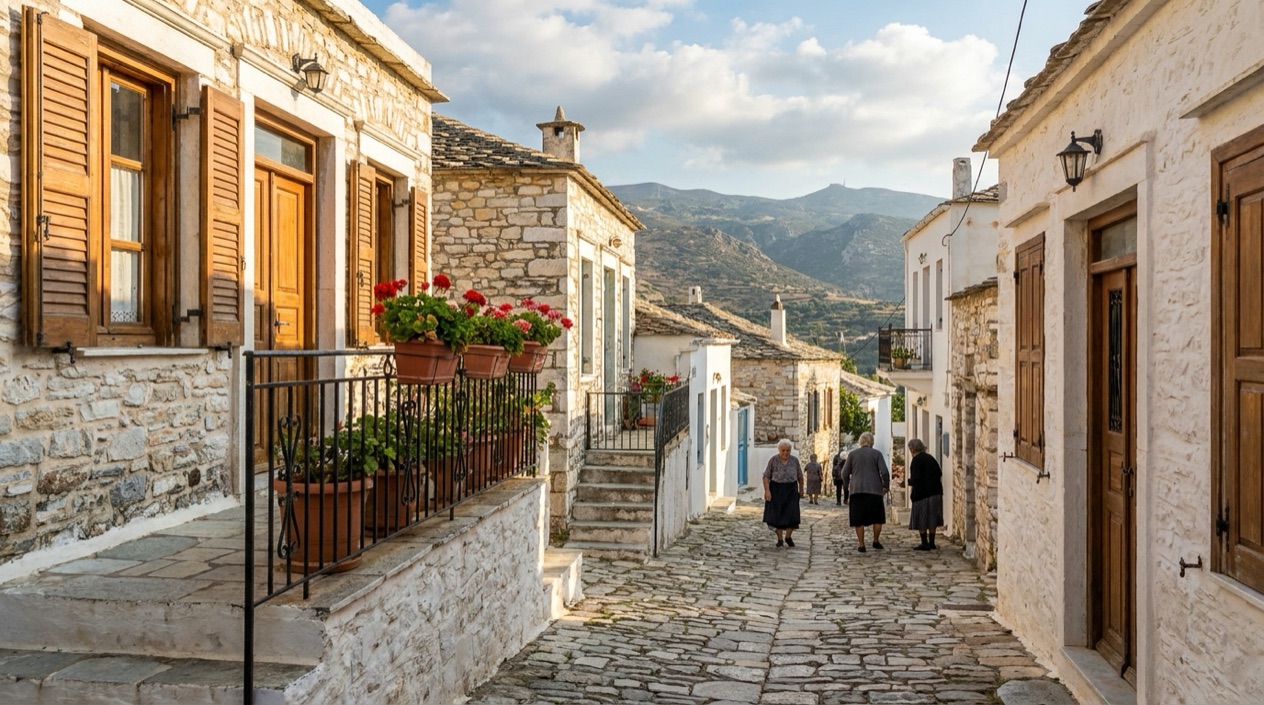
You step out of the bus or the car into a village that climbs a slope, where the lanes are paved in marble and the old men at the kafenio (the village coffeehouse) stop talking long enough to see who has arrived. Stone towers rise between the houses, and little arches carry you from one lane into the next. Apeiranthos is a mountain village on Naxos, and the visit is about wandering, museums and a long lunch.
Is visiting Apeiranthos worth it?
Yes, if you like to spend your time in a village with a character of its own rather than on a beach.
If your idea of Naxos is only sand and sea, it will feel like a detour. If you want to know how people live in the interior of the island, it is one of the places to understand it.
What sets it apart from other villages on the island is its mix of identity and collections. The local dialect and traditions resemble those of mountainous Cretan villages, and this has led some historians to think that Apeiranthos was built by Cretans in the 10th century.
You hear that distinct heritage in the way people talk about the place. The first written trace of the village goes back to 1420, in a reference by the Italian traveler Cristoforo Buondelmonti.
It is also a village with a museum for almost every taste: archaeology, folk art, geology and natural history. That is a lot of culture for a community of 773 people, the second largest village on Naxos after Filoti.
The scale of the place is what you notice: you can cover the lanes on foot and still find yourself at a different museum door every few turns. Naxos has sea, beaches and a port town, and Apeiranthos gives the island its mountain side.
What to see at Apeiranthos
The village itself is the first sight: marble underfoot, stone houses stacked against the hillside, and towers that recall the days when villagers kept watch over the slopes. Apeiranthos stands on the foothill of Mount Fanari, so the lanes tilt and turn, and every corner opens onto a different view of rooftops and terraces. Four museums are scattered through the village, and each is a separate stop.
The Archaeological Museum of Apeiranthos
The Archaeological Museum is where the island’s deeper past comes into focus. Naxos is the largest island of the Cyclades, and its ancient story reaches well beyond the village, so a small collection here works as an introduction to the objects people left in the ground across the island. Look for the everyday pieces, such as pottery and tools, that tell you how ordinary people lived.
Seen after a walk through the lanes, the museum makes the place feel older than it looks. The village you have just crossed sits on land that people have worked for a very long time. Take the museum slowly and let the labels connect the objects to the island around you.
The Museum of Folk Art
The Museum of Folk Art is the one that explains the village’s own identity. Folk collections in the Greek islands usually gather weaving, embroidery, household tools and costume, and this is the museum where the Cretan-like traditions of Apeiranthos are easiest to picture, since textiles and domestic objects show how a mountain household once functioned.
Look for the loomwork and the carved or painted details on everyday objects. They tell a story of a community that made what it needed with its own hands, high on a slope far from the port.
The Geological Museum
The Geological Museum looks at the rock under the village, and that is fitting. Naxos is a mountainous island, with Mount Zeus, also called Zas, reaching 3,284 feet as the highest peak in the Cyclades. The marble in the lanes you have been walking on is part of the same story, so the museum turns the stones at your feet into something to read.
Expect minerals and rock samples that show the island’s geology up close. If you have walked uphill to get here, you will look at the hillside differently afterward.
The Museum of Natural History
The Natural History Museum is the surprise, because it turns your attention to the sea. Its specimens include the loggerhead turtle (Caretta caretta), the sperm whale (Physeter macrocephalus), the Mediterranean monk seal (Monachus monachus) and the bottlenose dolphin (Tursiops truncatus). These are animals of the Aegean, and seeing them in a mountain village makes a good contrast with the dry slope outside.
It is a good stop when you want something to talk about over lunch. Afterward, the sea you can glimpse from the island’s heights feels a little less like scenery and a little more like a place with residents.
Hours, tickets and rules
Apeiranthos is a village visit built around four museums: the Archaeological Museum, the Museum of Folk Art, the Geological Museum and the Museum of Natural History. Each is a separate small collection, and the lanes between them are the real connecting thread. You pass doors, arches and little squares as you go from one to the next, and the village is part of the visit as much as any exhibit.
The four museums share the village but not a theme. One is about the objects people left in the ground, one about what households made and used, one about the rock beneath it all and one about the animals of the surrounding sea. You can take them in any order, and it makes sense to let the lanes decide which door comes next, since the village is laid out on a slope and the route follows the hill.
Beyond the museums, the village has its own places to stop. The kafenio is the social room of a Greek village, a place for coffee and conversation, and the tavernas serve the food of the Naxos interior, such as grilled meat, local cheese, potatoes and a plate of fried vegetables. Sit down at one of them between museums and the visit takes on its proper pace.
Time spent here is mostly time on foot, so the setting matters as much as the exhibits. The marble paving, the arches over the lanes and the stone towers are all part of what you came to see, and none of them has a door to open.
When to visit Apeiranthos
The months when you can walk the lanes in comfort and still count on dry weather are the answer. That is a good temperature for a village that is all about walking uphill and sitting outside afterward.
July is the other end of the scale. At Mykonos highs average in the low 80s and lows stay in the low 70s, and Naxos records essentially no rain.
A village on a mountain slope is a place to go in summer for the sake of the interior, and for the sun protection you will need as you cross open lanes. January is the wet month of the table, with rain on most of its days on Naxos, so a rain jacket belongs in the bag.
| Month | Average high at Mykonos (°F) | Average low at Mykonos (°F) | Rain at Mykonos (in) | Rain days at Naxos |
|---|---|---|---|---|
| January | 55.2 | 47.7 | 3.01 | 11.2 |
| April | 64.0 | 54.7 | 0.78 | 3.9 |
| July | 83.3 | 72.7 | 0.01 | 0.0 |
| October | 71.2 | 63.0 | 1.08 | 3.6 |
Spring and autumn also suit the eating side of the visit. A long lunch of local cheese, potatoes and grilled meat at a village taverna is more pleasant when you are not sitting in the full heat of summer. The marble lanes, the museums and the kafenio are the same in every season, and so is the pace of village life.
A visit in the rainy months has its own character, with the village largely to the people who live there. Stone and marble look different when wet, and the museums become the reason to be indoors rather than an item on a list. Pair the day with a warm drink at the kafenio.
Tips for your visit
Wear shoes with a good grip, because the lanes are paved in marble and the village sits on a slope. Smooth stone, a hillside and a day of walking are a good reason for sturdy soles. In the sunny months, bring sun protection and water, since the lanes are open to the sky between the arches. In the rainy months, a rain jacket is the consequence of the table.
Plan the day around the museums and the table. The four collections are small enough to take in between coffee and lunch, and the village has places to sit, so you can pace yourself rather than rush from door to door. Let the lanes lead you, because a wrong turn here usually ends in an arch or a small square you would have missed.
Naxos offers plenty to combine with the village. The island has beaches, among them Agios Prokopios, Agia Anna and Plaka, and a port town at Chora where the ferries arrive, about five and a half hours from Piraeus by regular ferry. Filoti, the one village larger than Apeiranthos, belongs on the same island map, and Mount Zas gives the interior its high point.
Think of Apeiranthos as the mountain chapter of a Naxos trip, set between the sea days and the harbor evenings. Come hungry, because the food of the interior is part of the reason to be here, and the lanes are best enjoyed with time in hand. End the visit where it began, at a table in the village.
Good to know before you go
Greece uses the euro, and a village taverna or kafenio is the place to have some small change ready for coffee. Apeiranthos keeps Eastern European Time, which becomes Eastern European Summer Time in the warm months, so the clocks of the village run ahead of the ones you left at home.
Sources
- Wikipedia, Apeiranthos (https://en.wikipedia.org/wiki/Apeiranthos), checked October 12, 2026
- Visit Greece (GNTO), Naxos (https://www.visitgreece.gr/islands/cyclades/naxos/), checked October 12, 2026
- Wikipedia, Naxos (https://en.wikipedia.org/wiki/Naxos), checked October 12, 2026
- Wikivoyage, Naxos (https://en.wikivoyage.org/wiki/Naxos), checked October 12, 2026
- Hellenic National Meteorological Service (HNMS), climatological normals 1991-2020 for Mykonos station (https://www.emy.gr/climatic-data), monthly mean daily maximum and minimum; rain from the ECMWF ERA5 reanalysis, 1991-2020, grid cell of Naxos (Open-Meteo), checked October 12, 2026
- ECMWF ERA5 reanalysis 1991-2020, grid cell of Naxos (Open-Meteo), checked October 12, 2026
To plan your stay
- Best Time to Visit Greece: September and Late May to Early June
- Arachova: Parnassus Mountain Town, Formaela Cheese, Ski Season and Saint George's Day
- American Airlines Flights to Greece: U.S. Cities, Athens Arrivals and Onward Island Flights
- Greece on a Budget: Cash Machines, Cards, Beaches and Ferries