
Across the narrow strait from Paros, the island of Antiparos opens into low hills, small farms and a town of lanes that end at the water. In the middle of the island, the ground gives way to a cave that people have walked into for thousands of years, first to shelter and later out of curiosity.
Is visiting the Cave of Antiparos worth it?
Yes, if you like your island days to include something other than a beach, and especially if you are already staying on Paros or Antiparos and want a place with real history under your feet. The cave rewards curiosity more than athletic effort, and it gives a different view of an island that people picture only as sand and sea. It also sits comfortably alongside a swim, a lunch and a walk through town.
What sets it apart from other sights nearby is that it is a natural place rather than a built one. The Venetian Castle in the island’s capital is a ring of homes, and Despotiko, the uninhabited island to the southwest, is an archaeological site.
The cave is neither: it is a hollow in the rock that people used as a natural shelter from the Neolithic period onwards.
It is also a good counterweight to the rest of the island. Antiparos is a small place, ideal for holidays away from all the noise, with sandy beaches and clear, emerald water. A visit to the cave adds a different texture to those days, one of rock, shadow and stories rather than sun and salt.
What to see at the Cave of Antiparos
The visit is a descent into the rock, and the interest lies in the cave’s shapes, its long human history and the traces visitors have left on it over time.
The cave itself
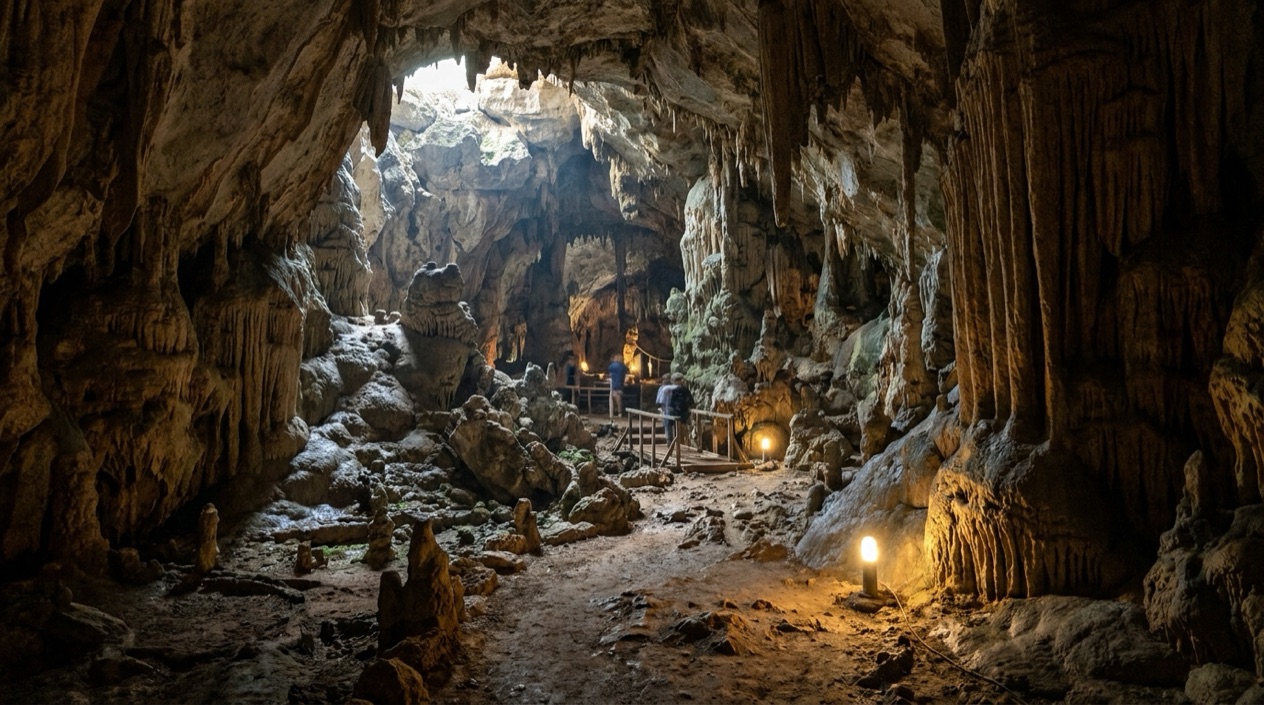
The cave lies in the center of the island, and it has been used as a natural shelter since the Neolithic period. That detail changes how you look at it. Before it was a sight, it was a refuge, a place where people came in out of the weather and the open country around it.
Caves of this kind are typically decorated by dripping water over a very long time, so look for the pale, rippled formations that hang from the ceiling and rise from the floor. Let your eyes adjust once you are inside, because the lighting shows the shapes but the space still feels very different from the bright island above.
Steps, barriers and lighting
The cave was renovated in the second half of the 20th century with EU funds. Barriers, steps, lighting, security cameras and loudspeakers were added, and these are what turn a rough natural hollow into a place you can walk through as a visitor.
The steps and barriers set the route, so the visit follows a defined path rather than free scrambling. The lights pick out the formations and the shape of the chamber, and they give you a sense of the space that a torch alone could not. It is a mix of old rock and modern fittings, and it is worth noticing where the two meet.
The names of Byron and Otto
Two well-known visitors carved their names into the Cave of Antiparos: Lord Byron, the English poet, and Otto, the first modern King of Greece. Their signatures are part of the story the cave tells about itself, a kind of guest book written in stone.
Carving a name in a cave is something we would not do today, and seeing the marks makes you think about how the place has been regarded across the years. It was a destination for travelers long before modern tourism arrived on the island. Looking for the names is a small game to play on the way through, and it gives the visit a thread beyond the rock formations.
The Venetian Castle in town
The Venetian Castle of Antiparos was built in 1440 by Giovanni Loredan. It stands in the island’s capital, on the northeastern coast, and it makes a natural companion to the cave because it shows a later chapter of the island’s story.
The homes inside the castle are protected, and any intervention on them requires permission from the archaeological department. That tells you the place is treated as a monument rather than just a pretty corner of town, so go to look and to walk through, not to alter or take anything.
How to get to the Cave of Antiparos
You reach the cave by getting to Antiparos first, and the way over is a local ferry from the port of Parikia on Paros. The island lies 5.0 miles from Parikia, and the passenger ferry runs from that port. The strait between the two islands is narrow and shallow, and Antiparos is only a few minutes from Paros, which is why so people treat the two islands as a pair.
Once you are on Antiparos, the cave is in the center of the island, while the capital sits on the northeastern coast. The island itself is small, about 6.8 miles from north to south and 2.8 miles at its widest, so the cave is never far from wherever you are staying. Inland, the island rises toward St. Elias, the highest peak, which stands in the middle of the island, and the cave lies in that same central part.
If you are starting from elsewhere, the route runs through Paros: you get to Parikia first and then take the local ferry across. Arrive at the port knowing that the crossing is the link between the islands and plan the rest of your day around the cave, the town and the beach you want to visit.
When to visit the Cave of Antiparos
The tourist season on Antiparos runs from Easter to October, and that is the stretch when the island is set up for visitors. Easter moves every year, so the opening of the season shifts with it, and by October the season is winding down. A visit to the cave belongs within those months, when the island’s services and cafés are working.
Within the season, think about what else you want from the day. The beaches on Antiparos are sandy with clear, emerald waters, so a cave visit pairs naturally with a swim afterward, and the cave gives you a change of scene from the open sun. The Aegean is a windy sea, and a visit underground is a good way to spend part of a day when you want something other than the shore.
Early and late in the season, the island has a different mood from midsummer. It is still a small island of about 1,265 permanent residents, and you feel that most when the summer rush has not yet arrived or has begun to fade. Pick the part of the season that suits you, and let the cave be one of the things you do on the island rather than the only thing.
Tips for your visit
Plan the cave as one stop in a day on Antiparos rather than the whole outing. Wear shoes that grip, since you are going down steps in a natural cave, and bring what you need for the rest of the day, such as a swimsuit and a towel, because the beaches are close by.
The steps and barriers are there for safety, and the cave is lit, so you follow a set route. If anyone in your group has trouble with stairs, keep that in mind, since the visit is built around them. Children can enjoy the shapes and the names on the walls, but they should stay within the barriers.
Combine the cave with the rest of the island. The Venetian Castle in the capital is a natural second stop, and the beaches give you a place to cool off afterward.
The best-known nudist beach is Camping, also called Theologians, at the north of the island opposite the uninhabited island of Diplo, and the far end of the town beach and Perigiali are nudist as well. Despotiko, the uninhabited island to the southwest, is a place of great archaeological importance.
Good to know before you go
Antiparos is a small island, so pack for a simple, low-key day: sun protection, water and something to wear on your feet that holds on stairs. The Aegean wind can be strong in summer, and the cave is a good place to be when it is. Greece uses the euro, and the cave visit is one part of a day that also includes the town, the castle and the sea.
Sources
- Wikipedia, Antiparos (https://en.wikipedia.org/wiki/Antiparos), checked October 12, 2026
- Visit Greece (GNTO), Antiparos (https://www.visitgreece.gr/islands/cyclades/antiparos/), checked October 12, 2026
- Wikivoyage, Antiparos (https://en.wikivoyage.org/wiki/Antiparos), checked October 12, 2026
To plan your stay
- Best Time to Visit Greece: September and Late May to Early June
- Arachova: Parnassus Mountain Town, Formaela Cheese, Ski Season and Saint George's Day
- American Airlines Flights to Greece: U.S. Cities, Athens Arrivals and Onward Island Flights
- Greece on a Budget: Cash Machines, Cards, Beaches and Ferries