
A taverna table spills onto a sloping street, a neighbor waters pots of basil from a balcony, and somewhere behind a doorway a radio plays a football match. Petralona does not announce itself with monuments.
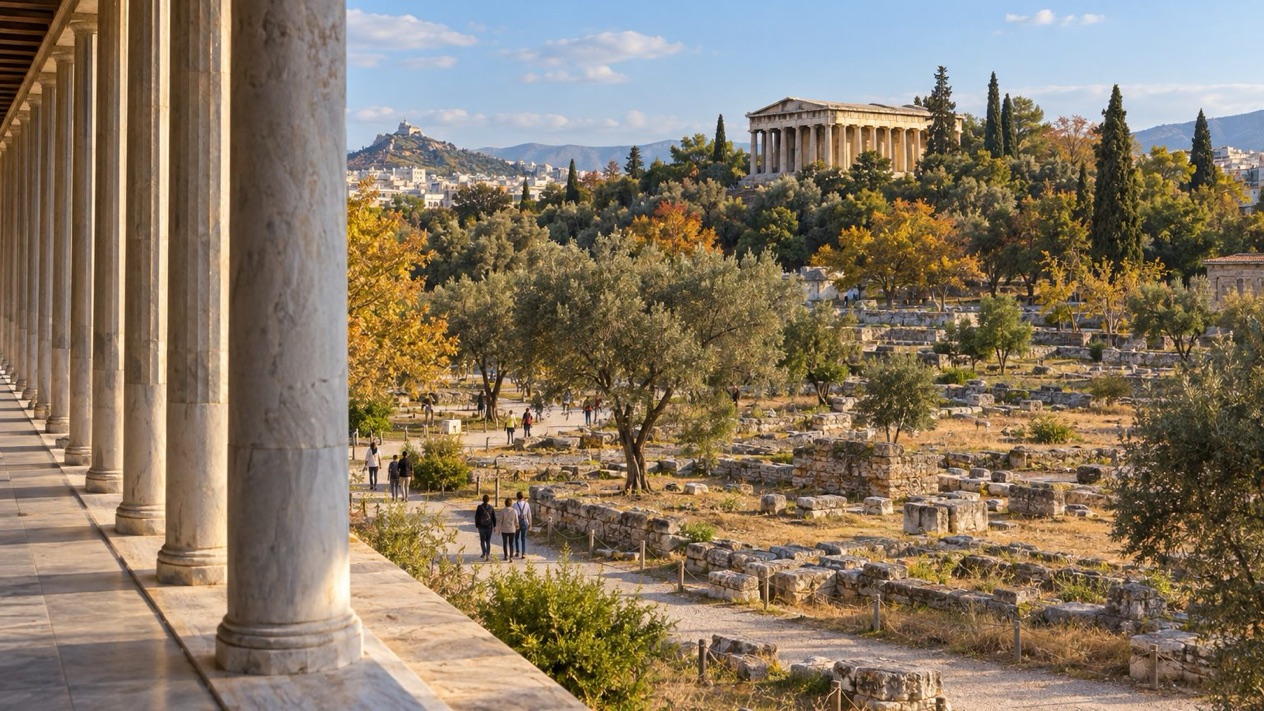
What is Petralona like?
Petralona is a lived-in neighborhood of the center of Athens, made of small houses, apartment blocks, corner cafés and family tavernas rather than sights with ticket booths. Athenians split it in two. Ano (Upper) Petralona lies between Philopappos Hill and the railway, while Kato (Lower) Petralona lies between the railway and Piraeus Street. The upper half climbs toward the hill, and the lower half sits in the flatter, busier streets around the metro.
The name tells you where it came from. Petralona comes from the Greek words Petrina Alonia, meaning stone threshing floors, the circular stone surfaces where grain was threshed before the city grew over the fields. Before that the area had another nickname, Katsikadika, after the goat herders who sold milk to residents. Goats were banned from Athens in February 1925, and the herders and their animals gave way to houses and streets.
Today it appeals to people who like to eat where Athenians eat and sleep away from the busiest streets around the Acropolis. It has the feel of a place with its own routines: the morning coffee at a kafenio (a traditional coffeehouse), the evening stroll, the Sunday table with several generations around it.
Things to do in Petralona
The pleasure of Petralona is in walking its streets and sitting down often, so the list that follows is made of places to wander and watch rather than sights to tick off.
Ano Petralona and the slope toward Philopappos Hill
Ano Petralona is the part of the neighborhood between Philopappos Hill and the railway, and it is the one to wander slowly. The streets here are lined with low houses, some old, some rebuilt into apartment blocks, with balconies full of plants and doorways that often open onto small courtyards. You see how Athenians actually live, away from the souvenir streets.
Pick a street that climbs and keep going until the hill comes into view above the rooftops. The hill itself is a green mass of trees and rock at the edge of the neighborhood, and its slopes frame the upper streets. Stop at a corner café on the way down and watch the neighborhood pass, with schoolchildren, dog walkers and shoppers carrying bags from the local grocer.
Kato Petralona and the line of the railway
The railway is the dividing line between the two halves, and walking from one side to the other shows how the character shifts. Kato Petralona, between the railway and Piraeus Street, has the heavier traffic and the everyday errands of a city district, with bakeries, hardware shops, pharmacies and cafés set along busier avenues.
This is also the side where the metro station sits, so it is the part of Petralona travelers see first. Take time to look at the shopfronts and the older buildings squeezed between newer ones. Each block mixes decades of Athenian building, and the contrast with the upper streets is part of the neighborhood’s charm.
Petralona F.C. and the neighborhood’s football habit
Football is part of the local identity. The club Petralona F.C. was founded in 1983 from the merger of AO Petralona and GS Petralona, two older local teams, and its name still turns up on scarves, wall graffiti and café conversations. Even if you never see a match, you notice how much the neighborhood belongs to its teams.
A café or ouzeri (a small place serving ouzo with plates of food) is a good place to hear it discussed. Ask a waiter about the local side and the answer tends to run longer than the question. It is a small way into the neighborhood’s sense of itself.
The name in the streets: threshing floors and goats
Walking Petralona with its past in mind changes how you read it. The Petrina Alonia, the stone threshing floors, belonged to an Athens of fields and farm work, and the goat herders of the Katsikadika days belonged to the same world. Nothing obvious marks those layers today, but the slope of the streets and the closeness of the hill hint at a time when this was the edge of town.
It is a good thought to carry along while you sit over a coffee or follow a side street, and it gives the neighborhood a story that is not found in the main guidebooks. Within reach of Petralona lie other districts. Kerameikos station on Line 3 is not far, and Plaka, with its picturesque streets, historic landmarks and lively shops, is a top attraction that gets crowded. Koukaki, linked by the Acropolis Museum and a pedestrian walkway to the ancient monuments, is considered fashionable. Petralona makes a calmer counterpoint to all three.
Eating and drinking in Petralona
This is the kind of district where the menu is written for people who come back every week, so the food leans toward home cooking, grills and small plates rather than anything staged for visitors.
Tavernas and ouzeries
A taverna is the backbone of a Greek meal out: a casual restaurant with a paper tablecloth or a plain wooden table, a menu of grilled meats, baked dishes and salads, and a carafe of house wine. Order several things for the table, a horiatiki (the Greek village salad with tomato, cucumber, olives and a slab of feta), something fried, something from the oven such as moussaka, and a plate of grilled meat or fish.
An ouzeri works on the same principle but starts from the drink. Ouzo, the anise spirit, arrives with a small carafe of water and a plate of meze, the little dishes that go with it. Think grilled octopus, fried small fish, olives, cheese, tomato and bread. You order a few plates, then a few more, and the afternoon stretches.
Coffee, sweets and the corner bakery
A kafenio is where the day starts. Order a Greek coffee, thick and served in a small cup with the grounds settled at the bottom, or a frappé, the iced instant coffee shaken with milk and sugar that Athenians drink for hours. Many cafés serve it alongside a glass of water and nothing is hurried.
Bakeries make the easiest breakfast. Look for a tiropita (cheese pie) or spanakopita (spinach pie), a koulouri (sesame bread ring) eaten on the walk, and honey-soaked pastries for later. For dessert, a spoon sweet or a plate of yogurt with honey is a traditional way to end a meal.
Souvlaki and gyros shops, the quick meals wrapped in pita with tomato, onion and sauce, fill any gap between meals. Their grills are among the simplest ways to eat well in Athens, and a neighborhood like Petralona has its share.
Staying in Petralona
It is a district of apartments, and lodging here leans toward rented flats and small guesthouses rather than large hotels. You wake up to the sounds of a real neighborhood: shutters, delivery vans, a bakery opening.
The tradeoff is distance from the monuments. Compared with Plaka, which has picturesque streets and lively shops but gets crowded, Petralona is the place where you step out of your door into everyday Athens. Compared with Koukaki, which is fashionable and linked to the Acropolis Museum by a pedestrian walkway, it is plainer and less polished.
Upper Petralona, near Philopappos Hill, has the slopes and the green edge, while Lower Petralona has the metro and the busier avenues. Choose the upper half if you want streets with more of a residential feel, and the lower half if you want to be close to the station and the main roads. Apartments in either half let you cook a little and shop at the local grocer.
As a base it works well for travelers who plan a few days in Athens and like to come home to a neighborhood with its own life, a taverna to return to, and a corner café where the staff begin to recognize you.
Getting to Petralona
The metro is the way into Petralona: the Petralona station is on Line 1 of the Athens Metro, and Kerameikos station on Line 3 is not far. The station sits in the lower half of the neighborhood, so the upper streets near Philopappos Hill mean a climb from the platform.
Buses fill in the rest. Routes 227 and 035 connect Petralona with the rest of the city center. On Athens buses, passengers cannot use the front door to get on or off, so board and leave by the other doors.
| Service | Hours |
|---|---|
| Athens Metro | 5:30 a.m. to 00:30 a.m. |
| Lines 2 and 3, Friday and Saturday nights | Later than usual |
Line 3 also reaches the airport, and the section between Airport and Douk. Plakentias has trains running every 30 minutes. Travelers coming from the airport by metro will need to change to Line 1 to reach Petralona station.
Once in the neighborhood, you move on foot. The streets are the point of Petralona, and the station, the cafés and the tavernas are all part of the same few blocks of ordinary Athenian life.
Good to know before you go
Petralona is a place to take slowly. Tavernas and cafés are where the neighborhood gathers, and a table is often yours for as long as you want it. Bring comfortable shoes for the sloping streets of the upper half, and plan your metro trips around the hours above if you stay out late.
The district has no ticketed sights of its own, so there are no admission fees to plan around. What you spend goes to the table, the café and the grocer.
Sources
- Wikipedia, Petralona (https://en.wikipedia.org/wiki/Petralona), checked October 12, 2026
- OASA, Athens urban transport (https://www.oasa.gr/en/), checked October 12, 2026
- Athens Transport, public transport guide (https://www.athenstransport.com/english/), checked October 12, 2026
- This is Athens, the official Athens tourism site (https://www.thisisathens.org/), checked October 12, 2026
To plan your stay
- Best Time to Visit Greece: September and Late May to Early June
- Arachova: Parnassus Mountain Town, Formaela Cheese, Ski Season and Saint George's Day
- American Airlines Flights to Greece: U.S. Cities, Athens Arrivals and Onward Island Flights
- Greece on a Budget: Cash Machines, Cards, Beaches and Ferries