
Midway through the trip, the ferry slides toward a rim of cliffs and the caldera of Santorini opens up, a flooded volcano with towns stacked along its edge. The route runs from the capital to the Cyclades and back, built for a first visit with room to stretch it.
Is 5 Days enough for Greece?
Five days is enough for a first taste of Greece, but not for the whole country. It gives you one great city and one great island, and it asks you to leave the rest for another trip.
This route spends two days in Athens, where the ancient hill, the old neighborhoods and the tavernas make a full introduction. The remaining days go to Santorini, an island in the southernmost Cyclades, built around an active volcano. Together they show the two faces travelers come for: the ancient world on the mainland and the Aegean on its islands.
What the plan leaves out is a long list, and that is the point of Greece. Crete is the largest Greek island and could fill a trip by itself, with its mountain villages, its gorges and a food tradition of its own. Mykonos and Naxos sit in the heart of the Cyclades, Rhodes and Lesbos belong to other parts of the Aegean, and the mainland holds Delphi and Meteora, each with a different mood from the beaches.
A trip this short works best when you accept the trade. Ferries between the mainland and the islands take real time out of a day, so the plan keeps to one island rather than hopping between three. You will see less, and you will see it with more attention, which is usually how Greece rewards a first visit.
If you have an extra day or two, the add-ons are Delphi, the sacred precinct on the slope of Mount Parnassus, and Meteora, where monasteries stand on top of rock towers. Either one changes the character of the trip from sea and sun to mountains and history. Both are described in the section on adapting the route, along with what to cut if you have less time.
Who is it for? First-time visitors who want the famous names without a spreadsheet, couples looking for a caldera view, friends who care more about meals than museums, and anyone who prefers to unpack twice rather than five times.
The itinerary stage by stage
Days 1 and 2: Athens
Spend the first day on the ancient core. The Acropolis rises over the city with the Parthenon on top, and below it lie the Ancient Agora and the lanes of Plaka, a neighborhood of picturesque streets, historic landmarks and lively shops that also gets crowded. Stay in or near Plaka and you step out of your door into the old town, with kafenia (traditional coffeehouses) setting tables onto the pavement.
Lunch can be souvlaki or gyros eaten standing up, or a long sit-down meal of meze, the small shared plates that Greeks order in rounds. Try horiatiki, the village salad of tomato, cucumber, olives and a slab of feta, with bread to mop up the oil. In the evening, ouzo turns cloudy with water and arrives with a plate of something salty.
Day two is for the rest of the city. The Athens Metro covers a lot of ground and runs late on weekends, so you can pair a museum with a neighborhood you have not seen, such as the area around Syntagma Square, where the tram line returns. Leave the evening open for a dinner of moussaka or grilled fish, then pack for the sea crossing.
Days 3 to 5: Santorini and the caldera
Day three is the crossing. Santorini lies about 120 miles southeast of the mainland, and the approach by sea is part of the experience, with the island appearing as a broken ring of cliffs around the old volcano. Sleep on the caldera rim if you can, since visitors can stay on the caldera rim, with views over the water to the volcano.
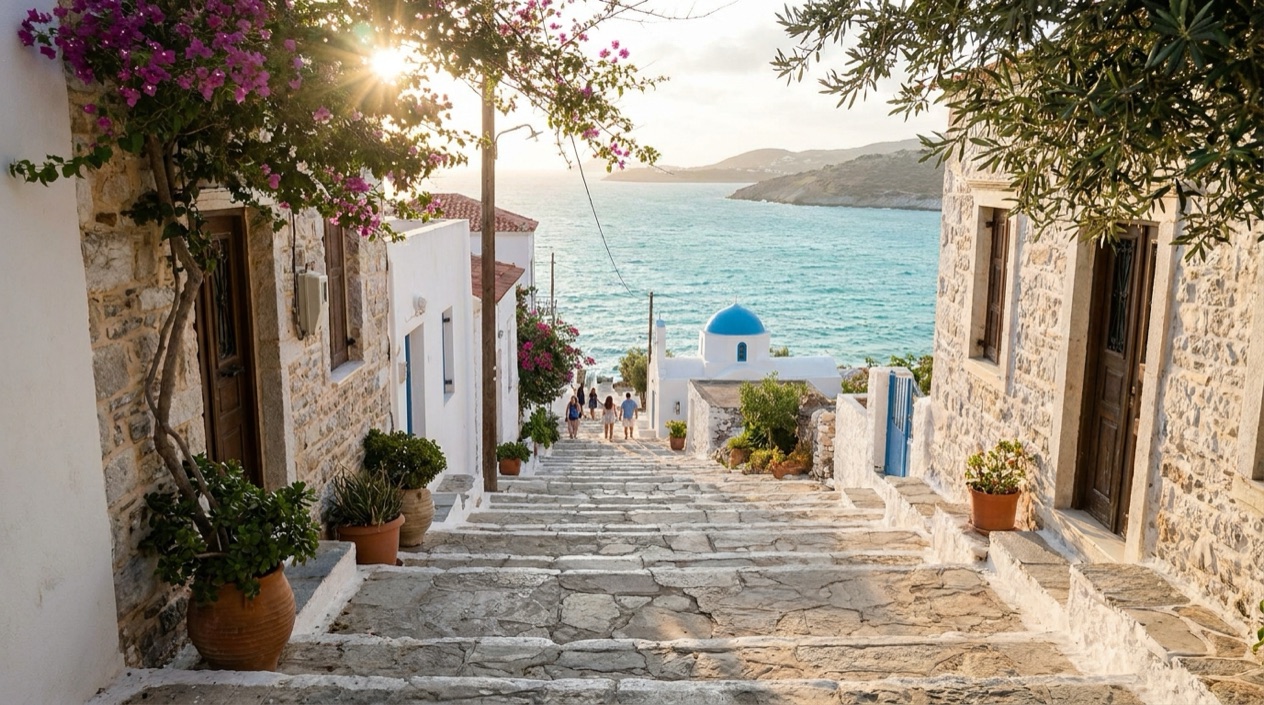
Day four is for the island. Fira and Oia are the towns people think of first, strung along the edge with cave houses, churches with blue domes and narrow lanes. In ancient times the island was known as Thera, and the archaeological site of Akrotiri belongs to that earlier chapter. The volcano in the middle of the bay is a wild natural wonder, and travelers go out to see it from the water.
Santorini tastes of its volcanic soil. Look for fava, the yellow split-pea purée, small sweet tomatoes, white eggplant and a crisp local white wine such as Assyrtiko.
Day five is the way back. Leave room for a last stroll or a last coffee on the rim before the return to Athens by sea. The final night or the flight home depends on your own schedule, so keep the day loose rather than fill it.
Getting between stops
| Leg | How |
|---|---|
| Around Athens | Metro, 5:30 a.m. to 00:30 a.m. (lines 2 and 3 later on Friday and Saturday nights) |
| Athens to Santorini | By sea |
| Santorini to Athens | By sea |
| Athens to Delphi (add-on) | By road |
| Athens to Meteora (add-on) | By road |
| Piraeus to Crete (alternative) | By sea, with ANEK Lines |
The one leg that shapes this trip is the crossing from the mainland to the Cyclades. Two companies are worth knowing by name. Blue Star Ferries provides services between the Greek mainland and the Aegean islands, with more than 20 destinations in its network. Golden Star Ferries, based on Andros, operates from the mainland to the Cyclades.
Within Athens, the metro and the buses do most of the work. One rule on the buses: passengers cannot use the front door to get on or off. The metro hours in the table are worth keeping in mind for a late dinner, since Friday and Saturday nights on lines 2 and 3 run later than the rest of the week.
For the add-ons, Delphi and Meteora are reached by road. Meteora is in Thessaly, with the town of Kalabaka at the foot of the rock towers, and Delphi sits on the southwestern slope of Mount Parnassus. A third option goes the other way entirely. Crete is reached from Piraeus by ANEK Lines, which operates mainly on the Piraeus to Crete routes and across the Adriatic, and Heraklion Airport lies 3.1 miles east of the center of Heraklion, in the area of Alikarnassos.
Heraklion Airport is the second busiest in Greece, after Athens. That matters if you decide to swap Santorini for Crete, since the island has its own gateway and does not depend on a ferry for the first step.
What to book before your 5 Days in Greece
Three things shape the trip, and they are worth settling first. The sea crossing from the mainland to the Cyclades comes first, since companies such as Blue Star Ferries and Golden Star Ferries serve that side of the Aegean. Next come the sites you most want to see in Athens, and last is where you will sleep on Santorini, where visitors can stay on the caldera rim.
Adapting the route
The weather in Athens changes the shape of the days more than the plan itself. The table gives the figures for the capital in four months, and they tell you what to pack: sun protection for July, a rain jacket for January, and a layer or two for the shoulder months.
| Athens | Average high (°F) | Average low (°F) | Precipitation (in) | Days with rain (1 mm or more) |
|---|---|---|---|---|
| January | 56.3 | 44.4 | 2.17 | 7.5 |
| April | 68.4 | 53.2 | 1.10 | 5.5 |
| July | 91.8 | 74.1 | 0.28 | 1.6 |
| October | 75.2 | 61.0 | 1.09 | 3.9 |
With less time or more
With four days, drop one of the Athens days and keep the island, since the sea crossing is the cost you pay once. With six or seven, add Delphi, an archaeological site on the slope of Mount Parnassus that was considered the navel of the Earth in antiquity and held the most important oracle of ancient Greece. The modern town sits close to the site, with traditional small houses, hotels and tavernas along two streets.
Meteora asks for a different kind of day. The monasteries stand on top of the rock towers, six of them still in use, and Kalabaka is the gateway at the foot of the rocks. Both Delphi and Meteora are on the UNESCO World Heritage List.
By season, wind and heat
If your dates are flexible, Mykonos offers a clue about the shoulder seasons. The best time to visit it is mid-May through June or September through mid-October, while July and August are extremely crowded. The island is nicknamed the island of the winds, so if you add it to the Cyclades, expect the Aegean breeze to be part of the scene.
In summer the heat in Athens is strong, as the July highs in the table show. That favors a slower pace on the ancient sites and more time at the sea. In winter the rain days add up, and the island plan is better swapped for more time in the city and the museums.
Families and a slower pace
A slower version keeps Athens to a single day and gives Santorini three nights without a second island. Naxos is an option for a different pace, since it is the largest island of the Cyclades, with an area of 170 square miles, and the highest mountain of the group, Zas, stands there. Its port at Chora is too small for cruise ships.
Crete is the larger swap. Its dishes give children and adults something to share, such as dakos (a barley rusk with tomato and cheese), gamopilafo (a wedding-style rice dish) and kalitsounia (small cheese pastries). The island covers 3,260 square miles, and its highest peak is Mount Psiloritis, also called Mount Ida.
Good to know before you go
Greece uses the euro, and the places in this plan are used to visitors, so prices are posted at the door of a taverna or a museum. Keep the sea crossing in mind when you plan the last day, and leave the final meal for a place you can settle into. The Aegean winds are part of island life, so pay attention to the sea on the days you travel by ferry, and expect the heat in Athens in summer to shape your hours outdoors.
Sources
- Wikipedia, Ancient Greece (https://en.wikipedia.org/wiki/Ancient_Greece), checked October 12, 2026
- Wikipedia, ANEK Lines (https://en.wikipedia.org/wiki/ANEK_Lines), checked October 12, 2026
- Wikipedia, Blue Star Ferries (https://en.wikipedia.org/wiki/Blue_Star_Ferries), checked October 12, 2026
- Wikipedia, Fast Ferries (https://en.wikipedia.org/wiki/Fast_Ferries), checked October 12, 2026
- Wikipedia, Golden Star Ferries (https://en.wikipedia.org/wiki/Golden_Star_Ferries), checked October 12, 2026
- Wikipedia, Greek islands (https://en.wikipedia.org/wiki/Greek_islands), checked October 12, 2026
- OASA, Athens urban transport (https://www.oasa.gr/en/), checked October 12, 2026
- Athens Transport, public transport guide (https://www.athenstransport.com/english/), checked October 12, 2026
- This is Athens, the official Athens tourism site (https://www.thisisathens.org/), checked October 12, 2026
- Santorini official guide (https://www.santorini.gr/), checked October 12, 2026
- Visit Greece (GNTO), Santorini (https://www.visitgreece.gr/islands/cyclades/santorini/), checked October 12, 2026
- Wikipedia, Santorini (https://en.wikipedia.org/wiki/Santorini), checked October 12, 2026
- Visit Greece (GNTO), Mykonos (https://www.visitgreece.gr/islands/cyclades/mykonos/), checked October 12, 2026
- Wikipedia, Mykonos (https://en.wikipedia.org/wiki/Mykonos), checked October 12, 2026
- Wikivoyage, Mykonos (https://en.wikivoyage.org/wiki/Mykonos), checked October 12, 2026
- Visit Greece (GNTO), Naxos (https://www.visitgreece.gr/islands/cyclades/naxos/), checked October 12, 2026
- Wikipedia, Naxos (https://en.wikipedia.org/wiki/Naxos), checked October 12, 2026
- Wikivoyage, Naxos (https://en.wikivoyage.org/wiki/Naxos), checked October 12, 2026
- Heraklion airport information (https://www.heraklion-airport.info/), checked October 12, 2026
- Visit Greece (GNTO), Crete (https://www.visitgreece.gr/islands/crete/), checked October 12, 2026
- Wikipedia, Crete (https://en.wikipedia.org/wiki/Crete), checked October 12, 2026
- Meteora, official information (https://www.meteora-greece.com/), checked October 12, 2026
- Visit Greece (GNTO), Meteora (https://www.visitgreece.gr/mainland/thessaly/kalabaka/), checked October 12, 2026
- Wikipedia, Meteora (https://en.wikipedia.org/wiki/Meteora), checked October 12, 2026
- Visit Greece (GNTO), Delphi (https://www.visitgreece.gr/mainland/central-greece/delphi/), checked October 12, 2026
- Wikipedia, Delphi (https://en.wikipedia.org/wiki/Delphi), checked October 12, 2026
- Wikivoyage, Delphi (https://en.wikivoyage.org/wiki/Delphi), checked October 12, 2026
- Hellenic National Meteorological Service (HNMS), climatological normals 1991-2020 for Elliniko station (https://www.emy.gr/climatic-data), monthly mean daily maximum and minimum; rain from the ECMWF ERA5 reanalysis, 1991-2020, grid cell of Athens (Open-Meteo), checked October 12, 2026
- ECMWF ERA5 reanalysis 1991-2020, grid cell of Athens (Open-Meteo), checked October 12, 2026
- Plan de the (duree choisie by the redaction)
To plan your stay
- Best Time to Visit Greece: September and Late May to Early June
- Arachova: Parnassus Mountain Town, Formaela Cheese, Ski Season and Saint George's Day
- American Airlines Flights to Greece: U.S. Cities, Athens Arrivals and Onward Island Flights
- Greece on a Budget: Cash Machines, Cards, Beaches and Ferries