
Somewhere in the middle of the trip, you sit down in a Naxos taverna with a plate of meze in front of you: a block of feta under olive oil, tomatoes that taste of the sun, bread torn by hand. Behind you the ferries have come and gone, and ahead lie a caldera and a long island of mountains.
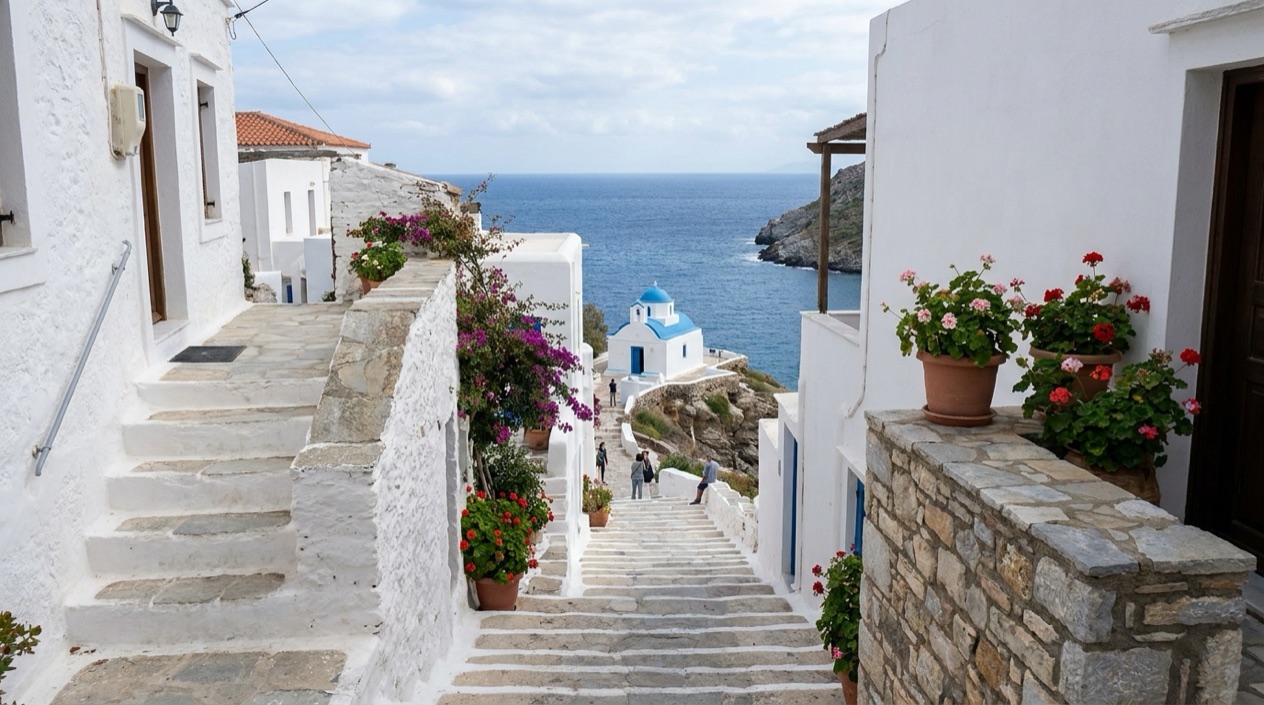
Is 21 Days enough for Greece?
Yes, three weeks is enough to see the mainland sites, three Cycladic islands and Crete without feeling hurried at every stop, as long as you accept that Greece is a country you sample rather than finish. The route here starts in Athens, climbs to Delphi and Meteora, crosses the Aegean to Mykonos, Naxos and Santorini, and ends on Crete. That gives you ancient ruins, monasteries on rock towers, island towns and a coast that runs on and on.
Each stage has a different character. Athens is a big, loud capital where the old city sits among apartment blocks and cafés.
Delphi and Meteora are mountain places, one a sacred precinct on the slope of Mount Parnassus and the other a set of rock towers crowned by monasteries. The islands are a different mood altogether: Mykonos is nicknamed the island of the winds, Naxos is a large island with real mountains, and Santorini is built around a volcanic caldera.
Crete closes the trip because it is the largest Greek island and has enough in it to feel like a country of its own. It also has Heraklion Airport, the second busiest in Greece after Athens, which makes the end of the trip simple to organize. Three weeks lets you eat a lot along the way, from souvlaki and gyros in Athens to dakos, a barley rusk topped with tomato and cheese, in Crete.
What the route leaves out is plenty. Rhodes and Lesbos, the fourth and third largest Greek islands, stay for another trip, as does Evia, the second largest. So do the Ionian islands such as Corfu, Kefalonia and Zakynthos. On the mainland, Nafplio, Mycenae, Epidaurus and Olympia are left aside too. If you try to add them, you lose the slow days that make an island stretch worth doing.
Three weeks also gives you room for a few unplanned days. The itinerary below sequences seven bases in a loop that begins in Athens and finishes in Heraklion, with a flight home from there.
The itinerary stage by stage
Days 1 to 4: Athens
Spend the first days getting your bearings in the capital. The Acropolis and the Parthenon are the reason people come, and around them are the streets of Plaka, which the city’s official tourism guide calls a top attraction with historic landmarks and lively shops, though it gets crowded. Sleep in the center, near a Metro line, so that the sights, the museums and the tavernas stay within reach.
Fill the evenings with a taverna meal: moussaka, grilled meats, a Greek salad with a thick slab of feta, a small glass of ouzo (the anise spirit) with the meze. Day four can be a slower one, with a coffee at a neighborhood café and a last look at the city before you leave by road for the mainland.
Days 5 to 8: Delphi and Meteora
Delphi sits on the southwestern slope of Mount Parnassus in Phocis, and in antiquity it was considered the navel of the Earth, a spiritual meeting place with the most important oracle of ancient Greece. It is a UNESCO World Heritage Site, designated in 1987. The modern town lies very close to the archaeological site and spreads across two streets lined with small houses, hotels and tavernas, so that is where you sleep and eat for these two days.
From Delphi you continue by road to Meteora in Thessaly, where the town of Kalabaka lies at the foot of the rocks on the left bank of the Pinios river. The monasteries on top of the rock towers are what makes the place so special, and six of them stand today as part of a complex added to the UNESCO list in 1988. Base yourself in Kalabaka or in the village of Kastraki, both close to the rocks, and give the last two days to the monasteries and the views around them.
Days 9 to 11: Mykonos
From the mainland you cross to the Cyclades, and Mykonos is your first island. It lies between Tinos, Syros, Paros and Naxos, in the heart of the island group, and its nickname, the island of the winds, tells you that the weather outside can be lively. Stay in or near the main town and spend the days on its lanes, its harbor and its beaches.
The island is small, with an area of 33.0 square miles, and the main town gets very full in July and August, which are described as extremely crowded. The best time to be here is mid-May through June or September through mid-October. Meals are the main event: grilled fish at the harbor, small plates with local cheese and a long evening that stretches past dessert.
Days 12 to 14: Naxos
Naxos is the largest and most fertile island of the Cyclades, and the change of pace from Mykonos is easy to feel. Zas, its highest mountain, is also the highest of the whole group. The port at Chora is too small for cruise ships, so the main town is where you arrive, stay and wander among its old streets and waterfront tavernas.
Use these days for the island’s farms and villages. Potatoes, cheese and grilled meats are the kind of food you find on a fertile island, and a long lunch under a vine-covered terrace suits the pace. Keep one day without plans, since Naxos rewards wandering.
Days 15 to 17: Santorini
Santorini is the largest island of a small, circular archipelago formed by the caldera, and it is the southernmost of the Cyclades. In antiquity it was known as Thera.
Spend these days looking at the caldera from different angles, eating tomatoes, fava and fresh fish at a cliffside table, and tasting the island’s wines. The island sits about 120 miles southeast of the mainland, which is why the sea crossing feels like a real arrival. When you are done, you leave by sea for Crete.
Days 18 to 21: Crete
Crete is the largest Greek island, and its southern edge reaches the south of the Aegean. Stay in Heraklion, where the airport lies 3.1 miles east of the center, and use the first days for the city, its markets and a wander around the old harbor. Crete has a coastline of 650 miles, so the beaches and villages beyond the city are a good reason to stay four days.
Eat as much as you can. Dakos, gamopilafo (a rich rice dish) and kalitsounia (small cheese pastries) are among the traditional dishes of Crete, and a table of meze with raki, the local spirit, is a fine way to end the trip. On day 21 you fly home from Heraklion, the final stop of the loop.
Getting between stops
| Leg | How |
|---|---|
| Athens to Delphi | By road |
| Delphi to Meteora | By road |
| Meteora to Mykonos | By road and by sea |
| Mykonos to Naxos | By sea |
| Naxos to Santorini | By sea |
| Santorini to Crete | By sea |
| Heraklion to home | By air |
The mainland legs are road legs, and the island legs are sea legs, with the sea joining Mykonos, Naxos and Santorini to each other and to Crete. Several companies run ferries in Greek waters. Blue Star Ferries links the Greek mainland with the Aegean islands and serves more than 20 destinations, Golden Star Ferries sails from the mainland to the Cyclades, and ANEK Lines operates mainly between Piraeus and Crete.
In Athens, the Metro runs from 5:30 a.m. to 00:30 a.m., and lines 2 and 3 stay open later on Friday and Saturday nights. The city’s buses do not allow passengers to use the front door to get on or off. Heraklion Airport is where the trip ends, and it is the second busiest airport in Greece after Athens.
Greece is a country of islands, which shapes how the route is built. Crete lies about 62 miles south of the Peloponnese, and Santorini is about 120 miles southeast of the mainland, so the movement across the sea is part of what you see of the country rather than a gap between sights. Keep the route in the order given and the legs follow one another naturally.
What to book before your 21 Days in Greece
Settle the sea crossings between the islands first, since they hold the Cyclades stretch together, and the flight home from Heraklion. Then fix a bed in each base: central Athens, the modern town of Delphi, Kalabaka or Kastraki for Meteora, and the caldera if you want to stay in it on Santorini. The archaeological sites and monasteries come after that.
Adapting the route
The season changes the trip more than any other choice. Mykonos has a best time of mid-May through June or September through mid-October, and the same logic suits the whole loop, since July and August bring the crowds. The Athens figures show the range between seasons.
| Athens month | Average high (°F) | Average low (°F) | Rain (inches) | Days with rain |
|---|---|---|---|---|
| January | 56.3 | 44.4 | 2.17 | 7.5 |
| April | 68.4 | 53.2 | 1.10 | 5.5 |
| July | 91.8 | 74.1 | 0.28 | 1.6 |
| October | 75.2 | 61.0 | 1.09 | 3.9 |
In July the capital is hot, so the Acropolis, the Delphi site and the monastery rocks ask for sun protection and water. In January the same places are cooler and wetter, and a rain jacket is the sensible companion. April and October sit between the two. These are the Athens figures, and the islands and the mountains have their own conditions.
If you have fewer days, cut the middle. Keep Athens, one island and Crete, or drop the mainland stretch and fly into the Cyclades. If you have more, add a fourth island or a second base on Crete, or one of the places left out, such as Rhodes or Corfu.
For a slower trip, stay longer on Naxos, where a large fertile island has farms and villages to fill the days, and cut Delphi down to one night. Families with children can put the weight on the island days and treat the mainland stage as two stops in place of three. For a trip in the shoulder months, the Mykonos best time is the guide: May and June at the start, or September and early October at the end.
The Cyclades take their rhythm from the sea and the wind, and Mykonos earns its nickname as the island of the winds. A flexible day is the best protection against a change in the weather.
Good to know before you go
Greece uses the euro, so keep some on you for the tavernas and the small shops on the islands. Athens and Plaka are crowded streets, so keep your attention on your surroundings and your plans.
On the islands, the sea and the wind set the pace, and Mykonos in particular is the island of the winds. Pack sun protection for July, a rain jacket for winter, and comfortable shoes for the ruins and the rock paths.
Sources
- Wikipedia, Ancient Greece (https://en.wikipedia.org/wiki/Ancient_Greece), checked October 12, 2026
- Wikipedia, ANEK Lines (https://en.wikipedia.org/wiki/ANEK_Lines), checked October 12, 2026
- Wikipedia, Blue Star Ferries (https://en.wikipedia.org/wiki/Blue_Star_Ferries), checked October 12, 2026
- Wikipedia, Fast Ferries (https://en.wikipedia.org/wiki/Fast_Ferries), checked October 12, 2026
- Wikipedia, Golden Star Ferries (https://en.wikipedia.org/wiki/Golden_Star_Ferries), checked October 12, 2026
- Wikipedia, Greek islands (https://en.wikipedia.org/wiki/Greek_islands), checked October 12, 2026
- OASA, Athens urban transport (https://www.oasa.gr/en/), checked October 12, 2026
- Athens Transport, public transport guide (https://www.athenstransport.com/english/), checked October 12, 2026
- This is Athens, the official Athens tourism site (https://www.thisisathens.org/), checked October 12, 2026
- Santorini official guide (https://www.santorini.gr/), checked October 12, 2026
- Visit Greece (GNTO), Santorini (https://www.visitgreece.gr/islands/cyclades/santorini/), checked October 12, 2026
- Wikipedia, Santorini (https://en.wikipedia.org/wiki/Santorini), checked October 12, 2026
- Visit Greece (GNTO), Mykonos (https://www.visitgreece.gr/islands/cyclades/mykonos/), checked October 12, 2026
- Wikipedia, Mykonos (https://en.wikipedia.org/wiki/Mykonos), checked October 12, 2026
- Wikivoyage, Mykonos (https://en.wikivoyage.org/wiki/Mykonos), checked October 12, 2026
- Visit Greece (GNTO), Naxos (https://www.visitgreece.gr/islands/cyclades/naxos/), checked October 12, 2026
- Wikipedia, Naxos (https://en.wikipedia.org/wiki/Naxos), checked October 12, 2026
- Wikivoyage, Naxos (https://en.wikivoyage.org/wiki/Naxos), checked October 12, 2026
- Heraklion airport information (https://www.heraklion-airport.info/), checked October 12, 2026
- Visit Greece (GNTO), Crete (https://www.visitgreece.gr/islands/crete/), checked October 12, 2026
- Wikipedia, Crete (https://en.wikipedia.org/wiki/Crete), checked October 12, 2026
- Meteora, official information (https://www.meteora-greece.com/), checked October 12, 2026
- Visit Greece (GNTO), Meteora (https://www.visitgreece.gr/mainland/thessaly/kalabaka/), checked October 12, 2026
- Wikipedia, Meteora (https://en.wikipedia.org/wiki/Meteora), checked October 12, 2026
- Visit Greece (GNTO), Delphi (https://www.visitgreece.gr/mainland/central-greece/delphi/), checked October 12, 2026
- Wikipedia, Delphi (https://en.wikipedia.org/wiki/Delphi), checked October 12, 2026
- Wikivoyage, Delphi (https://en.wikivoyage.org/wiki/Delphi), checked October 12, 2026
- Hellenic National Meteorological Service (HNMS), climatological normals 1991-2020 for Elliniko station (https://www.emy.gr/climatic-data), monthly mean daily maximum and minimum; rain from the ECMWF ERA5 reanalysis, 1991-2020, grid cell of Athens (Open-Meteo), checked October 12, 2026
- ECMWF ERA5 reanalysis 1991-2020, grid cell of Athens (Open-Meteo), checked October 12, 2026
- Plan de the (duree choisie by the redaction)
To plan your stay
- Best Time to Visit Greece: September and Late May to Early June
- Arachova: Parnassus Mountain Town, Formaela Cheese, Ski Season and Saint George's Day
- American Airlines Flights to Greece: U.S. Cities, Athens Arrivals and Onward Island Flights
- Greece on a Budget: Cash Machines, Cards, Beaches and Ferries