
FLORIDA · RENTING A CAR · THE RULES THAT APPLY
A Florida vacation usually begins at a rental counter, with a set of keys, a bag of sunscreen and four hundred miles of causeways, pine flatwoods and beach road waiting. The driving itself is the easy part: wide lanes, flat land, gas stations every few exits, and a coastline that keeps appearing on your right.
What surprises visitors is never the traffic. It’s a lane a rental car is not allowed to enter, a toll invoice that arrives weeks later, a booster seat rule written by age, and a move-over duty that asks for something specific the moment you see flashing lights on the shoulder.
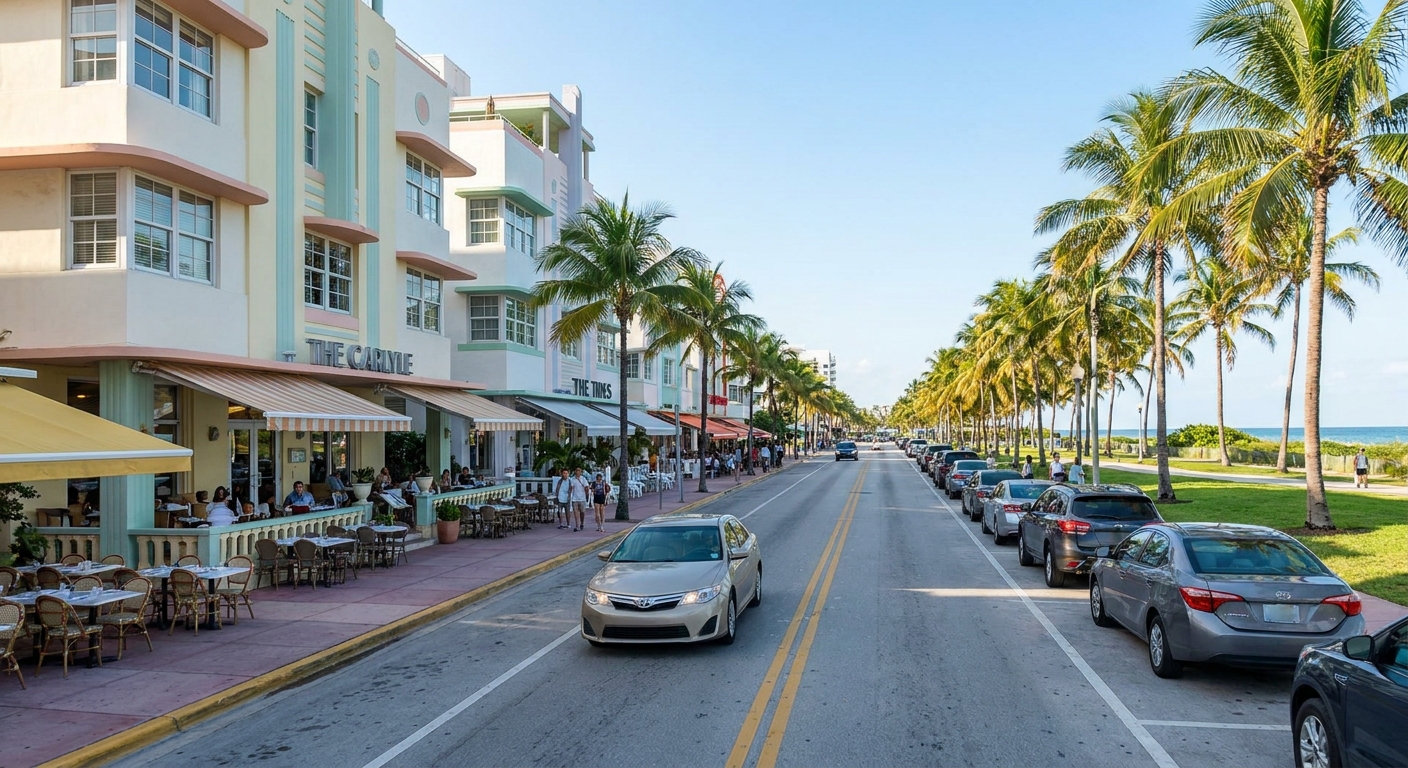
DRIVING IN FLORIDA · AT A GLANCE
Carry your home license on your person, take a transponder for the car, and the remaining rules fit into five short statutes worth knowing before you leave the lot.
NO IDP REQUIRED BY LAW · LICENSE ON YOU, NOT IN THE SAFE · MANAGED LANES NEED A TRANSPONDER
Go for: the Overseas Highway, the Gulf beach road and the Everglades’ two entrances, all of which reward a car and none of which need anything exotic on your license.
Think twice before: declining the rental transponder if your route uses express lanes around Miami or Orlando: a car without one cannot legally travel a managed lane at all.
License: Florida Statutes s. 322.04 · Tolls: Florida’s Turnpike Enterprise · Child seats, belts, speed, move over: ss. 316.613, 316.614, 316.187, 316.126 · full sources at the end
On this page
- Do I need an International Driving Permit?Statute 322.04, and the two ages in it
- How tolls work in a rental carSunPass, Toll-By-Plate and managed lanes
- Child seat rules in FloridaAge 5 and under, plus the taxi exemption
- Florida speed limits70, 65 and 60 mph, set by statute
- What to do when a vehicle is stopped on the shoulderVacate the lane, or drop 20 mph
- Seat belt rules by seat and by ageUnder 18 anywhere, 18 and over in front
- Transponder fees and credit card coverageThe two costs Florida law does not set
Florida publishes its driving rules as numbered statutes anyone can read: 322.04 for licenses, 316.613 for child restraints, 316.614 for belts, 316.187 for speed, 316.126 for move over. The tolls come from a different authority, Florida’s Turnpike Enterprise, and they behave differently from anything in the statute book. Our getting-around guide covers the trains and the airports.
Do you need an International Driving Permit in Florida?
Florida law does not require one. Statute 322.04 exempts from holding a Florida license « a nonresident who is at least 18 years of age and who has in his or her immediate possession a valid noncommercial driver license issued to the nonresident in his or her home state or country ». The words « or country » sit in the statute itself, so a valid license from home is the document the state asks for.
Two ages live inside that exemption. Eighteen applies to a motor vehicle generally, and sixteen applies to the class of vehicle a Class E license covers. In both cases the condition is the same: the home license travels on the person of the driver.
That phrase, « immediate possession », is the part visitors trip over. A license in the hotel safe or zipped into a suitcase back at the resort does not meet it. Keep it in the wallet you carry, alongside whatever the rental company asked for at the counter, and check the rest of the paperwork in our know before you go guide.
Florida tolls: SunPass, toll-by-plate and the lanes you cannot enter
Florida’s toll roads are electronic. A driver without a SunPass or a compatible transponder gets photographed, and a Toll Enforcement Invoice goes to the vehicle’s registered owner covering 30 days of tolls, plus a $2.50 administrative fee. On a rental, the registered owner is the rental company, so the invoice reaches you through them.
The operator publishes the price gap between the two methods without being asked. SunPass customers « always pay the lowest toll amount and can save an average of 25% on tolls when compared to TOLL-BY-PLATE », in the Turnpike Enterprise’s own words.
Then there are the managed lanes, the express lanes that run down the middle of the busiest corridors. Toll-By-Plate does not work on them. Florida’s Turnpike states it plainly: a transponder is required to travel in a managed lane, so a rental car without one cannot use them at all. Not at a higher price, not with an invoice afterward. Simply not.
Rates are not uniform across the state. They are set by region, Panhandle, Northeast, Central, West Central, South Central and South Florida, and the schedules currently in force took effect on July 1, 2023. A Turnpike run through South Florida and a Panhandle stretch are priced under separate schedules.
One number on your final bill comes from neither the state nor the schedule. Rental firms add their own daily charge for the transponder they lend, on top of the tolls themselves, and no company publishes a stable rate we can quote. Ask at the counter, get it in writing on the agreement, and budget it as its own line the way our trip cost guide treats parking.
Child seat laws in Florida
Florida law fixes the ages, not the manufacturer. Statute 316.613 requires a crash-tested, federally approved restraint for every child aged 5 or younger. Through age 3 it has to be a separate carrier or the vehicle’s own integrated seat. At 4 and 5, a booster is allowed as well, which gives families one extra option for the years when a carrier starts to feel absurd.
The exceptions written into the statute are narrow, and worth knowing before someone offers your kid a ride. The 4-to-5 rule does not apply when a seat belt is used and the child is being carried free of charge by someone outside the immediate family, or in a medical emergency, or with a doctor’s documentation.
A hired vehicle sits outside the requirement entirely. The statute exempts a chauffeur-driven taxi, limousine, sedan, van, bus or motor coach hired for compensation. The duty to protect the child stays with the parent, and plenty of families still travel with their own seat from the airport. The vehicle itself, though, is not breaking the rule by lacking one.
Getting it wrong is a moving violation, and 3 points go on the license. A driver can instead ask the court for permission to take an approved child restraint safety program, after which the penalty and the points may be waived. Traveling with kids in general gets its own treatment in our Florida with kids guide.
Florida speed limits: 70, 65 and 60
Three ceilings are set in law rather than on signs. Statute 316.187 allows 70 mph on limited access highways, 65 mph on any other highway outside an urban area of 5,000 or more people that has at least four lanes divided by a median, and 60 mph as the maximum the Department of Transportation may set on other roads under its authority. Speeding is cited as a moving violation under chapter 318, the same category as a child restraint breach, and not a parking matter.
Florida Move Over law
Statute 316.126 asks more of a driver than most visitors expect. On an interstate or any highway with two or more lanes, you must vacate the lane closest to the stopped vehicle. Changing lanes is the primary duty, not slowing down in place.
Where moving over is not possible, traffic beside you or a single lane in your direction, the statute gives a number. Slow to 20 mph below the posted limit when that limit is 25 mph or more, and to 5 mph when the limit is 20 mph or less. Off a 70 mph stretch of the Turnpike, that means 50 mph past the shoulder.
Police cars are only the beginning of the list. The rule covers authorized emergency vehicles, sanitation vehicles, utility service vehicles, wreckers showing amber lights, road and bridge maintenance or construction vehicles showing warning lights, and any disabled vehicle showing hazard lights, using flares, or with people visibly beside it. A family changing a tire on the shoulder of I-75 triggers it exactly as a patrol car does.
Seat belts in Florida: front seat and back seat rules
Statute 316.614 splits the rule by age and by seat. Every passenger and driver under 18 must be belted, wherever they sit. Anyone 18 or over must be belted in the front seat. A breach is a nonmoving violation under chapter 318, a lighter category than a speeding ticket.
The back seat is where visitors guess wrong in both directions. For adults aged 18 or over, the statute does not require a belt back there: it requires one for everyone under 18 in any seat, and for the front seat at any age. Everybody buckles anyway on a rental, because a Florida interstate is no place to test the point.
Florida driving costs
Two line items on a Florida rental bill come from the company and the card issuer rather than from state law. The first is the daily transponder charge described above. The second is insurance: whether a US or foreign credit card covers a Florida rental depends on the card, not on Florida law, and no official page settles it. Call the number on the back of the card before you travel and ask for the coverage in writing.
Everything else on the road here is knowable in advance, and mostly generous. License in your wallet, transponder on the windshield, booster for the five-year-old, and a lane change when the amber lights appear on the shoulder. Then the Overseas Highway, or the Gulf road at six in the evening. Our Florida road trip guide plots the routes, and the state orientation helps you pick which Florida gets the week.
Sources & data for this guide
- Nonresident exemption, « or country », the two ages and « immediate possession » · Florida Statutes 2026, s. 322.04 · leg.state.fl.us · checked Sep 24, 2026
- Electronic tolls, Toll Enforcement Invoice, $2.50 administrative fee, the 25% average gap, managed lane transponder requirement, regional schedules effective July 1, 2023 · Florida’s Turnpike Enterprise, Toll Rates and Toll-By-Plate · checked Sep 24, 2026
- Child restraint ages, booster at 4 and 5, narrow exceptions, hired-vehicle exemption, 3 points and the safety program · Florida Statutes 2026, s. 316.613 · checked Sep 24, 2026
- Belt rule by age and seat, nonmoving violation under chapter 318 · Florida Statutes 2026, s. 316.614 · checked Sep 24, 2026
- Speed ceilings of 70, 65 and 60 mph and the chapter 318 citation · Florida Statutes 2026, s. 316.187 · checked Sep 24, 2026
- Move over duty, the 20 mph and 5 mph reductions, and the full list of vehicles covered · Florida Statutes 2026, s. 316.126 · checked Sep 24, 2026
- Rental company transponder charges and credit card rental coverage are set by the company and the issuer, not by Florida law, and no official source states a stable figure · confirm both on your rental agreement and with your card issuer.
To plan your stay
- Best Time to Visit Florida: Dry Season, Hurricane Months and Spring Break Crowds
- Where to Stay in Florida: Hotel Tax by County, Resort Fees and the Eight Bases
- Getting Around Florida: Tolls, Rental Fees, Brightline and Free Transit
- Things to Know Before Going to Florida: Time Zones, Beach Access, Taxes and REAL ID