
RAINBOW SPRINGS · FLORIDA · JUNE
Rainbow Springs runs at 73.8°F whether the calendar says February or June. What June changes is everything around it: the air at the nearest NOAA station averages a 90.3°F high, the month’s rain total more than doubles May’s, and the sun stays up until 8:31 p.m. A swim that takes nerve in winter becomes the only sensible decision at two in the afternoon.
That is the trade, and a second one comes with it. Eleven days in an average June bring measurable rain, and the park has 356 parking spaces to hand out on the first Saturdays of the American summer. For the park itself, our Rainbow Springs guide covers the layout. The dates and degrees below belong to June.
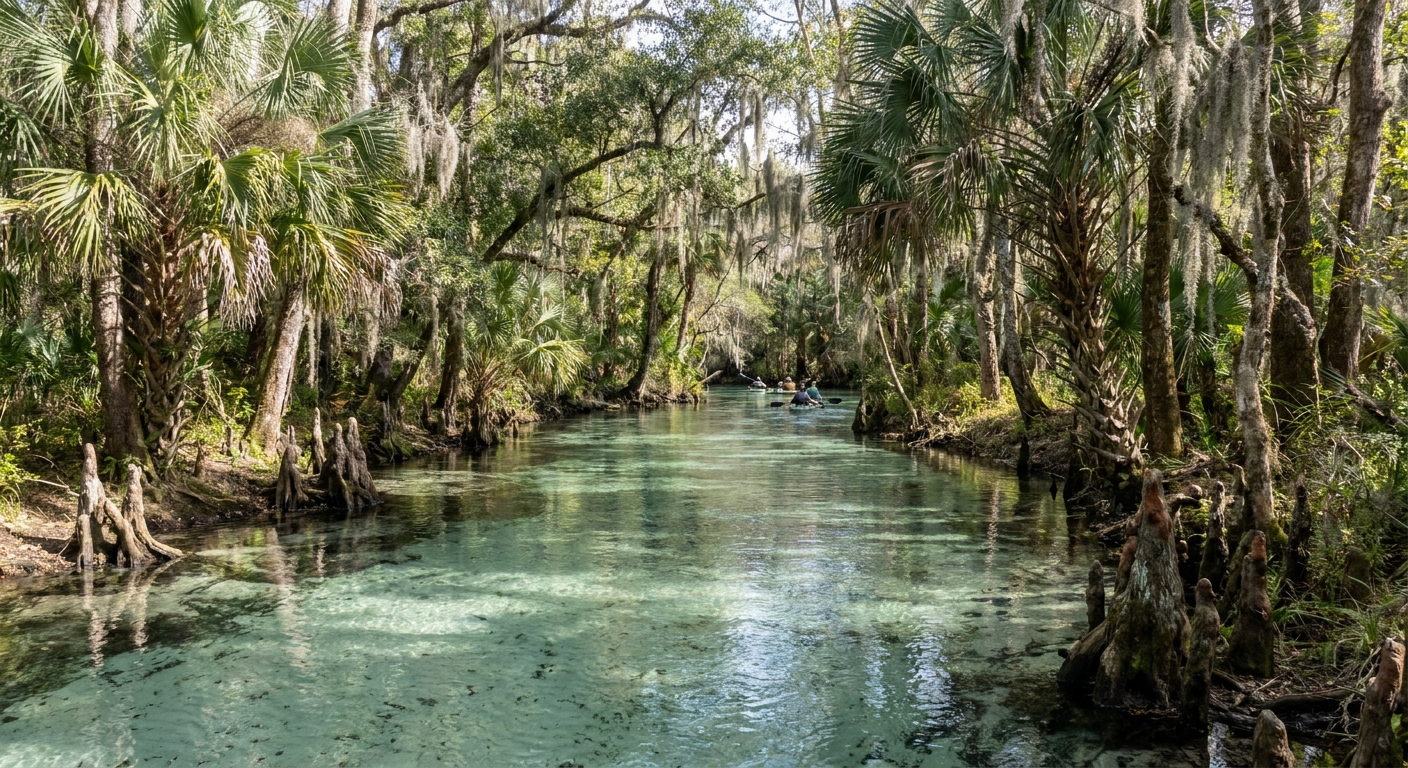
THE MONTH AT A GLANCE · JUNE
June puts 90.3°F afternoons over 73.8°F spring water and keeps the light until 8:31 p.m., and it asks for an early arrival, because 356 parking spaces close the gate when they fill.
AVERAGE HIGH 90.3°F · 11 RAIN DAYS · WATER 73.8°F · 356 PARKING SPACES
Go for: cool water under full summer heat, two designated swim areas, two paddle launches, and an evening that stays usable until sunset at 8:31 p.m.
Think twice before: planning a hiking day, since 3.4 miles of trail under a 90.3°F afternoon is a different sport, and before rolling up to the gate mid-morning on a weekend.
Air: NOAA NCEI 1991-2020, Gainesville Regional AP · Water: USGS gauge 02313095 · Facilities: Florida DEP inventory 2024
On this page
- June highs, lows and rain days90.3°F, 7.56 inches, and where the thermometer sits
- How hot it gets, morning to afternoonA 20.8°F spread, and 73.8°F water under it
- Crowds and parking on a June Saturday356 spaces, and what we could not verify on fees
- Things to do in JuneTwo swim areas, two launches, 3.4 miles of trail
- A two-day plan for JuneEarly gate, midday shade, boardwalk after six
- June, May or July?How the three months compare on rain and heat
- Is June worth it?Who should go, and who should take May
The normals below describe the air, and they come from a thermometer some distance away, so read them as a regional signal rather than a reading at the water’s edge. For the wider state calendar, the best time to visit Florida handles the dry and wet seasons, and getting around Florida handles the driving.
Rainbow Springs weather in June: average highs, lows and rain days
| Measure | June figure | In practice |
|---|---|---|
| Average high | 90.3°F | Full summer heat by early afternoon |
| Average low | 69.5°F | The cool belongs to the early morning |
| Monthly rain | 7.56 inches | More than double May’s 3.08 inches |
| Days with 0.10 in or more | 11.0 | Roughly one day in three arrives wet |
| Days with 1 in or more | 2.1 | Two real soakings in an average June |
| Daylight, June 15 | 14 h 02 m | Sunrise 6:29 a.m., sunset 8:31 p.m. |
| Spring water | 73.8°F | One gauge reading, steady all year |
Every figure here for the air comes from one place: NOAA NCEI’s 1991-2020 monthly normals for station USW00012816, Gainesville Regional Airport, about 48 miles (78 km) from the spring. June there averages a high of 90.3°F and a low of 69.5°F, with 7.56 inches of rain across the month. That is a real station record rather than a modeled grid cell, which matters, but it is still 48 miles of Florida away and it measures air. The water keeps its own number.
Eleven days in an average June record at least 0.10 inch of rain, and 2.1 of them deliver an inch or more. Book four days at the spring and the odds favor at least one that meets water from above as well as below. Florida’s wet season runs May through October and hands most of its rain over in short, heavy afternoon storms, so a wet day is rarely a lost day. Swim in the morning, keep the middle of the afternoon flexible, and treat thunder as the signal to get out.
There are 20.8°F between the average high and the average low, and almost all of that relief sits before breakfast. Nothing in the June range asks for warm clothes. What the bag needs instead is a rash guard or a light long sleeve for the hours in the water, a rain shell that packs small, shoes you can walk into the river, a towel that dries, and a second dry shirt for the drive home. Sunscreen goes on before the 90.3°F part of the day, not during it.
On June 15 the sun rises at 6:29 a.m. and sets at 8:31 p.m. local time, 14 hours and 2 minutes of daylight. The practical gift is the evening: the stretch between six and half past eight is comfortably outdoors, and the boardwalk is better walked then than at noon. A late start does not cost you the day in June. It may well cost you the parking space.
How warm is Rainbow Springs in June?
Take the two numbers apart. The average June afternoon at the station reaches 90.3°F, the average night bottoms out at 69.5°F, a spread of 20.8°F. The spring sits outside that argument entirely: the USGS gauge at Rainbow Springs, station 02313095, read 73.8°F (23.2°C) on September 11, 2026, and it reads close to that every day of the year. That is one instantaneous reading rather than an average of daily maxima, so treat it as a spot value. In June the air runs 16.5°F above the water.
Mornings near 69.5°F need nothing more than a shirt, and the first hour at the gate is the only hour that feels mild. By noon the question flips: shade, hat, water, and a swim rather than a walk. Getting out of 73.8°F water into 90°F air is pleasant for about ninety seconds and cold after that, so a towel within reach is worth the carry. Evenings hold their heat, and dinner outdoors at eight is a June habit rather than a gamble.
Freezing nights are not a June question in central Florida, and the month’s normal low of 69.5°F settles it. We found no daily-extremes series for the station, so we give no count of unusually cool nights. The one number that behaves itself all month is the water: whatever the air does between dawn and 3 p.m., the run is still 73.8°F when you get in.
How busy is Rainbow Springs in June? Crowds and prices
June opens the American summer vacation, schools let out, and a spring holding 73.8°F water becomes the obvious answer to a 90.3°F afternoon. We found no occupancy series and no monthly room-rate series for this corner of Florida, so we crown no month cheap and no month expensive. What we can count is the hard limit. The state’s own facilities inventory lists 356 parking spaces at Rainbow Springs State Park, and when the lot fills, the gate closes.
Those 356 spaces are the number to plan against, and no booking replaces them. We could not verify whether the park takes reservations or what time it opens, because floridastateparks.org answers automated reads with a 403. Treat the morning itself as the reservation. A June weekend also rewards a bed close enough that you are not starting the drive at sunrise, and four to six weeks out is our own working rule for that (est.), not a measured one. Where to stay in Florida sorts the regions.
We could not verify the county lodging-tax rate, so we give no percentage. The entrance fee is missing from our sources for the same reason as the hours, and Florida state park prices vary by park and by season, so a figure copied from another spring does not transfer to this gate. Read the fee from the park’s own page the week you travel, and keep it out of your arithmetic until you have. Our Florida trip cost guide covers the rest of the budget.
One upgrade changes June more than any other: the bed. A night within a short drive of the gate puts you in the lot in the first hour, when 356 spaces are still a number rather than a problem, and it buys the swim before the air reaches its average. Rented gear at one of the park’s two launches comes second. A bigger cooler, a longer drive or a better dinner move nothing at all about how the day runs.
Things to do in Rainbow Springs in June
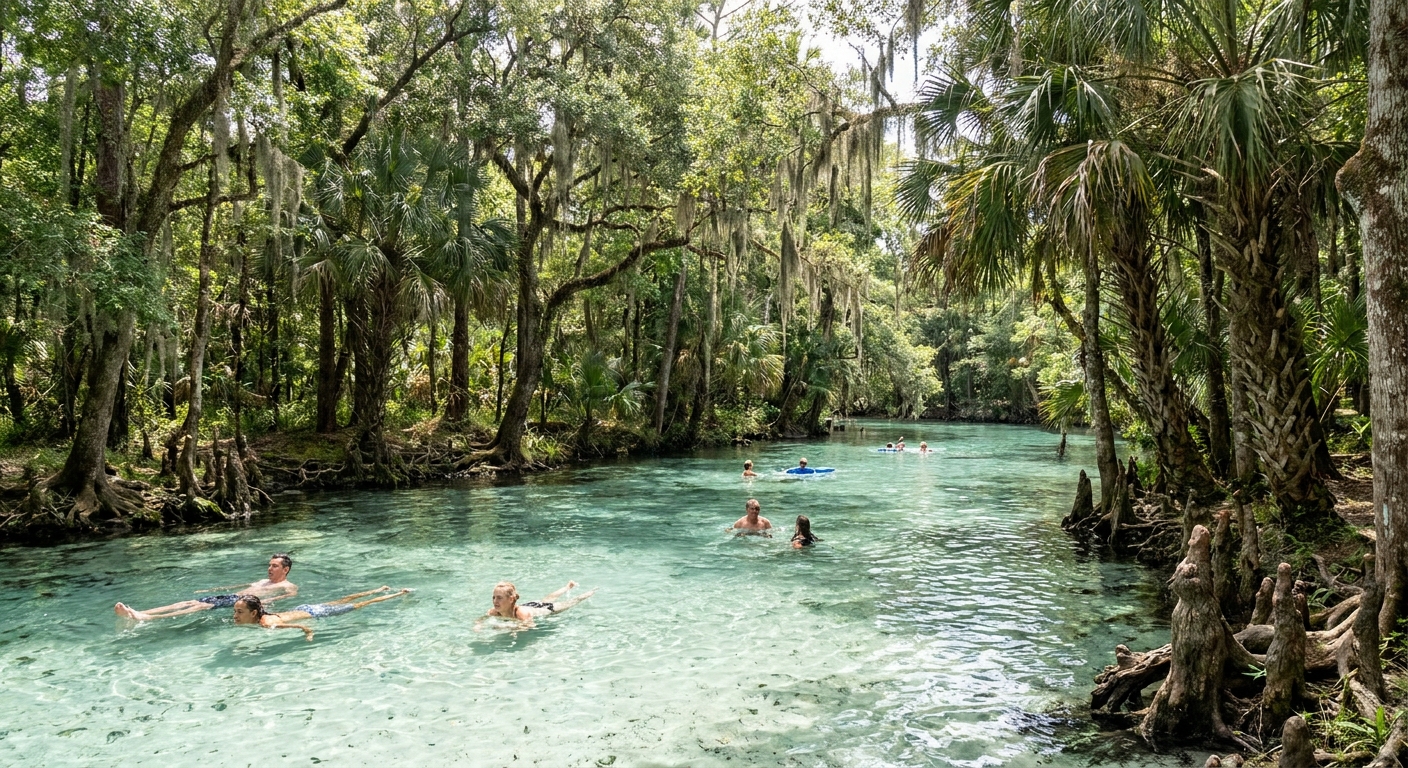
Air at 90.3°F over water at 73.8°F is the whole reason to come in June. Sixteen and a half degrees of difference turns a swim into relief instead of a dare, and the same 73.8°F in a cool month asks for conviction most visitors do not have. Add light until 8:31 p.m. and the swimmable stretch of a June day runs from mid-morning to dinner. No cooler month on the calendar offers that span.
The state’s 2024 facilities inventory counts what is actually here: 2 designated swimming areas, 2 launches for canoes, kayaks and tubes, 3.4 miles of hiking trail, 332 feet of boardwalk, 1 observation platform, and the 356 parking spaces already mentioned. It is a compact park, and the count explains its shape. Most of a June day happens in the water or beside it, with the trail as the optional extra.
The 73.8°F in the run will read the same in January. The 3.4 miles of trail will not. Walking them under a 90.3°F afternoon is a different activity from walking them in winter, and June is the month when the 332 feet of boardwalk and the observation platform become the walking most people actually do. Paddlers get the better end of the deal, since the two launches put you on the water rather than beside it.
We cannot point to anything free with confidence: the fee schedule did not come through to us, and we found no manatee count for the river either, so we promise no wildlife and no free day. What costs nothing is the sequencing. Arrive in the first hour, swim before the heat peaks, and save the boardwalk for the long end of the afternoon. For winter manatees elsewhere in the state, see our manatee guide.
Rainbow Springs in June: a two-day itinerary
Day one runs early. Be at the gate in the first hour, because 356 spaces are the day’s real ticket. Swim from mid-morning while the air climbs toward 90.3°F, then break for lunch and shade in the early afternoon, the part of a Florida summer day most likely to turn dark. Take the second swimming area around four. Walk the 332 feet of boardwalk and the observation platform after six, with sunset still two hours off, and eat at eight in daylight.
Day two puts the paddle first: one of the two launches in the morning, and the 3.4 miles of trail only if you genuinely want them in June heat. If the sky turns, and 11 days in an average June bring at least 0.10 inch, swap the order rather than leave. Rain on a spring is a non-event for a swimmer who is already wet. The 2.1 days a month that drop an inch or more are the ones to spend under a roof. Thunder ends water time. Wait it out, then get back in.
Rainbow Springs in June vs May and July
| Measure | May | June | July |
|---|---|---|---|
| Average high | 87.4°F | 90.3°F | 91.1°F |
| Average low | 62.6°F | 69.5°F | 71.6°F |
| Monthly rain | 3.08 in | 7.56 in | 6.68 in |
| Days with 0.10 in or more | 4.5 | 11.0 | 10.5 |
| Spring water | about 73.8°F | about 73.8°F | about 73.8°F |
May keeps its rain in check: 3.08 inches over 4.5 days at 0.10 inch or more, under a high of 87.4°F. June more than doubles both, 7.56 inches across 11.0 wet days, making it the wettest of the three. July turns the heat up again to 91.1°F and comes back slightly drier than June, 6.68 inches across 10.5 days. The water ignores every line of that, holding around 73.8°F in all three months, so the choice is about air and rain only.
Shift four weeks back and you drop 6.5 wet days and take 6.9°F off the nights, paying 2.9°F off the afternoon and losing some evening light. Our Rainbow Springs in May page makes that case in full. Shift four weeks forward and July hands you 0.8°F more heat for 0.88 inch less rain, a trade too small to plan a vacation around. Nobody is swapping months for a warmer swim at 73.8°F.
Is June a good time to visit Rainbow Springs?
Yes for swimmers, paddlers and families whose plan is the water: 90.3°F afternoons over a 73.8°F spring is the strongest argument June makes, and the light runs to 8:31 p.m. No for hikers, for anyone who wants a quiet Saturday lot, and for travelers who need a dry week. Eleven wet days out of thirty is not something you plan a picnic against, and 356 spaces at the front of the American summer is a narrow door.
If that reads as a no, take May. The high drops only 2.9°F to 87.4°F, the rain falls to 3.08 inches, and wet days fall from 11.0 to 4.5. Nights at 62.6°F sleep better as well. You pay for it with a shorter evening and a slightly cooler afternoon, over exactly the same 73.8°F water. Traveling with children changes that arithmetic, and Florida with kids covers it.
What June holds that its neighbors do not is the combination: full summer heat arriving alongside 14 hours and 2 minutes of daylight on the 15th, sunset at 8:31 p.m., and water that has not shifted a degree to meet any of it.
The last word
Set the alarm and June mostly handles itself. The gate closes when 356 spaces fill, in the order people arrive, so the single decision that shapes your trip is what time you leave the house. One more fact for the float: Florida keeps a legal category for its biggest springs, and statute 373.802(5) defines Outstanding Florida Springs as every historic first-magnitude spring the Florida Geological Survey determines, plus six named by hand in the law. Read the park’s fee and hours from the source before you drive, swim in the morning, and save the boardwalk for eight o’clock.
Sources & data for this guide
- June normals (90.3°F high, 69.5°F low, 7.56 in) and rain-day counts · NOAA NCEI monthly normals 1991-2020, station USW00012816, Gainesville Regional Airport, about 48 miles from the spring · checked Sep 24, 2026
- May and July normals used in the comparison · same NOAA NCEI 1991-2020 series, same station · checked Sep 24, 2026
- Daylight, sunrise 6:29 a.m. and sunset 8:31 p.m. on June 15 · sunrise-sunset.org, converted to local time · checked Sep 24, 2026
- Water temperature 73.8°F (23.2°C) · U.S. Geological Survey NWIS, station 02313095 Rainbow Springs, instantaneous reading, not a monthly average · checked Sep 24, 2026
- 356 parking spaces, 2 swimming areas, 2 paddle launches, 3.4 miles of trail, 332 feet of boardwalk, 1 observation platform · Florida Department of Environmental Protection, Recreational Facilities Inventory, 2024 annual report · checked Sep 24, 2026
- Outstanding Florida Springs definition · Florida Statutes 373.802(5), leg.state.fl.us · checked Sep 24, 2026
- Editorial admission: we could not read the park’s entrance fee or opening hours, since floridastateparks.org returns a 403 to automated reads, and we found no manatee count for the river · verify fees and hours with the park before you travel
To plan your stay
- Best Time to Visit Rainbow Springs: Month-by-Month Weather, the Quiet Weeks and Summer Heat
- Rainbow Springs in May: Water Temperature, Rain Days and Crowds
- Rainbow Springs in July: Weather, Water Temperature, Crowds and Parking
- Rainbow Springs in April: Weather, Water Temperature, Crowds and a Two-Day Plan