
FLORIDA · FOOD AND DRINK · 27.7° N
Florida’s best-known dishes come with dates attached. Stone crab claws appear when the law says they may, wild oysters disappear from the docks for a summer quarter, and the strawberries that crown the state dessert run through the cool months. In between sit the things nobody regulates and everybody knows: a pressed Cuban sandwich, a fried grouper fillet on a soft bun, a paper cup of coffee sweet enough to stand a spoon in. Half the pleasure of eating here is knowing which kind of dish you are ordering.
A surprising amount of the Florida menu is written into statute. The pie is official. The beverage is official. The word fresh on a juice list has a legal definition, and the fish name on a lunch board has one too. None of that makes the food less fun, and mostly it tells you when to show up. Line it up with the season you pick and the eating plans itself.
THE STATE’S TABLE AT A GLANCE · FLORIDA
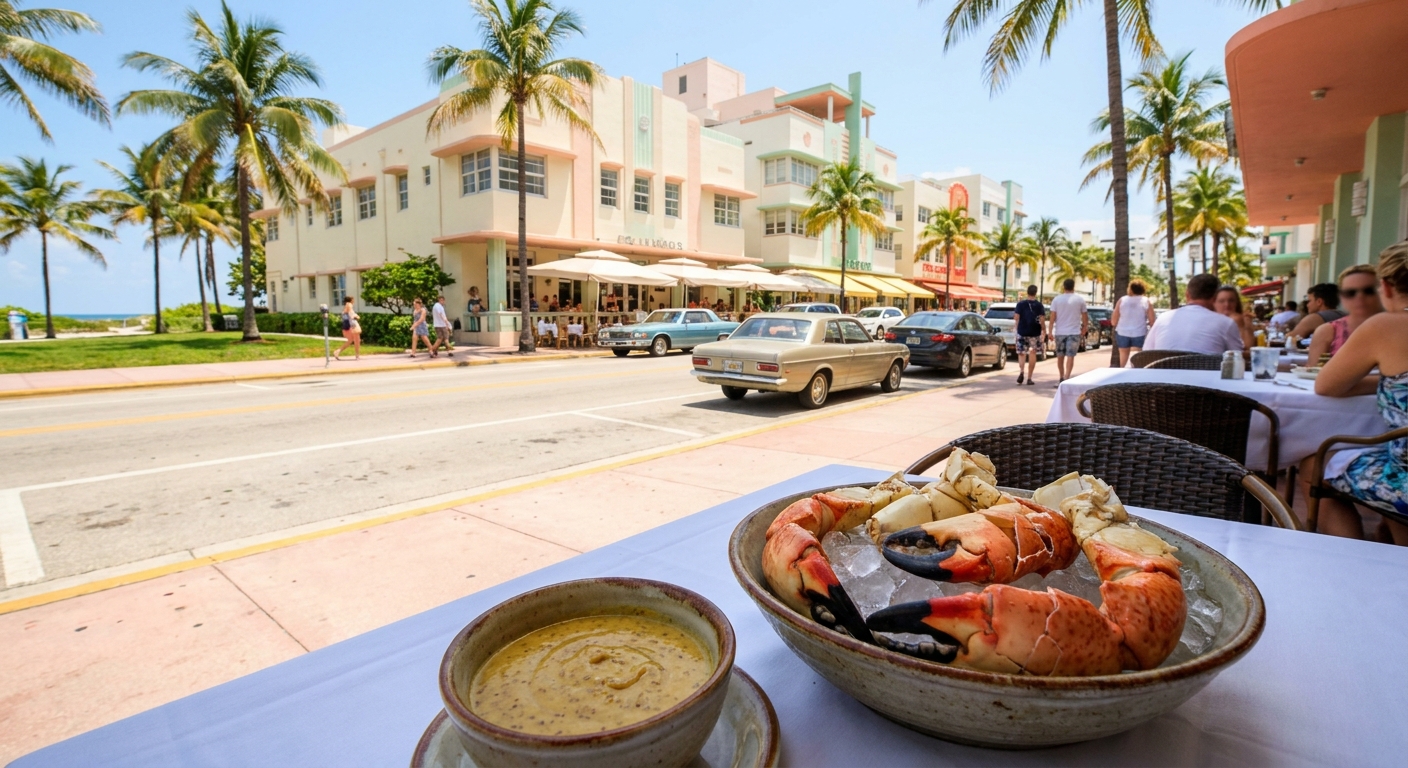
Two Florida signatures run on legal seasons, so time the trip around the claws and the oysters and let the rest of the menu, which is available all year, look after itself.
STONE CRAB: OCT 15 – MAY 1 · WILD OYSTERS CLOSED JUL 1 – SEP 30 · ORANGES FROM SEPTEMBER
Go for: cold cracked claws with mustard sauce, a sandwich pressed flat in a plancha, fritters in the Keys, and citrus picked in the state you are standing in.
Think twice before: ordering raw oysters if you have chronic liver disease or a weakened immune system: the notice Florida requires on the menu tells you to eat them fully cooked.
Seasons and size limits: Florida Administrative Code · State foods: Florida Statutes · Raw oysters: Florida Department of Health · full sources at the end
On this page
- When stone crab claws are legalOctober 15 to May 1
- Florida’s official state pieKey lime, plus the 2022 state dessert
- Cuban sandwich and cafecitoHow a colada gets split
- What a grouper sandwich isThe Gulf Coast lunch, and the law on the name
- Where Keys conch comes fromImported, by rule
- Raw oysters and Vibrio riskThe menu notice and the cooking times
- Florida citrus seasonOranges from September through June
The two dated dishes sit at opposite ends of the year: claws arrive with the cool months, while the wild oyster harvest shuts for the hottest quarter. Everything else runs on habit rather than statute, from Tampa’s argument about salami to the smoked fish dip that turns up at every Gulf beach cottage. The regions differ, and so does lunch: Miami eats at a walk-up window, the Gulf Coast eats fried fish on a bun, the Keys eat fritters.
When is stone crab season in Florida?
Florida law sets the harvest, possession and sale season for stone crab from October 15 through May 1 each year. From May 2 through October 14, no stone crab of any size may be harvested, held or sold, with a single exception: claws a dealer put into inventory before May 2. A claw offered in July comes out of that inventory, or it should not be on the plate at all.
Only the claw is taken, and only a big one. The forearm, the propodus, must measure at least 2 7/8 inches from the elbow to the tip of the lower, immovable finger. Anything shorter stays in the water with its owner.
The crab itself goes back over the side. Possessing or transporting an intact stone crab or its body, dead or alive, is unlawful, and only legal-sized claws may be kept. Claws may never be taken from an egg-bearing female.
A recreational harvester is limited to 1 gallon of claws a day, and no more than 2 gallons may be aboard any vessel. That vessel limit holds however many people are on board.
Claws come to the table already cooked, and usually cold, the shell cracked in the kitchen or at your seat, with mustard sauce on the side. The meat is sweet and firm, closer to lobster than to blue crab, and it needs nothing else on the plate.
What is Florida’s official pie?
Key lime pie has been the official state pie since 2006, when the Legislature wrote it into the statutes. A separate law covers dessert: strawberry shortcake with natural Florida dairy topping took that title in 2022. Ordering both in one sitting is entirely legal.
The pie is a custard of sweetened condensed milk, egg yolks and the juice of small, sharp Key limes, poured into a graham-cracker crust and finished with meringue or whipped cream. Color is the tell. Those ingredients set pale yellow, and a green slice got its color from a bottle.
Cuban sandwich and cafecito in Florida
The Cuban sandwich is Florida’s Cuban-American contribution to the lunch counter: roast pork, ham, Swiss cheese, pickles and mustard on Cuban bread, pressed flat and hot in a plancha until the cheese surrenders. Tampa adds salami, Miami leaves it out, and the argument over who does it right is part of the dish. Take a side; everyone else already has.
Café cubano is espresso sweetened as it brews, the sugar whipped with the first drops into a pale foam called espumita. In Miami it is ordered at a ventanita, the walk-up window on the street side of the café, and drunk standing at the counter in about the time it takes to say hello.
A colada is the sharing size: one cup of sweet espresso with a stack of thimble-sized plastic cups, meant to be split among roughly three to six people, more when everyone is only topping up, fewer when it is you and one colleague with time to talk. Nobody counts heads. Whoever carries it back to the group pours.
What is a grouper sandwich?
The grouper sandwich is the Gulf Coast’s signature lunch: a thick fillet of grouper, a firm, mild white fish, fried, grilled or blackened with spices, served on a bun with lettuce, tomato and tartar sauce. The fish is solid enough to hold its shape under a bun lid, and that is most of the reason it became the sandwich fish of the Gulf.
Florida law says a restaurant may not knowingly serve one food under the name of another, and the same statute covers the fish on the menu: a grouper that is not grouper counts as a misrepresentation, punishable as a second-degree misdemeanor.
Two more counter foods belong to the same coastline. Smoked fish dip is the cooler-box food of the Florida shore: smoked fish, often mullet, flaked into cream cheese or mayonnaise with a little onion and hot sauce, eaten on saltine crackers. Gator tail is alligator meat from the tail, cut into chunks, usually breaded and deep-fried and served with a dipping sauce, mild in taste, somewhere between chicken and white fish.
Where does conch in Florida come from?
Conch fritters are the Keys’ bar snack: chopped conch folded into a seasoned batter with peppers and onion, deep-fried into rough golden balls and served with a tangy dipping sauce. They arrive hot enough to need a minute, and the good ones carry more conch than batter.
The queen conch is a protected species in Florida. Nobody may harvest, kill or possess a live queen conch, in or out of Florida waters, wherever it was taken. An empty shell may be picked up only if no animal was living inside it.
So the conch in the fritters is imported. The rule exempts dealers holding queen conch lawfully harvested in and imported from another country, and requires them to keep the paperwork that proves it. A plate of fritters in Key West is a legal import, fried locally.
Is it safe to eat raw oysters in Florida?
Wild oysters have a closed season of their own. No oyster may be harvested from Florida waters from July 1 through September 30, and in Wakulla, Dixie and Levy counties the closure runs June 1 through August 31. The legal minimum size is 3 inches.
Apalachicola oysters are back, barely. The bay was closed to all oyster harvest through December 31, 2025. The new rule reopens it from October 1 to the last day of February, and only when at least one public reef qualifies. Commercial harvest runs on weekdays, recreational harvest on weekends, and a recreational permit holder may take no more than 1 bag per season.
Any Florida restaurant serving raw oysters has to post one notice, on the menu or on a placard: “There is risk associated with consuming raw oysters. If you have chronic illness of the liver, stomach or blood or have immune disorders, you are at greater risk of serious illness from raw oysters, and should eat oysters fully cooked. If unsure of your risk, consult a physician.”
Vibrio vulnificus is the bacterium behind that wording, and it lives naturally in warm, brackish seawater. The Florida Department of Health says most people get it from raw or undercooked shellfish, especially oysters. Healthy people usually come away with a mild illness, but it can turn life-threatening for anyone with a weakened immune system or chronic liver disease.
Cooking is the state’s answer, and it publishes the times: boil oysters in the shell until they open and 5 minutes more, or steam them until they open and 9 minutes more, discarding any that stay shut. Shucked oysters need at least 3 minutes of boiling, or 10 minutes of frying at 375°F. A char-grilled dozen on a Panhandle deck clears that bar easily.
When is citrus season in Florida?
Orange juice has been the official state beverage since 1967, under a law that defines it as the juice of mature oranges of the species Citrus sinensis and its hybrids. The fruit caught up later: the orange became the official state fruit in 2005.
The word fresh carries a legal meaning on a Florida restaurant menu. It means juice without additives, pressed from the fruit within 12 hours or less of the sale, and selling a synthetic or flavored drink as fruit juice is a second-degree misdemeanor. It is the same statute that governs the fish name on the lunch board.
The state agriculture department gives Florida oranges a harvest from September through June, and grapefruit and tangerines from September through May. It attaches its own caveat: weather can shift the schedule.
That same calendar puts Florida strawberries from December through April, mangoes from May through August and avocados from June through January. Come in February and the berries that top the state dessert are in full run. Come in June and three seasons overlap on one table: the last oranges, the first avocados, and mangoes in mid-run.
Sources & data for this guide
- Stone crab season, claw measurement, intact-crab rule and bag limits · Florida Administrative Code 68B-13.005, 68B-13.007, 68B-13.009 · checked Sep 24, 2026
- State pie (2006), state dessert (2022), state beverage (1967), state fruit (2005) · Florida Statutes 15.052, 15.0522, 15.032, 15.0315 · checked Sep 24, 2026
- Legal meaning of “fresh” juice and food misrepresentation · Florida Statutes 509.292 · checked Sep 24, 2026
- Queen conch protection and importation exemption · Florida Administrative Code 68B-16.001, 68B-16.004, 68B-16.007 · checked Sep 24, 2026
- Oyster closed seasons, 3-inch minimum and the Apalachicola reopening · Florida Administrative Code 68B-27.003, 68B-27.004, 68B-27.005 · checked Sep 24, 2026
- Raw oyster consumer advisory wording · Florida Administrative Code 61C-4.010(9) · checked Sep 24, 2026
- Vibrio vulnificus risk groups and cooking times · Florida Department of Health · checked Sep 24, 2026
- Harvest windows for citrus, strawberries, mangoes and avocados · Florida Department of Agriculture and Consumer Services, Crops in Season · checked Sep 24, 2026
- Dish descriptions here are editorial common knowledge and carry no figures. Gulf shrimp seasons and the reasons behind the queen conch ban were not sourced and are not stated. No restaurant, price or ranking is included.
To plan your stay
- Best Time to Visit Florida: Dry Season, Hurricane Months and Spring Break Crowds
- Where to Stay in Florida: Hotel Tax by County, Resort Fees and the Eight Bases
- Getting Around Florida: Tolls, Rental Fees, Brightline and Free Transit
- Things to Know Before Going to Florida: Time Zones, Beach Access, Taxes and REAL ID