
JAMAICA · FOOD AND DRINK · 18.1° N
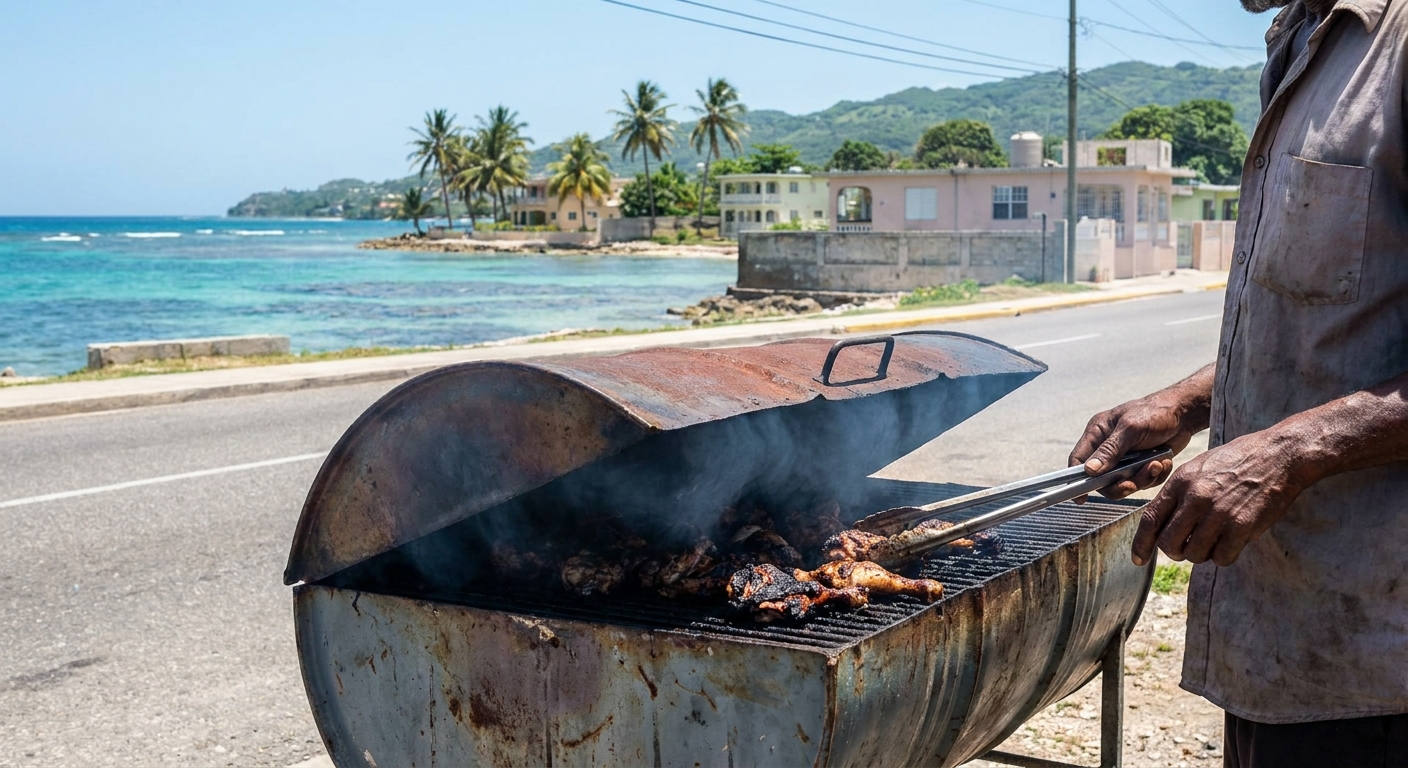
The smell reaches you before the sign does: pimento wood burning under a cut oil drum at the edge of a road, chicken chopped to order and handed over by weight in paper. Jamaica feeds you standing up about as often as it feeds you sitting down, and a good share of the island’s best cooking never sees a dining room.
Breakfast here runs savory and often repeats dinner: ackee and salt cod, callaloo, boiled green banana, fried dumplings, plantain. The drinks keep the same everyday logic, with Jamaican lager in the cooler and coconut water sold from the nut at the roadside. The one thing on the table with a legal definition is the coffee, and that definition is a measurement.
THE TABLE AT A GLANCE · JAMAICA
Eat jerk where the pan is, take the patty inside a coco bread, and treat the name on a coffee bag as an altitude rather than a slogan.
ACKEE AND SALT COD IS THE NATIONAL DISH · COFFEE BELT: 3,000 TO 5,500 FEET · JERK IS A COOKING METHOD BEFORE IT IS A PLATE
Go for: pimento smoke at the roadside pan, a beef patty eaten standing at a bakery counter, high-ester rum, and coffee grown on slopes below a 7,402-foot peak.
Think twice before: picking ackee yourself: the government’s rule is that pods must not be gathered until they open naturally, that the aril must be cleaned of its red fiber, and that the cooking water must be thrown away.
Protected names: JIPO · Coffee altitudes and ackee: Jamaica Information Service · Mountains: UNESCO · full sources at the end
On this page
- Why Blue Mountain coffee carries that nameThe 3,000 to 5,500-foot rule
- What jerk is and how it is cookedPimento wood and the roadside pan
- The national dish, and the ackee safety ruleAckee and salt cod
- Street food you eat standing upPatty and coco bread
- Which rum names are protectedHigh ester, and the 2004 law
- What Jamaicans eat for breakfastSavory, and often last night’s dinner
Prices, opening hours and the name of the best pan on a given road belong to the vendor in front of you, and no registry publishes them. For what a week of eating does to a budget, the trip cost guide carries the numbers, and know before you go handles the practical layer around the table.
What is Jamaica Blue Mountain coffee?
Take a bag off a shelf in Kingston and the name printed on it is a measurement. Only coffee grown between 3,000 and 5,500 feet may be sold as Jamaica Blue Mountain Coffee. The same bean from below 3,000 feet leaves the island as Jamaica High Mountain Coffee, and elevation is the entire difference between the two labels.
Blue Mountain Peak, the highest point in the country, stands at 7,402 feet, so the growing belt sits on the slopes a good way under the summit. The range itself was inscribed as a UNESCO World Heritage site in 2015, covering 26,251.6 hectares and spanning 850 to 2,256 meters of elevation. Our Blue Mountains guide gets you onto those slopes.
Irish Town, in St. Andrew, is one of the growing areas the government names, and it is the one we are willing to name too. Lists of the growing parishes circulate in two versions, one giving four parishes and another giving two, and we could not read either on a page from JACRA, the authority that certifies the coffee.
JIPO’s own argument for defending the name is economic. Blue Mountain Coffee fetches a high price on the world market because of its reputation, and the geographical indication is what keeps that reputation tied to the place. The office works to protect the coffee the same way it treats Jamaica Jerk and Jamaica Rum.
What is Jamaican jerk?
Jerk names a way of cooking before it names a plate. Meat gets rubbed or marinated with a paste built on scotch bonnet pepper and pimento, the berry American shelves call allspice, then cooked slowly over a smoky fire. Pork and chicken are the usual meats, and the cook decides how far the heat goes.
Wood matters as much as rub. Pimento wood is what gives the smoke its particular smell, and the equipment is rarely more elaborate than a cut oil drum with a hinged lid, set up where the traffic passes. The meat is chopped to order with a cleaver and sold by weight in paper, with bread or festival on the side if the pan runs to it.
This is roadside food more than restaurant food, and the pans keep their own hours. JIPO names “Jamaica Jerk” among the products made exclusively in Jamaica, so the words on a bottle of sauce in an American supermarket are a claim about origin. For addresses and opening times, ask the people around you: no registry publishes those, and neither do we.
Ackee and saltfish, Jamaica’s national dish
Ackee and salt cod is the national dish, and the fruit in it is the national fruit: ackee, Blighia sapida. Cooked with onion, pepper and flaked salt cod, the soft yellow arils break up and look startlingly like scrambled eggs, which is why so many first-timers order it at breakfast without knowing what they asked for.
The fruit came from West Africa, probably aboard a slave ship. Dr. Thomas Clarke introduced it to the eastern parishes in 1778, and Captain William Bligh carried plants from Jamaica to England in 1793. That second voyage is where the botanical name comes from.
The fruit is toxic until it opens itself, and the Jamaican government publishes the rule in three parts: the pods must not be gathered until they open naturally, the aril must be cleaned of its red fiber, and the cooking water must be thrown away. Correct harvesting and correct cooking work together against the toxin, not one without the other.
In practice the rule falls on whoever picks and cooks. A plate set in front of you in a hotel or a cookshop has already been through all three steps, and the caution belongs to the closed pod still hanging in somebody’s yard. Admire that tree, take the photograph, leave the picking to the household.
The dish arrives with a supporting cast: callaloo, fried dumplings, boiled green banana, plantain. Kitchens in Kingston and Montego Bay serve it morning and evening alike, and what it costs is set by the kitchen rather than by any list we could publish.
Jamaican patty and coco bread
The patty is a folded pastry turnover, its crust colored yellow with turmeric or annatto, filled most often with spiced minced beef. Bakeries, gas stations and airport counters all sell them, they are eaten standing up, and the filling arrives hotter than the pastry suggests.
Coco bread is the upgrade. Soft, slightly sweet and folded over on itself, it takes the whole patty inside, turning a snack into a proper lunch for the price of one more item at the counter. Ask for it that way and nobody will blink.
Which names are protected as Jamaican rum?
Jamaica protects the names of its own products in law. The Protection of Geographical Indications Act dates from 2004 and was amended in 2018 by Act No. 11. A geographical indication is a sign on goods that ties them to a place and to the quality that place gives them.
JIPO names Jamaica Jerk and Jamaica Rum as products “both made exclusively in Jamaica.” A bottle wearing the second of those names is making a statement about where it was distilled, and registering the name is what gives that statement teeth abroad.
What distillers mean by the Jamaican style is high ester: a heavy, pungent, fruity character that comes out of long fermentation and separates it from lighter Spanish-style rums. Blenders far from the island buy Jamaican rum precisely for that weight, using a small measure of it to give a whole blend its accent.
On the island you meet it neat, over ice, or cut with lime. Sorrel, the deep red hibiscus drink tied to Christmas, takes rum happily, so a December trip lands right in sorrel season (timing is here). Ginger beer with a real bite to it does the same job all year.
What do Jamaicans eat for breakfast?
Morning food looks a lot like evening food: ackee and salt cod, callaloo, boiled green banana, fried dumplings, plantain. Nothing about that arrangement is considered heavy at seven in the morning, and a plate of it will carry you past lunch.
Sweet breakfast is the foreign habit here, and resort kitchens will produce pancakes for anyone who asks. Asking instead for what the kitchen cooks for itself costs nothing and is never taken as an imposition. A day out starts better on the local version.
Then coffee, and now the label means something. Above 3,000 feet the bean can carry the Blue Mountain name, below it the same bean goes out as High Mountain, and growers around Irish Town in St. Andrew will happily tell you which slope is theirs. Ask the question at the counter: it is the shortest route from a souvenir bag to an actual conversation.
Sources & data for this guide
- Protection of Geographical Indications Act (2004, amended 2018 by Act No. 11), and the products named as made exclusively in Jamaica · Jamaica Intellectual Property Office · checked Sep 24, 2026
- Blue Mountain coffee altitudes (3,000 to 5,500 feet), High Mountain below, Irish Town in St. Andrew, Blue Mountain Peak at 7,402 feet · Jamaica Information Service · checked Sep 24, 2026
- Ackee as national fruit, Blighia sapida, 1778 and 1793, and the harvesting and cooking rule · Jamaica Information Service, national symbols · checked Sep 24, 2026
- Blue and John Crow Mountains, inscribed 2015, 26,251.6 hectares, 850 to 2,256 meters · UNESCO World Heritage Centre · checked Sep 24, 2026
- Growing parishes: two different lists circulate, one naming four parishes and another naming two, and we could not read either on a page from JACRA, the certifying authority · checked Sep 24, 2026
- Descriptions of jerk, patty and coco bread, rum style, breakfast habits and everyday drinks are editorial and carry no figures · no restaurant, price or recipe is published here · confirm hours and prices with vendors on the ground.
To plan your stay
- Best Time to Visit Jamaica in 2027: Weather, Hurricane Season and Prices, Month by Month
- Where to Stay in Jamaica: Best Areas Compared, All-Inclusive or Not
- Getting Around Jamaica: Route Taxis, the Knutsford Express and Transfers
- Things to Know Before Going to Jamaica: Money Habits, Vendor Etiquette and Local Customs