
The Ionian Islands are a string of green islands off Greece's west coast, with cliff-backed beaches, Venetian towns, and water in several shades of blue. Six main islands make up the group: Corfu, Paxos, Lefkada, Kefalonia, Ithaca, and Zakynthos. Pick one or two, go in late spring or from mid-September to October, and rent a car or a boat once you land.
What makes the Ionian Islands different from the rest of Greece?
The Ionian Islands are green. Heavy winter rain feeds olive groves, cypresses, pines, and vineyards, which can surprise anyone who pictures Greece as bare Aegean rock. The coasts are rugged, and the west sides of the bigger islands drop in cliffs to beaches where milky turquoise water slides into deeper blue.
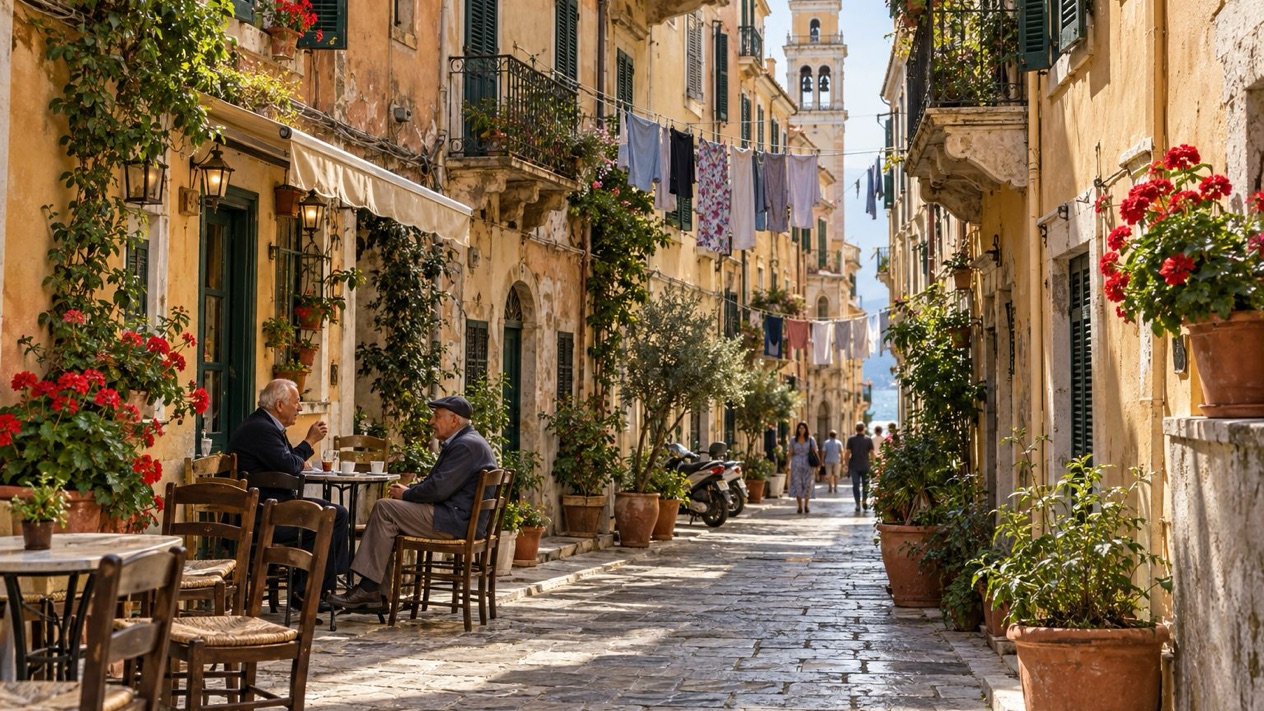
The islands also feel a little Italian. Venice ruled the islands for centuries, and it shows in the castles, the bell towers, and the baroque churches. Corfu added French and British layers, and on the Spianada, the big square beside the Old Town, you might even come across a cricket match. Music runs through island life, from Corfu's marching bands in full regalia to the strolling musicians who sing at dinner on Lefkada and Zakynthos.
The food carries the same history. Two dishes top the list in Corfu: pastitsada, a hearty veal or chicken stew over thick pasta, and sofrito, tender veal simmered for hours with garlic and parsley. Fish lovers can look for bianco, fish in a white sauce, and bourdeto, a spicy fish stew. On Corfu, locals favor ginger beer and kumquat liqueur. Kefalonia is known for Robola wine and a rich meat pie, and Zakynthos for mandolato, a nougat worth asking for.
Because the main islands are large, they feel less packed than small Cyclades such as Mykonos or Santorini, even in peak season. They are also among the best places in Greece to be on a boat, with favorable winds and safe anchorages.
Which Ionian island is right for you?
Corfu: the big, busy, cosmopolitan one
Corfu is the best known and the most developed of the islands. Package tourism arrived early, and some stretches of coast are built up like the Spanish Costas. The island is big enough, though, to hold corners as beautiful as anywhere in the group, including Paleokastritsa and Kalami and Kouloura, the coves made famous by the Durrell brothers' books.
The Old Town comes first: cobbled alleys, the Liston arcade, the Venetian forts, and dozens of buildings left by Venetian, French, and British rulers. Walkers can tackle the Corfu Trail, about 137 miles (220 km) long, and golfers get one of Europe's biggest courses at Ermones, in the Ropa Valley.
Paxos and Antipaxos: small, pricey, and lovely
Paxos feels like the Ionian shrunk down to a small size, with a lush green interior, cliff views, and turquoise beaches. The island lacks the water to support large hotels, so its limited facilities sit in just three villages, and it gets very crowded in season. Sailing flotillas are especially fond of Paxos, and their spending has given the island an upmarket feel that makes it among the priciest places to visit in the Ionians. Most of its own beaches are modest, and the best swimming is next door.
Antipaxos, less than 1.2 miles (2 km) to the south, has sandy blue-water coves that have been compared with the Caribbean. There is little lodging and usually only a few beach tavernas, open by day in season, so treat it as a day trip. Boats run across from all three Paxos villages, and in summer you'll share the coves with craft from Corfu and the mainland too.
The pair suit sailors and anyone who finds Corfu too hectic. Paxos is best avoided in high season.
Lefkada: beaches and wind
Lefkada is linked to the mainland by a causeway and a swing bridge, so on the busy east side it barely feels like an island. The 14th-century castle of Santa Maura guards the approach. The rugged west coast is the star, and Porto Katsiki, Egremni, and Kathisma are famous far beyond Greece. Egremni is reached by about 400 steps, so save some energy for the climb back up. For a quieter patch, walk to the far end of Kathisma. Agios Nikitas, a traditional village on the west coast, is flanked by good beaches.
Windsurfers and kitesurfers come for Vasiliki and Myli, where the wind is strong and the waves are relatively safe. Nydri on the east coast is a big yachting base and a good launch for the little islands of Meganisi, Kalamos, and Kastos. At Sappho's Leap on Cape Doukato, where legend says the poet leapt from the cliffs, Greek hang-gliders hold a tournament in July.
You'll want a car or a scooter to reach the beaches. Lefkada suits beach people and active travelers looking for a low-key base, with just two major resorts on most of the island.
Kefalonia: the big all-rounder
Kefalonia is the largest of the Ionian Islands, and many consider it the best all-rounder, with real towns, knockout beaches, and mountains. Mount Ainos, at 5,340 feet (1,628 m) the highest peak in the Ionians, is the heart of a national park with rare Cephalonian fir trees. Hiking trails, remote coves, and sea caves keep you busy for days.
Myrtos is the postcard beach, a white crescent under towering cliffs. The view over it from the main road is a stunner, but there is no shade down on the sand, so bring a sun umbrella. Melissani is a cave with an underground lake, and the water glows blue-green when the sun shines in around noon. Drogarati, a cave some 150 million years old, is worth a stop too. For villages, Fiskardo is a fishing town of boats, shops, and seafood that turns magical after dark, and Assos has a Venetian castle half swallowed by pines and cypresses.
Distances are long, so rent a scooter or a car. Kefalonia suits road trippers, hikers, and people who want variety.
Ithaca: Odysseus and quiet
Ithaca is Odysseus's legendary homeland. It is rugged and rocky, with few beaches beyond some pebbly coves, and that has kept tourism light. Walkers will enjoy the interior, where sites tied to the Odyssey are scattered through good hiking country. Kioni is a listed settlement worth a visit, and medieval Anogi sits high on a mountain ridge.
Ithaca suits walkers and anyone who likes literature with their landscape.
Zakynthos: Shipwreck Beach and turtles
Zakynthos, also called Zante, is famous for Navagio, the Shipwreck Beach, a crescent of sand sandwiched between towering cliffs. Many visitors come to see it, and it is among the most visited sights in Greece, and the view from the cliffs matches the photos. Go by boat, or look down from the clifftop near the monastery of Agios Georgios ton Gremnon. Kayaking to the Blue Caves is another highlight.
The island's sea and coast became Greece's first marine park, and endangered loggerhead turtles come ashore in spring to lay their eggs in the sand. The south has gone the same tourist route as Corfu, and the party town of Laganas fills with stag and hen groups, while the rest of the island moves at a gentler pace. Zakynthos suits boat lovers, sightseers, and anyone happy to pick a quiet corner.
Kythira: the far south
Kythira is officially counted among the Ionians but lies farther south, apart from the core group, and is reached from the southern Peloponnese, so plan it as its own trip. It has a Venetian castle in Hora, the Neraida waterfall, the British-built Katouni bridge, and Kaladi beach. Try ladopaximada, olive oil rusks.
How do you get to the Ionian Islands?
Corfu, Zakynthos, and Kefalonia have airports, with seasonal international flights and domestic flights from Athens year-round. Lefkada is about 12 miles (20 km) from Aktion airport near Preveza, and a bridge links it to the mainland, so a rental car does the rest.
Ferries leave from ports on Greece's west coast daily or every other day. From Patra, boats go to Kefalonia and Ithaca. From Killini, you can reach Kefalonia and Zakynthos. From Igoumenitsa, boats go to Corfu and Paxos.
How do you get between the islands?
Corfu to Paxos takes about an hour from Corfu's main port, with several sailings a day in summer. Boats from Vasiliki on Lefkada reach Kefalonia daily in about three hours, ferries link Kefalonia with Zakynthos, and a morning boat from Kefalonia to Ithaca returns in the afternoon, so you can take your car across and drive around for the day. From Corfu, a ferry also crosses to Albania.
The most rewarding compact route is Lefkada, Kefalonia, and Ithaca, which keeps transfers short and mixes beaches, small harbors, and scenic coastal drives.
To skip ferry schedules altogether, charter a boat. Greece charges a fee on private and professional leisure vessels over seven meters long in Greek waters, so ask your charter company how it's handled.
When is the best time to visit the Ionian Islands?
Peak season runs from late June through August. Beaches fill up, cruise ships arrive, and prices are at their steepest. If you must go then, choose a quieter island such as Ithaca.
The shoulder seasons are the sweet spot: late April to early June, and mid-September to the end of October. Tavernas are open, crowds are thinner, and the weather stays warm. Spring brings the fewest visitors and the freshest greenery, but the sea is still cold. In fall the sea is warmer, though the weather can turn unsettled. Both seasons are good for a flexible island-hopping trip around Corfu, Paxos, Lefkada, and Zakynthos, since marinas and smaller beaches tend to be quieter than in midsummer.
What should Americans know before going?
U.S. citizens can visit Greece without a visa for up to 90 days for tourism or business. Your passport should have at least three months of validity beyond your planned departure date, and one reported lost or stolen will get you turned away. Officers may ask for proof of sufficient funds and a return ticket or other evidence of departure, and you should carry your passport or another photo ID at all times.
Greece is generally safe, but petty crime is common in popular tourist spots, and thieves are known to break into rental cars for passports, valuables, and luggage, so it is wise to keep your belongings with you. Greece also has one of the highest traffic fatality rates in the EU, so drive and ride carefully, and wear a helmet on any scooter or motorbike, as the law requires. Strikes can disrupt ports and airports, forest fires are common in the dry summer months and sometimes close roads, and earthquakes occur regularly.
Book ferries, rental cars, and lodging early for July and August. Before you leave home, get an international driver's permit: Greek law requires one alongside your U.S. license, even if the rental desk doesn't ask. Once you're there, check ferry timetables a few days before each crossing.
Sources
- Visit Greece (GNTO) (https://www.visitgreece.gr/en/islands/ionian-islands), checked October 18, 2026
- johnnyafrica.com (https://johnnyafrica.com/best-ionian-island-greece/), checked October 18, 2026
- discovergreece.com (https://www.discovergreece.com/ionian-islands), checked October 18, 2026
- roughguides.com (https://www.roughguides.com/greece/the-ionian-islands/), checked October 18, 2026
- wander-lust.nl (https://www.wander-lust.nl/ionian-islands-greece/), checked October 18, 2026
- U.S. Department of State (https://travel.state.gov/content/travel/en/international-travel/International-Travel-Country-Information-Pages/Greece.html), checked October 15, 2026
- U.S. Department of State (https://travel.state.gov/content/tsg_aem/us/en/home/international-travel/travel-advisories/destination.grc.html), checked October 15, 2026
To plan your stay
- Best Time to Visit Greece: September and Late May to Early June
- Arachova: Parnassus Mountain Town, Formaela Cheese, Ski Season and Saint George's Day
- American Airlines Flights to Greece: U.S. Cities, Athens Arrivals and Onward Island Flights
- Greece on a Budget: Cash Machines, Cards, Beaches and Ferries