
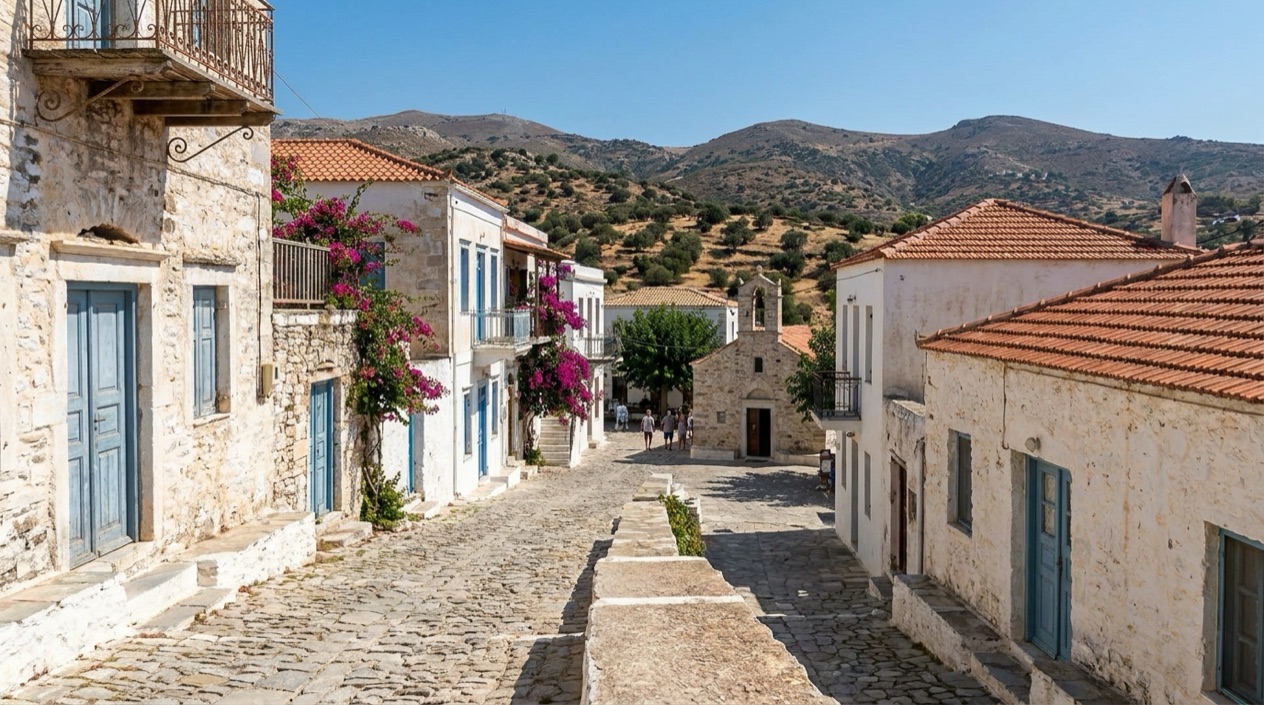
You reach Halki with olive trees on every side, and the village shows itself slowly: a stone tower, a church bell, a square with café chairs under the shade. Nothing here is a single monument to tick off. Halki is a village in the Tragea valley on Naxos, and a visit means walking its lanes, looking into its old churches and tasting what the island makes from lemon leaves and thyme honey.
Is visiting Halki worth it?
Those who come only for sand and swimming will find the beaches elsewhere on Naxos, mostly on the western side near Chora.
What sets Halki apart from the island’s other inland villages is how many kinds of things sit close together. Naxos is the largest island of the Cyclades and also the most fertile, and the Tragea valley shows that fertility better than the coast does.
Olive groves fill the valley floor, old stone houses line the lanes, and Venetian towers stand beside churches that carry frescoes inside. It is farm country with a long memory, and the village keeps a working life of its own, with shops, workshops and kafenia (the small coffeehouses where locals stop for coffee and talk).
Next to the better-known villages of Filoti and Apiranthos, Halki gives you a different feel. Filoti climbs the slope of the mountain, and Apiranthos is a village of marble-paved lanes.
Halki spreads over the valley and rewards a slow loop on foot from the square, with detours into churches and side streets.
It also pays off at the table. Naxos is known within Greece for its Arseniko Naxou cheese, its potatoes, its honey drawn largely from thyme, and kitron, a local lemon-citrus spirit. Halki is one of the villages where that food culture is easiest to taste, with tavernas serving local cheese, grilled meat and vegetables from the valley, and a distillery where kitron is made.
What to see at Halki
The village center and its lanes
The heart of Halki is its main street and the small square where the cafés and tavernas gather. Here the old neoclassical mansions stand shoulder to shoulder with newer shopfronts, and many of the older buildings have been restored. You see carved doorways, balconies with iron railings, bougainvillea spilling over walls and shops selling local products.
Take the side lanes as well as the main street. They lead to courtyards, small chapels and views over the valley’s olive trees. Stop for a coffee at one of the kafenia and watch village life pass: neighbors greeting each other, a delivery van squeezing between walls, a grandmother carrying bread home.
Venetian towers
Naxos has a history of Venetian rule, and Halki still carries it in its stone towers. These fortified houses were built for noble families who ruled the island’s countryside, and they are among the strongest reminders of that period on Naxos. In the village you can see one of them rising above the surrounding houses, solid, square and plain compared with the decorated mansions beside it.
Look at the thick walls, the small windows high up and the heavy gateway. Such a tower was a home and a defensive refuge at once, and standing in front of it explains how the old estates around the valley worked. It makes a good photograph against the green of the olive trees.
Village churches and their frescoes
The Tragea valley is known for its early Christian and Byzantine churches, and Halki holds some of the best known. Panagia Protothroni, one of the oldest churches in the village, is often mentioned, and Agios Georgios Diasoritis, a smaller church, is known for its painted walls. Inside such churches you find painted saints, scenes from the Gospels and dark blue and ochre pigments that have survived across generations.
Orthodox churches are living places of worship, not only monuments, so a visit is a quiet encounter with a working tradition. Look for the carved wooden icon screen, the hanging oil lamps and the candles lit by villagers. Outside, bell towers and whitewashed courtyards frame the buildings, and the olive trees make a backdrop in any season.
Kitron, honey and cheese
A distillery in the village makes kitron, the lemon-citrus spirit that is one of the island’s signatures. It comes from the leaves and fruit of the citron tree, and you taste it in small glasses, sometimes in a green version, a yellow one or a clear one. It tastes sharp and sweet at once, a little like lemon candy with an edge.
Around it, the shops of Halki sell Naxian honey, much of it drawn from thyme blossom, as well as local cheeses, preserves and herbs. At a taverna you can order a plate of Arseniko Naxou cheese, a salad of valley tomatoes and a dish of potatoes fried the Naxian way. It is the part of the visit that stays on the palate after you leave.
When to visit Halki
Halki is a village you walk through outdoors, so the weather shapes the visit more than any opening time. Spring and autumn give the gentlest conditions for strolling the lanes and sitting in the square. In April the rain is scarce and in October the air still holds the warmth of summer, which makes both months comfortable for lingering over a long lunch at a table outside.
Summer is the season of the beaches, and the inland lanes of Halki can feel hot. At Mykonos, close to Naxos, highs in July average in the low 80s, and the rain at Naxos all but disappears. Sun protection and water are the sensible additions to a bag, and a stop in a shaded café or inside a stone church breaks up the day.
Winter brings a different village. January has plenty of rainy days, so a rain jacket is the practical answer, and the olive groves look their greenest. Some seasonal businesses on the island may keep shorter schedules at that time, so a village stroll is better planned around the weather than around any single sight.
| Month | Average high at Mykonos (°F) | Average low at Mykonos (°F) | Precipitation at Mykonos (in) | Days with rain at Naxos |
|---|---|---|---|---|
| January | 55.2 | 47.7 | 3.01 | 11.2 |
| April | 64.0 | 54.7 | 0.78 | 3.9 |
| July | 83.3 | 72.7 | 0.01 | 0.0 |
| October | 71.2 | 63.0 | 1.08 | 3.6 |
A festival day on Naxos fills the squares with music and dancing, and village churches hold their feast days with a liturgy and a shared meal. Dates move from place to place and year to year, so ask in the village about the next panigiri, the local saint’s day celebration, if you hope to catch one.
Tips for your visit
Start with what you carry. Comfortable shoes with a good grip suit the stone lanes and the church steps. In summer, bring sun protection and a bottle of water. In January, a rain jacket is the sensible companion, since rain falls on a good share of days that month. Carry a little cash for the small shops, and bring a camera for the frescoes’ neighbors, the towers and the olive groves.
Combine Halki with other parts of the island. Chora, the capital and largest town of Naxos, holds the Portara, the great marble doorway of the Temple of Apollo, as well as the Castle of Naxos and an Archaeological Museum that displays Neolithic finds from the Zas cave, with jewelry, pottery and tools. From the other villages of the interior, Filoti and Apiranthos among them, you can build a loop through the mountains.
The beaches of Agios Prokopios, Agia Anna, Plaka and Mikri Vigla lie mostly on the western side near Chora, and the water there is a natural counterpart to a day among the olive groves. Together, a morning of churches and kitron in Halki and a swim later make a varied day on Naxos, though you decide how to pace them yourself.
Getting to the island is part of the plan. Naxos is about five and a half hours by regular ferries from Piraeus, and from the port at Chora you continue to the villages.
Take your time with the meal. Order several small plates to share, try the local cheese and finish with a glass of kitron. Ask the people at the table or the shop what they would taste first. Villagers are usually glad to talk about their produce, and a conversation over a plate of potatoes tells you as much about Halki as any church wall.
Good to know before you go
Euros are the currency, and the village shops and tavernas are small businesses, so a few coins and small notes are handy for a coffee or a jar of honey. Take the usual care with your belongings and your steps on worn stone.
Wear shoes with a firm sole, and in summer plan for the heat of the valley, because the lanes offer little escape from the sun between shaded stops. Villagers greet visitors warmly, and a kalimera (good morning) is received with a smile.
Sources
- Wikipedia, Naxos (https://en.wikipedia.org/wiki/Naxos), checked October 12, 2026
- Visit Greece (GNTO), Naxos (https://www.visitgreece.gr/islands/cyclades/naxos/), checked October 12, 2026
- Wikivoyage, Naxos (https://en.wikivoyage.org/wiki/Naxos), checked October 12, 2026
- Hellenic National Meteorological Service (HNMS), climatological normals 1991-2020 for Mykonos station (https://www.emy.gr/climatic-data), monthly mean daily maximum and minimum; rain from the ECMWF ERA5 reanalysis, 1991-2020, grid cell of Naxos (Open-Meteo), checked October 12, 2026
- ECMWF ERA5 reanalysis 1991-2020, grid cell of Naxos (Open-Meteo), checked October 12, 2026
To plan your stay
- Best Time to Visit Greece: September and Late May to Early June
- Arachova: Parnassus Mountain Town, Formaela Cheese, Ski Season and Saint George's Day
- American Airlines Flights to Greece: U.S. Cities, Athens Arrivals and Onward Island Flights
- Greece on a Budget: Cash Machines, Cards, Beaches and Ferries