
A carafe of cold white wine lands on a taverna table next to a bowl of skordalia, the garlic dip, and the first sip tastes of pine needles and lemon. Down the coast on Santorini, a glass of Assyrtiko carries a salty edge that seems to come straight off the volcanic cliffs. Greek wine runs from that resinated house pour to mineral island whites, dark mainland reds and syrupy dessert wines, and you meet all of it at the table.
What is Greek wine?
Greek wine is a collection of local styles built on native grapes, from the pine-resin whites of Attica to the volcanic Assyrtiko of Santorini and the sweet wines of the islands. Many of the grapes are rarely seen outside the country, so a wine list in a Greek restaurant often reads like a map of unfamiliar names.
The modern wine trade took shape in the twentieth century. A Wine Institute was set up by the Ministry of Agriculture in 1937, the country’s first Cabernet Sauvignon vineyard was planted in 1963, and appellation laws followed in 1971 and 1972. Those laws are why a label can tell you the region the grapes came from.
Retsina, the pine-resin wine
Retsina is a white wine, sometimes a rosé and very rarely a red, flavored with pine resin. It has been made for at least 2,000 years, and its taste is said to come from the ancient habit of sealing amphorae with Aleppo pine resin. Today the resin goes into the must during fermentation, while the rest of the winemaking follows the methods used for ordinary white or rosé wine.
In the glass it is strong and distinctive, with a scent of pine that some drinkers love at once and others need a second glass to understand. It became the national beverage of Greece during the 1960s, and as tourism grew it became the wine the world associated with Greece. Attica, Boeotia and Euboea are the major production centers, and the European Union protects the name retsina as a designation for Greece and parts of southern Cyprus.
The wine is made for food. It is considered an ideal match for strong flavors such as skordalia, and it belongs on the table with a spread of meze, those small shared plates that arrive before the main dishes. Served cold with salty, garlicky things, the resin starts to make sense.
Assyrtiko and the volcanic island style
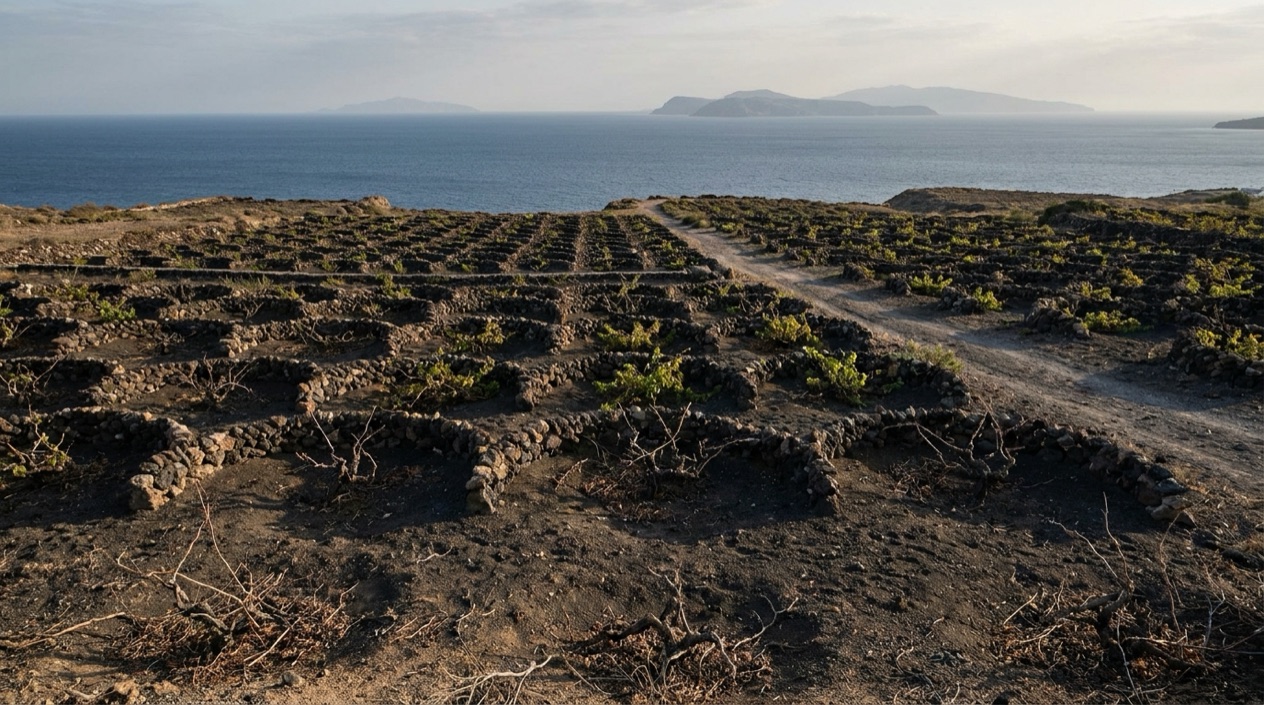
Assyrtiko is a white grape native to Santorini, an island that is the remnant of an ancient volcano. The vineyards are arid and windswept, and the vines grow close to the ground. Growers have long trained them into low, basket-shaped coils called kouloura, which shelter the grapes from strong winds and from the sun.
The result is a low-yielding, concentrated wine with a briny freshness and sharp acidity, and the grapes keep that acidity even when very ripe. Many of the island’s old vines are ungrafted, because Santorini is considered free of phylloxera, the pest that devastated vineyards elsewhere. That is why you hear the word old so often when sommeliers talk about Santorini bottles.
Assyrtiko has also traveled. It is widely planted on Paros and is found in Chalkidiki on the mainland, and across Greece it makes both dry wines and sweet ones. In retsina it is often blended with Savatiano, a grape with less acidity.
Vinsanto and Nykteri
Santorini has made wine since ancient times, and its wines became famous across Europe in the Middle Ages under the influence of the Republic of Venice. That history lives on in Vinsanto, a sweet wine made in the passito style. The grapes are left to dry in the sun after harvest, then crushed, fermented and aged in oak barrels.
To carry the Vinsanto label on Santorini, the wine must be mostly Assyrtiko, blended with Athiri, Aidani and small amounts of other local white grapes. The drying itself runs for 12 to 14 days. The aging takes far longer, at least 24 months in oak, which gives the wine its deep color and its dried-fruit sweetness.
Nykteri is the island’s other special style. The name means working the night away, because the grapes were traditionally harvested at night to avoid the heat. It must spend at least three months in oak, so it tastes rounder than a typical steel-fermented white.
Which regions and grapes are best known?
The best-known pairings are Assyrtiko on Santorini, Xinomavro in Naoussa, Moschofilero in Mantineia, Robola on Kefalonia, Savatiano in Attica, and Vidiano and Liatiko on Crete. Each grape belongs to a landscape, so a trip across the country becomes a tasting in itself.
Macedonia and Naoussa: Xinomavro
Xinomavro is the leading grape of Macedonia, centered on the town of Naoussa. It is a red with great aging potential, and its palate is often compared to tomatoes and olives, which sounds odd until you taste a glass beside grilled lamb or a plate of roasted vegetables. Young bottles are firm and savory, and older ones soften into something close to a Mediterranean cousin of a fine Italian red.
Macedonia has several other wine regions, among them Amyntaio, Epanomi, Goumenissa, Pieria and Chalkidiki. Chalkidiki is also where Assyrtiko grows on the mainland. If your route runs through the north of the country, these names on a menu are worth ordering by the glass.
The Peloponnese: Moschofilero and Nemea
Moschofilero comes from Mantineia in Arcadia, in the Peloponnese. It makes crisp, floral wines, both still and sparkling, and it suits drinkers who find Assyrtiko too severe. A glass of it before dinner is a gentle introduction to Greek whites.
The Peloponnese holds more wine regions than any single list can hold. Nemea, Monemvassia-Malvasia and Patras all sit on its roster, and Nemea in particular is a name you will see on red wine labels in restaurants across the country. The peninsula rewards anyone who orders by region rather than by brand.
The islands: Kefalonia, Crete and the Aegean
Robola is grown in the mountainous vineyards of Kefalonia, in the Ionian Islands. It has a smoky, mineral and lemony character that suits seafood, and it is a natural order beside grilled fish. The Ionian wine regions also include Corfu, Zakynthos and Lefkada.
Crete has its own grapes. Vidiano is a white native to the island, grown mainly around Rethymno and Heraklion, and it is hard to cultivate, so only small amounts are made. Liatiko is a native red, deemed to shine as a sweet wine. The island’s wine regions include Archanes, Dafnes, Peza and Sitia.
In the Aegean, the wine regions include Lemnos, Paros, Rhodes, Samos and Santorini. On Rhodes, Athiri is the main grape used for retsina, so even the resinated wine changes from island to island.
Attica and the rest of the mainland
Savatiano is the main white grape of Attica, the region around Athens. It stands up to heat and shows floral, fruity aromas when it is fermented cold. It is also the grape behind much of the retsina poured in the capital’s tavernas.
Elsewhere on the mainland, Central Greece includes Atalanti, Thessaly has Rapsani, Nea Anchialos and Messenikola, and Epirus has Zitsa and Metsovo. These are lesser-known names on most American shelves, which makes them a good reason to ask what the house recommends.
Where can you taste it?
You taste Greek wine most naturally at a taverna table, with meze in front of you, and then in the wine regions themselves where the grapes grow. The setting changes the glass. A carafe of retsina with garlic dip tells a different story than a bottle of Santorini Assyrtiko poured beside grilled fish.
At the taverna table
A taverna is the everyday Greek restaurant, and it is where retsina feels at home. Order it cold with skordalia and other strongly flavored meze, the combination that retsina is considered ideal for. Many tavernas pour house wine by the carafe, which lets you try a local style without committing to a full bottle.
Greek habits around the glass are part of the experience. A glass of water is traditionally served with any drink you order, one for each drink, though in touristy areas you may have to ask. After the meal, the drinking does not stop.
In Crete, raki, also called tsikoudia, is considered an after-dinner drink and often arrives with fruit as dessert. It is a spirit of 35 to 40 percent alcohol, served cold in the summer months.
On the islands
On Santorini, tasting means Assyrtiko, Vinsanto and Nykteri in the place where the grapes grow among low-trained vines. The same grape appears on Paros, so island-hopping can turn into a side-by-side comparison of one variety grown in two places. Crete adds Vidiano and Liatiko, and Kefalonia adds Robola.
Island drinking is not only wine. On Lesbos, Mytilene is particularly famous for its ouzo, with brands including Mini, Number 12, Sans Rival, Arvanitis, Barba Yianni and Aphrodite. Mainlanders do not drink ouzo with ice, but tourists and islanders generally do. Be wary of bars that serve imported spirits at suspiciously low prices, because genuine imports are likely to be very expensive, and a cheap pour may be a locally distilled spirit with flavorings called bomba, sometimes passed off as whisky or gin in island bars catering to young people.
In the wine regions
The wine regions are where the labels come from, and each one has its own character. Naoussa is the town at the center of Xinomavro country, and Mantineia in Arcadia is home to Moschofilero. Nemea and Patras anchor the Peloponnese, while Attica and Atalanti stand for Central Greece. Following one grape through its home region gives a trip a shape.
If you cannot visit, a good wine list does much of the same work. Ask for the local grape of the region you are in, whether Robola on Kefalonia, Vidiano in Heraklion or Savatiano in Athens, and the meal fills in the rest. Between glasses, coffee fits the Greek table too, from the thick, strong Greek coffee in a small cup to the shaken iced frappé of the hot summer months.
Good to know before you go
Water arrives with your drink in most Greek cafés and tavernas, but on some small islands the tap water is imported and heavily chlorinated, so visitors prefer bottled. Iced tea in mass-sector tavernas and cafés usually means instant, so ask twice if you want brewed.
Retsina has a strong, resinous taste, so start with a small glass or a carafe shared by the table before ordering a bottle.
Sources
- Wikipedia, Assyrtiko (https://en.wikipedia.org/wiki/Assyrtiko), checked October 12, 2026
- Wikipedia, Greek wine (https://en.wikipedia.org/wiki/Greek_wine), checked October 12, 2026
- Wikipedia, Retsina (https://en.wikipedia.org/wiki/Retsina), checked October 12, 2026
- Wikipedia, Santorini wine (https://en.wikipedia.org/wiki/Santorini_wine), checked October 12, 2026
- Wikivoyage, Greece, section Drink (https://en.wikivoyage.org/wiki/Greece#Drink), checked October 12, 2026
To plan your stay
- Best Time to Visit Greece: September and Late May to Early June
- Arachova: Parnassus Mountain Town, Formaela Cheese, Ski Season and Saint George's Day
- American Airlines Flights to Greece: U.S. Cities, Athens Arrivals and Onward Island Flights
- Greece on a Budget: Cash Machines, Cards, Beaches and Ferries