
A small glass of ouzo turns milky white the moment water touches it, and within a minute the table is crowded with saucers: olives, a wedge of feta under oregano, a bowl of pink taramosalata, a pan of saganaki still hissing at the edges. Nobody hurries.
The talk goes on between the plates, and the next dish arrives before the last one is finished. This is how a Greek taverna works, in a village on an island or on a side street in a city, and the page that follows is about eating that way: what meze is, what a taverna offers, and how to order without stumbling.
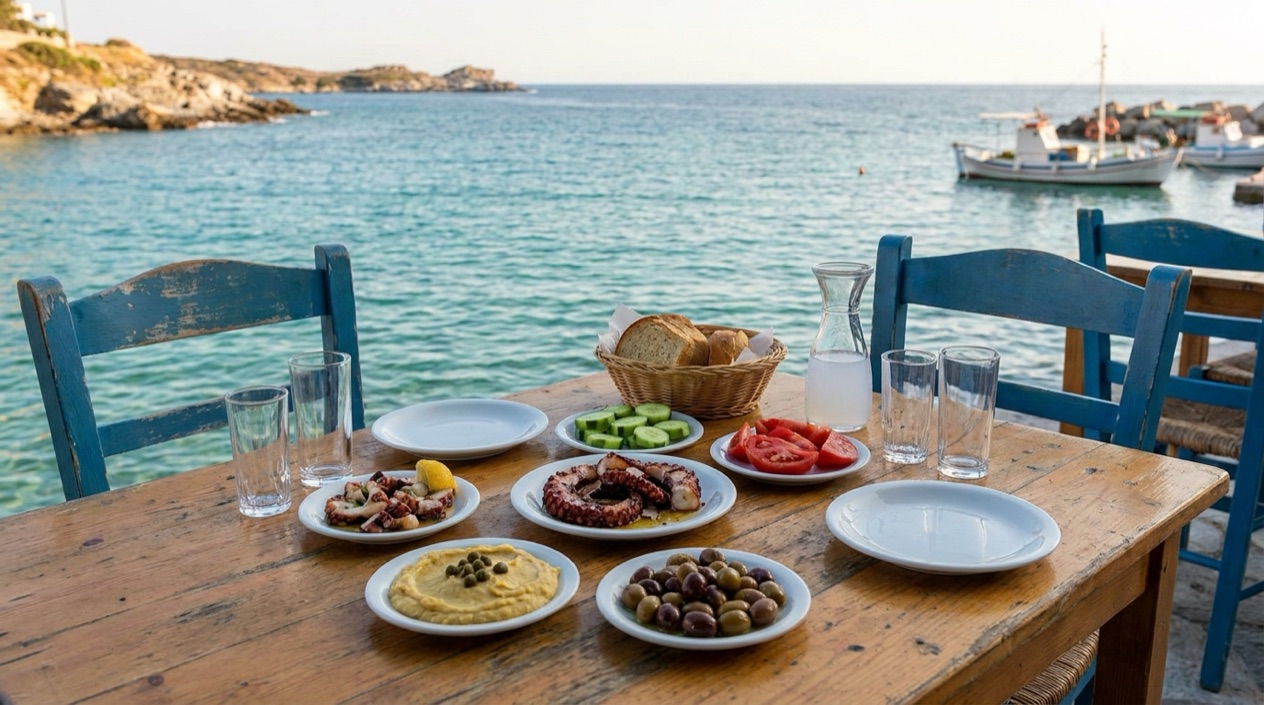
What is a Greek taverna?
A taverna is a small Greek restaurant that serves Greek cuisine, and it is the place where most meals with a local flavor happen. Taverna and estiatorio, the slightly more formal sit-down restaurant, are widespread across Greece, serving home cooking at affordable prices to both locals and tourists. The food leans on olive oil, vegetables, grains, fish and meat, with oregano, mint, garlic, onion and dill doing much of the seasoning.
Olive oil is the most characteristic and ancient element of the cuisine and it ends up in most dishes. It glosses the tomatoes, pools under baked vegetables and finishes the salad. Together with wheat and wine it forms the old triad on which Greek cooking rests, and the Mediterranean diet that grew from it has been on the UNESCO Intangible Cultural Heritage Lists since 2013.
The table and the salad
A taverna meal tends to begin with choriatiki, the Greek salad: tomatoes, cucumber, onion, olives and a slab of feta that plays the central part. Greek salad is traditionally dressed only with olive oil. Vinaigrette or lettuce show up mostly in the most tourist-oriented restaurants, so a bowl that arrives plain and glossy is the one to expect.
Around the salad come the plates that give the evening its shape: grilled meats, baked vegetables, fried cheeses, fish where the sea is close. Feta can be bought packed or by the weight in shops, which hints at how much of the country’s food revolves around it. Greek yogurt, with real body and 10% fat, shows up at the end of a meal or at breakfast, often with honey.
Dishes that belong to one island
Many of the best taverna plates are tied to a single place. On Santorini, tomatokeftedes, tomato fritters, are well known throughout the island, crisp outside and soft and sweet within. On Crete, staka me ayga pairs poached or fried eggs with local staka, a buttery cream mixed with flour, a rich plate that makes more sense once you see how the island eats.
Fish dishes are common in coastal regions and on the islands, so a harbor taverna will often put the sea first on the menu. On the mainland, avgotaracho Messolongiou, a PDO product made from flathead mullet caught in the Messolonghi-Etoliko Lagoons, is the kind of local specialty worth looking for. Chios, in the Aegean, grows mastic, an aromatic plant resin that flavors sweets and spirits.
An old habit with new menus
Eating out has deep roots here. The earliest evidence of a Greek restaurant came out of the Agora of Athens during excavations by the American School of Classical Studies in the early 1970s. Fish bones and shellfish remains showed that it served oysters, mussels, murex and large fish, while a wine shop nearby poured local Attic wine alongside imports from Chios, Mende, Corinth, Samos and Lesbos.
The habit survived empires. In the Byzantine Empire, a 10th-century ordinance set a curfew on places serving wine to prevent drunken violence.
Today, as tourism has grown, many tavernas have added English menus, and some in tourist areas employ touts to draw in passersby or pay commissions to tour guides who send business their way. A taverna in the Anemomilos district of Corfu town is one of many you can still find by wandering rather than being steered.
What is meze?
Meze is a selection of small dishes served as appetizers in Eastern Mediterranean cuisines, much like Spanish tapas or Italian stuzzichini. In Greece it is commonly a plate of snacks set down to accompany drinks such as ouzo and tsipouro, and it can easily grow from a nibble into the whole meal.
The word itself has traveled. It was borrowed from the Turkish meze, meaning appetizer, which in turn came from the Persian maze, meaning taste or relish. The tradition began in the Byzantine Empire and developed in Ottoman Greek houses and tavernes, which is why the same small plates appear, with local twists, across a wide stretch of the region.
What arrives on the table
Common features of a meze spread include cubes of cheese, olives, grilled meats and snacks like stuffed vine leaves. Dips are central: taramosalata, melitzanosalata (a smoky eggplant salad) and fava, a spread that tastes mellow and earthy. Kalamata olives, sliced hard-boiled eggs, garlic bread, salads and fried vegetables fill the gaps between them.
Seafood joins in where the sea is near, and grilled octopus is the dish that most people picture. Saganaki, fried or grilled cheese, arrives bubbling and is meant to be squeezed with lemon and torn apart. Sheep, goat and cow cheeses all appear in different forms, and the point is to order several and pass them around rather than to claim one plate each.
What goes in the glass
Meze exists partly to give drinks something to lean on. Ouzo is the anise-flavored spirit that clouds when diluted, and the island of Lesbos is particularly famous for it. Tsipouro, a grape spirit, sits beside it on many tables. On Crete, tsikoudia is the most common aperitif, poured in small glasses with the first plates.
Wine, as the ancient Agora shows, has a very long history here, and the ancient Greek diet itself rested on wheat, olive oil and wine. Sip rather than gulp: the little plates and the spirits are built for a slow table, where a single glass can last through several dishes.
Meze beyond Greece
Meze has different faces elsewhere. In the Levant, arak and beer are often drunk with mezze, especially when meats are ordered. In Palestinian cuisine, mezze typically means the sample dishes served at the start of a formal meal, and it is also served alongside a nargila, the water pipe.
In Southeast Europe, meze is closer to an Italian antipasto: cured cold cuts, cheese and salads dominate, and cooked food is left out. Albanian platters carry prosciutto, salami and brined cheese with roasted peppers or marinated green olives.
In Bulgaria, lukanka, a spicy sausage, soujouk, a dry spicy sausage, and sirene, a white brine cheese, are popular, as is shopska salad. The Greek version, with its fried cheeses, dips and seafood, sits at the warmer, more cooked end of the family.
How do you order?
You order by sitting down, letting the bread and water arrive, and then choosing a few plates to share rather than one main dish each. It is customary in Greece to be served water and bread soon after being seated, and the pace from there is yours to set. Begin with a salad and two or three meze, and add more as the table empties.
The hour and the first minutes
Greeks dine around 14:00 to 15:00 for lunch and 21:00 to 23:00 for dinner, though tourist establishments may open as early as 12:00. Dinner is the main meal, and in the hot summer months it is commonly eaten as late as 21:00 or 22:00. Arriving at a taverna at that hour means a full room and a lively one.
Once seated, the water and bread come, and the waiter will talk you through what the kitchen has that day. Pointing at what other tables are eating works as well as any phrase. The meal usually ends the same way: when you ask for the bill, it is customary to receive a small free dessert, often fruit or a sweet spoon of something.
Choosing plates and fish
Build the table in layers. Start with dips and cheeses, add a vegetable or two, then bring in grilled meat or fish if you still have room. Seasonal fruit follows the same rhythm: strawberries and cherries emerge in markets from May onwards, while kiwis and oranges are the fruits of winter, and a taverna’s dessert plate tends to reflect it.
Fresh fish needs a small pause. It is sold by the kilogram and can be very expensive, so budget diners should ask the cost of their portion before ordering. By law, frozen seafood must be marked as such on the menu, so the menu itself will tell you whether the octopus or squid came from the freezer.
Reading the room
Some signs suggest a place is aimed at passersby rather than at diners. Bad signs include desserts listed on the menu, large food posters outside, waiters yelling for clients, or plates taken away while you are still seated. A room filled with Greek voices at the late hour is a better signal than any poster.
Vegetarians can build a full table from salads, dips, beans and baked vegetables, though restaurants catering strictly to vegans and vegetarians are practically non-existent outside Athens and Thessaloniki. In the morning, bougatsa, a popular breakfast pastry sold mainly in bougatsadika shops alongside pies, pastries and drinks, makes a different kind of first meal. For something sweet later, Greek sugar bakeries sell locally made ice cream by the weight, much cheaper than at ice cream kiosks, and baklava layers tissue-thin pastry with honey, cinnamon and chopped walnuts.
Good to know before you go
A taverna meal is paid at the table when you ask for the bill, and it is worth knowing that restaurants officially charge a cover fee in many places. If the amount heads toward the top of the range, consider eating elsewhere.
For a quick bite outside the taverna world, a hamburger with a Coke at Goody’s, a popular fast food chain, costs €3-5. Fresh milk can be sold only for a few days after production, which makes it relatively expensive, so do not expect it at every breakfast.
| Fee | Amount | Who pays |
|---|---|---|
| Restaurant cover fee | €0.30 to €2 | Each diner |
Sources
- Wikipedia, Greek cuisine (https://en.wikipedia.org/wiki/Greek_cuisine), checked October 12, 2026
- Wikipedia, Meze (https://en.wikipedia.org/wiki/Meze), checked October 12, 2026
- Wikipedia, Taverna (https://en.wikipedia.org/wiki/Taverna), checked October 12, 2026
- Wikivoyage, Greek cuisine (https://en.wikivoyage.org/wiki/Greek_cuisine), checked October 12, 2026
- Wikivoyage, Greece, section Eat (https://en.wikivoyage.org/wiki/Greece#Eat), checked October 12, 2026
To plan your stay
- Best Time to Visit Greece: September and Late May to Early June
- Arachova: Parnassus Mountain Town, Formaela Cheese, Ski Season and Saint George's Day
- American Airlines Flights to Greece: U.S. Cities, Athens Arrivals and Onward Island Flights
- Greece on a Budget: Cash Machines, Cards, Beaches and Ferries