
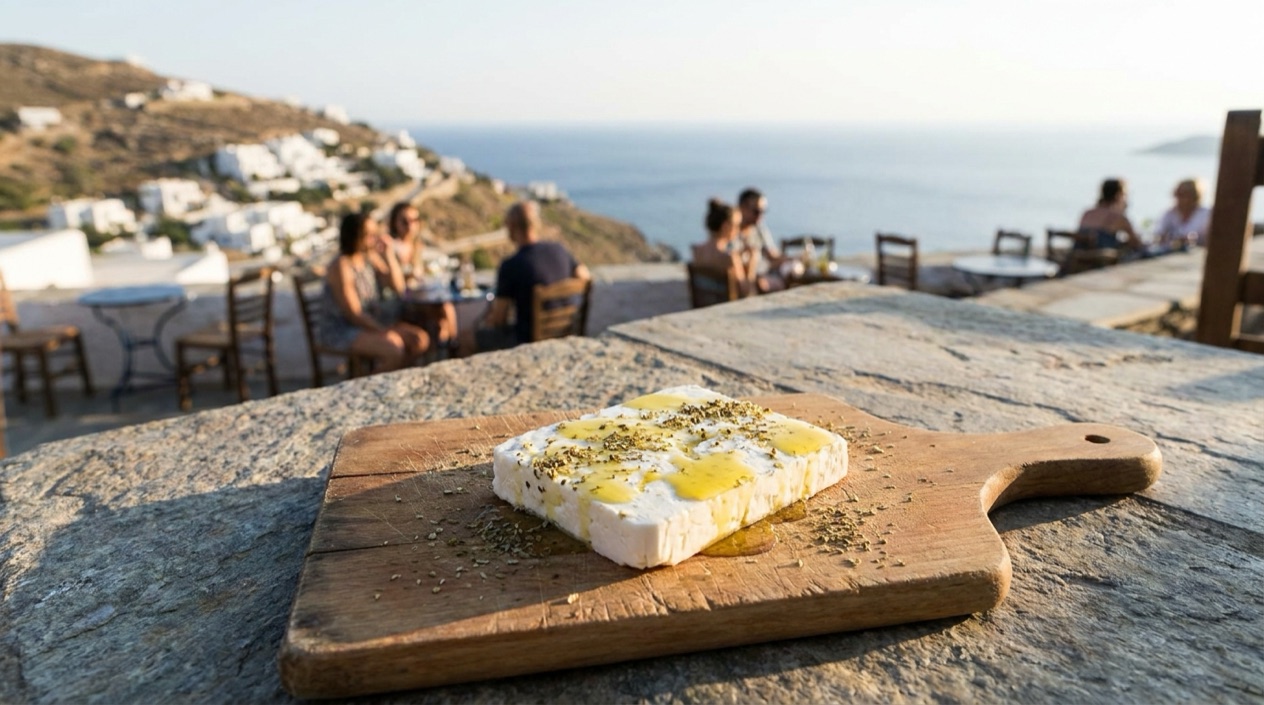
A slab of white cheese lands on the table at a taverna, glistening with olive oil and dusted with dried oregano, next to a bowl of tomatoes and a basket of bread. Someone breaks off a corner with a fork, someone else spears an olive, and the plate is half empty before the main dishes arrive. Across Greece, from Athens to Thessaloniki to the islands, cheese is part of nearly every meal, and feta is only the beginning.
What is feta?
Feta is a white brined cheese from Greece, made from sheep’s milk or from a mixture of sheep and goat’s milk. It is sold in blocks that sit in salty liquid, and it comes out of the brine firm enough to slice but soft enough to crumble under a fork. The taste runs from creamy and mildly tangy to sharp and peppery, depending on how it was made, and it is always salty.
That saltiness explains how Greeks eat it. Feta is rarely a snack on its own in large portions. It seasons other food: a block on top of a salad, a crumble over beans, a slice beside a ripe tomato. The cheese is very high in salt, so a small piece goes a long way, and a glass of wine or a splash of ouzo seems to make more sense with it than water does.
What the PDO label protects
Within the European Union, the name feta is protected by a Protected Designation of Origin. In practice that means a cheese sold under the name must follow a precise recipe, starting with the milk. It comes from sheep, or from sheep with a small share of goat, and the milk has to come from the same area where the cheese is made.
The rules also set limits on how wet and how rich the cheese may be. For the shopper, this is why a block labeled feta in a Greek market feels dense and slightly dry compared with soft white cheeses of other kinds.
| Feature | EU PDO requirement for feta |
|---|---|
| Milk | Sheep milk, or sheep milk with up to 30% goat milk from the same area |
| Moisture | Maximum 56% |
| Fat in dry matter | Minimum 43% |
Kefalonia and the feta that was left out
The island of Kefalonia has long made feta, yet it was left out of the area the PDO covers. A cheese from the island may taste just like the blocks sold on the mainland, but the label does not extend to it. When you eat on Kefalonia, you are eating a local cheese with a story attached that the official paperwork does not tell.
It is a good reminder that cheese in Greece is local before it is national. A village, a flock and a mountain pasture shape what ends up in the brine barrel, and the label is only one way of describing what you taste.
Feta by another name, and the free crumbs
In Thessaloniki, the same cheese is simply called tyrí, which is the general word for cheese in the south of Greece. Ask for tyrí and you get the white block, not a menu of options. It is a small sign that the word feta belongs as much to the export market and the label as to everyday speech in some cities.
At a cheese counter, a curious thing happens as the block is cut: the knife leaves crumbs. This crumble is called trímma, and because it cannot be sold as a neat slice, it is usually given away for free if you ask.
It is excellent stirred into scrambled eggs or scattered over a salad. And if you carry feta home and keep it longer than a week, it is best left in brine or lightly salted milk, because out of the liquid it dries relatively quickly, even in the refrigerator.
Which other Greek cheeses are there?
Greece makes far more than feta, with hard cheeses for grating and frying, fresh cheeses made from whey, and pungent local wheels that rarely travel beyond their island or village. Sheep and goat milk dominate, and a good deli or market stall will let you taste before you buy, one thin slice after another.
Names and styles shift from one region to the next, so a cheese you try on one island may have a cousin with a different name a short ferry away. That is part of the pleasure of eating your way around the country: the cheese board changes with the map.
Hard cheeses: graviera, kefalotyri and kasseri
Graviera is a firm, nutty cheese, often with a faint sweetness, that is as good at the end of a meal with fruit as it is shaved over pasta. Kefalotyri is saltier and sharper, a hard cheese that holds up to a hot pan, which is why it appears in fried cheese dishes and baked casseroles.
Kasseri sits somewhere between the two. It is pale yellow, springy, mild and a little buttery, and it melts well. You meet it sliced in sandwiches, folded into pies and tucked into toasted bread at a bakery counter. Of the three, kasseri is the one most likely to be put on the table in thick slices rather than crumbled.
Fresh and whey cheeses: manouri, mizithra and anthotyro
Fresh cheeses are the soft side of the Greek dairy world. Manouri is creamy and mild, with a richness that suits both savory and sweet plates, and you often find it cut into wedges and served with honey or fruit preserves. Mizithra and anthotyro are made from whey, light and crumbly when fresh, and firmer and saltier when aged and dried for grating.
These cheeses are the ones to look for if feta feels too salty. They add a milky freshness to pies, to pasta and to the barley rusks that are served with tomato and cheese on some islands. At a bakery or a village shop, a fresh round of mizithra or anthotyro is a good thing to ask about.
Local wheels and regional surprises
Beyond the names that appear in every supermarket, many islands and mountain villages keep their own cheeses: peppery goat cheeses, wheels ripened in cellars, soft spreads that are mixed with herbs, cheese kept in wine or in oil. Some are strong enough to surprise anyone expecting the gentle taste of feta.
A plate of three or four small slices, served with bread and honey or fig preserves, is a quiet education in what the flocks of one place eat and produce.
Cousins around the region
Greece does not hold white brined cheese to itself. Similar cheeses are made traditionally in the Balkans, in Cyprus, around the Black Sea and in West Asia. If you travel on beyond Greece, you may meet a crumbly white cheese on the table that looks like feta and tastes a little different, with its own local salting and milk.
Back in Greece, that family resemblance is exactly why the PDO exists. It marks the Greek version, made from its own flocks and its own pastures, as something specific that can be named and protected.
How are they served?
Greek cheese is served in thick slabs on salads, fried until golden as saganaki, baked in parcels, folded into pies and drizzled with honey for dessert. Most meals begin with something cheesy within reach, and even a plain plate of bread, olives and a slice of white cheese counts as a respectable start.
It is customary to be brought water and bread soon after sitting down, and a small sweet treat often arrives free when you ask for the bill. Greeks tend to dine around 14:00 to 15:00 for lunch and 21:00 to 23:00 for dinner, though restaurants aimed at visitors may open earlier, so cheese appears as a first plate at a long, slow table.
On the salad: the horiatiki
The Greek salad, horiatiki, is the clearest picture of how feta is eaten. Tomatoes, cucumber, onion, peppers and olives are cut in big pieces, and a whole slab of feta is set on top, sprinkled with oregano. It is traditionally dressed only with olive oil. Vinaigrette or lettuce show up only in the most tourist-oriented restaurants.
You are meant to break the cheese up yourself and mix it into the juices at the bottom of the bowl, where tomato, oil and brine blend into something to mop up with bread. Many diners save that last bite for the end of the plate.
Fried and baked: saganaki and cheese in the oven
Saganaki is cheese fried until the outside turns golden and crisp and the inside softens. It is usually made with a firm cheese that holds its shape in the pan, often with a squeeze of lemon on top, and arrives hot enough that people wait a moment before cutting in. Some versions are cooked with shrimp or with tomato sauce.
Feta itself is often baked, wrapped in paper or foil with tomato, peppers, olive oil and herbs, so that it turns soft and spoonable. Scooped onto bread, it makes a warm meze for sharing. A glass of ouzo or a cold beer sits well beside it, as the strong aniseed taste cuts through the richness.
In pies and pastries
Tyropita is a cheese pie of thin, flaky pastry filled with a soft white cheese, and spanakopita adds spinach to the mix. Bakeries sell them as triangles or in large trays cut into squares, and they are eaten warm, in the hand, at any hour of the day, often with a coffee.
Greek pastry cooking turns up in sweet form as well. Baklava, made of tissue-thin layers of pastry with honey, cinnamon and chopped walnuts, shows the same skill with layers of dough that makes a good cheese pie. If you eat one of each in the same day, you will see how the techniques are shared.
Cheese with something sweet
Greeks happily put cheese and honey on the same plate. Fresh cheeses such as manouri or mizithra, or even a slice of feta, are served with honey and sesame, with fig or quince preserves, or beside fresh fruit. Genuine Greek yogurt, which has 10% fat and is far richer than typical store-bought brands, often shares a table with honey and walnuts.
At a restaurant, a few signs suggest a kitchen that cares about its food. Bad signs include desserts listed on the menu, large food posters outside, waiters calling in customers from the street, or plates taken away while diners are still sitting. A smaller place that brings a plate of cheese and fruit unprompted at the end of the meal is usually doing it right.
If you do not eat dairy or meat
Cheese runs through so many Greek dishes that vegetarians eat well, but vegans have a harder time. Restaurants catering strictly to vegans and vegetarians are practically non-existent outside of Athens and Thessaloniki. In smaller towns and on the islands, expect to build a meal from vegetable dishes, beans and salads, and to ask what goes into each plate.
Good to know before you go
Greek restaurants commonly charge a cover fee for bread and the table setting, and the amount appears on the bill rather than on the menu. When the fee tends toward the top of the range, consider eating elsewhere.
Fresh fish is sold by the kilogram and can be very expensive, so ask the cost of your portion before ordering, and frozen seafood must be marked as such on the menu. A cheese plate or a salad with feta is an easy way to keep a meal light on the budget.
| Fee | Amount | Who pays |
|---|---|---|
| Restaurant cover fee | €0.30 to €2 per person | Each diner |
Sources
- Wikipedia, Feta (https://en.wikipedia.org/wiki/Feta), checked October 12, 2026
- Wikipedia, Greek cuisine, section History (https://en.wikipedia.org/wiki/Greek_cuisine#History), checked October 12, 2026
- Wikivoyage, Greece, section Eat (https://en.wikivoyage.org/wiki/Greece#Eat), checked October 12, 2026
To plan your stay
- Best Time to Visit Greece: September and Late May to Early June
- Arachova: Parnassus Mountain Town, Formaela Cheese, Ski Season and Saint George's Day
- American Airlines Flights to Greece: U.S. Cities, Athens Arrivals and Onward Island Flights
- Greece on a Budget: Cash Machines, Cards, Beaches and Ferries