
Somewhere between the marble of the Acropolis and a stone stairway cut into a Meteora cliff, travelers in Greece start to wonder which of these places carry the UNESCO label. The answer is a long and varied list, running from mountain temples and monastery rocks to island towns and early Christian ruins. Each site sets its own entry fee, so the label tells you about the place but not about the ticket.
Which UNESCO sites are in Greece?
Greece has 21 properties on the World Heritage List, made up of 18 cultural sites and three mixed ones, which count for both their culture and their landscape. The country ratified the World Heritage Convention on 17 July 1981, and the list has grown from a single temple in the mountains to a spread that takes in the mainland, the Peloponnese and the islands.
That spread is what makes the list useful for planning. A trip built around it can move from marble citadels to cliff-top monasteries, from a walled medieval town to a Venetian old town, and the sites sit in very different landscapes.
The first inscription: Bassae
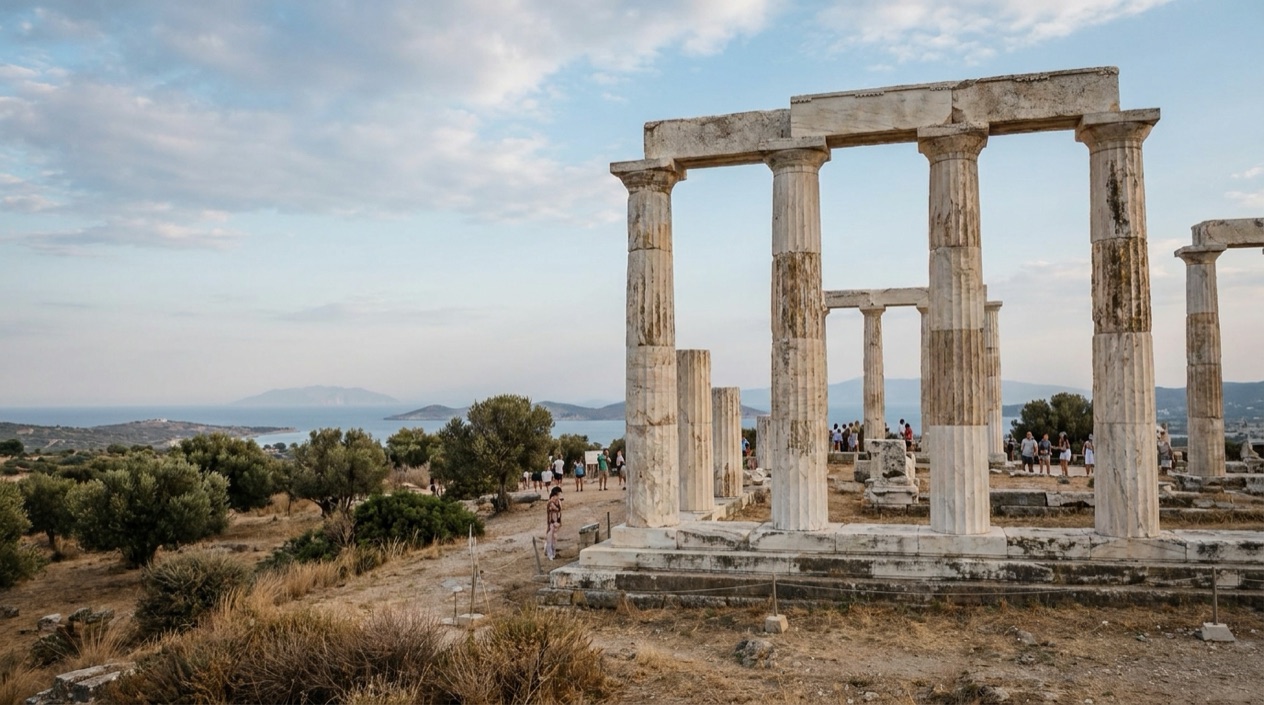
The Temple of Apollo Epicurius at Bassae was the first site in Greece to be inscribed, in 1986. It stands in the mountains of Arcadia in the Peloponnese, and it was built in the 5th century BCE.
A mountain temple is a different experience from the city monuments visitors know first. Here the setting does much of the work: high country, open sky and a sanctuary placed far from any harbor or town.
The three mixed properties
Three Greek properties are listed as mixed: Meteora, Mount Athos and Mount Olympus. Mixed means that nature and human heritage are recognized together, which suits places where a mountain and its meaning cannot be separated.
Meteora is the one travelers can picture at once, a rock formation in Thessaly crowned with Orthodox monasteries. Mount Athos is a monastic mountain, and Mount Olympus is the peak of Greek mythology, the home of the gods in the old stories. Each is its own kind of destination, and each asks for its own planning.
Cities, islands and early Christian sites
The rest of the list is largely cultural, and it reads like a short history of the country told in places. There is the Acropolis of Athens, the Medieval City of Rhodes, the Old Town of Corfu, the Monastery of Saint John the Theologian on Patmos and Philippi in Eastern Macedonia and Thrace.
Together they cover the classical age, the Crusader orders, Venetian rule, Orthodox pilgrimage and the first Christian communities. If you like to travel by theme, you can follow any one of those threads across the map without repeating yourself.
Which are best known?
Six properties give the clearest picture of the range: the Acropolis of Athens, Meteora, the Medieval City of Rhodes, the Monastery of Saint John on Patmos, the Old Town of Corfu and Philippi. Each tells a different chapter, and each is easy to place in a trip once you know what you are looking at.
The Acropolis of Athens
The Acropolis gathers the Parthenon, the Erechtheion, the Propylaia and the Temple of Athena Nike, all built in the 5th century BCE. Together they form a single hilltop sanctuary above the city, and you read them as a sequence: the gateway first, then the great temple, then the smaller shrines.
Athens spreads out below the rock, so the monument also works as a lookout over rooftops, streets and the surrounding hills. It is a site that rewards a little reading beforehand, because each building has its own role and its own story from the old city.
Meteora
Meteora in Thessaly is a rock formation that hosts 24 Orthodox monasteries, many of them built on almost inaccessible peaks in the 15th century. Seen from the valley, the stone pillars rise like towers and the monasteries sit on their tops, which is the picture travelers carry in their heads before they arrive.
Opening days and hours differ from one monastery to the next, so treat each one as its own visit rather than one big site.
Rhodes, Patmos and Corfu
The Medieval City of Rhodes is surrounded by a wall of 2.5 miles, built by the Knights Hospitaller, who held the island from 1309 to 1523. You walk through gates into a town shaped by the order, with streets that still follow the medieval layout.
On Patmos, the Monastery of Saint John the Theologian was founded in the late 10th century and has been a place of pilgrimage ever since. The Old Town of Corfu has roots going back to the 8th century BCE, though its buildings are mostly from the Venetian period and the 19th century, which is why its arcades and squares feel so different from the island towns of the Aegean.
Philippi
Philippi was founded in 356 BCE by Philip II of Macedon and later became an early center of Christianity. It is the site on the list that links the Macedonian world with the first Christian communities in Europe.
Located in Eastern Macedonia and Thrace, it sits well away from the island routes that shape most itineraries. That makes it a natural addition for travelers exploring northern Greece rather than the Aegean.
How do you plan visits?
Plan around the entry fee of each site, because every site charges its own ticket and there are no longer any combo tickets. The amount depends on how visitors a site receives, so a site with far fewer visitors costs less than one of the big names.
What the entry fee depends on
Archaeological sites and museums are priced in tiers by their annual visitor numbers. The busiest places sit in the top tier, and smaller sites drop down through the middle tiers to the base fee.
| Annual visitors | Entry fee |
|---|---|
| Over 200,000 | €20 |
| Over 75,000 | €15 |
| Over 15,000 | €10 |
| Other sites and museums | €5 |
Discounts and separate tickets
Entrance fees are halved for EU citizens over 65 and for teachers accompanying students. Because there are no combo tickets, the cost of a trip with several sites is simply the sum of each one, which is worth keeping in mind when you count how many stops to include.
Putting sites together by theme
A good way to plan is by theme rather than by map. Orthodox heritage links Meteora and the monastery on Patmos. The Knights Hospitaller and the Venetians link Rhodes and Corfu. Ancient sanctuaries link the Acropolis and Bassae, while Philippi pairs the Macedonian and early Christian stories.
Island stops can add other sights that are not part of the World Heritage count. On Samos, the Tunnel of Eupalinos is a subterranean aqueduct built in the 6th century BC. On Zakynthos, the National Marine Park is the primary nesting ground for loggerhead sea turtles in the Mediterranean, and Santorini’s capital, Fira, stands on the edge of a high cliff above the sea.
Good to know before you go
Fees at Greek sites are paid in euros, and each place sets its own, so it helps to count the sites you want before you count the days.
Mixed properties such as Mount Athos and Mount Olympus are mountain landscapes with their own character, and they ask for a different kind of planning than a city monument. The Acropolis and Rhodes are places you walk through on foot, while Patmos and Meteora are visits to working religious communities, and each deserves its own place on the calendar.
Sources
- Wikipedia, List of World Heritage Sites in Greece (https://en.wikipedia.org/wiki/List_of_World_Heritage_Sites_in_Greece), checked October 12, 2026
- Wikivoyage, Greece, section See (https://en.wikivoyage.org/wiki/Greece#See), checked October 12, 2026
To plan your stay
- Best Time to Visit Greece: September and Late May to Early June
- Arachova: Parnassus Mountain Town, Formaela Cheese, Ski Season and Saint George's Day
- American Airlines Flights to Greece: U.S. Cities, Athens Arrivals and Onward Island Flights
- Greece on a Budget: Cash Machines, Cards, Beaches and Ferries