
On the quay at Piraeus, with the ferries lined up and the boarding signs in Greek letters, a phone becomes the most useful thing in your pocket. It tells you which gangway is yours, where the bus stop is on the other side of the island and what the menu at lunch actually says. A few apps cover nearly all of it: a maps app with offline maps, the ferry companies’ own booking tools, a translator and the transit routes of Athens and Thessaloniki.
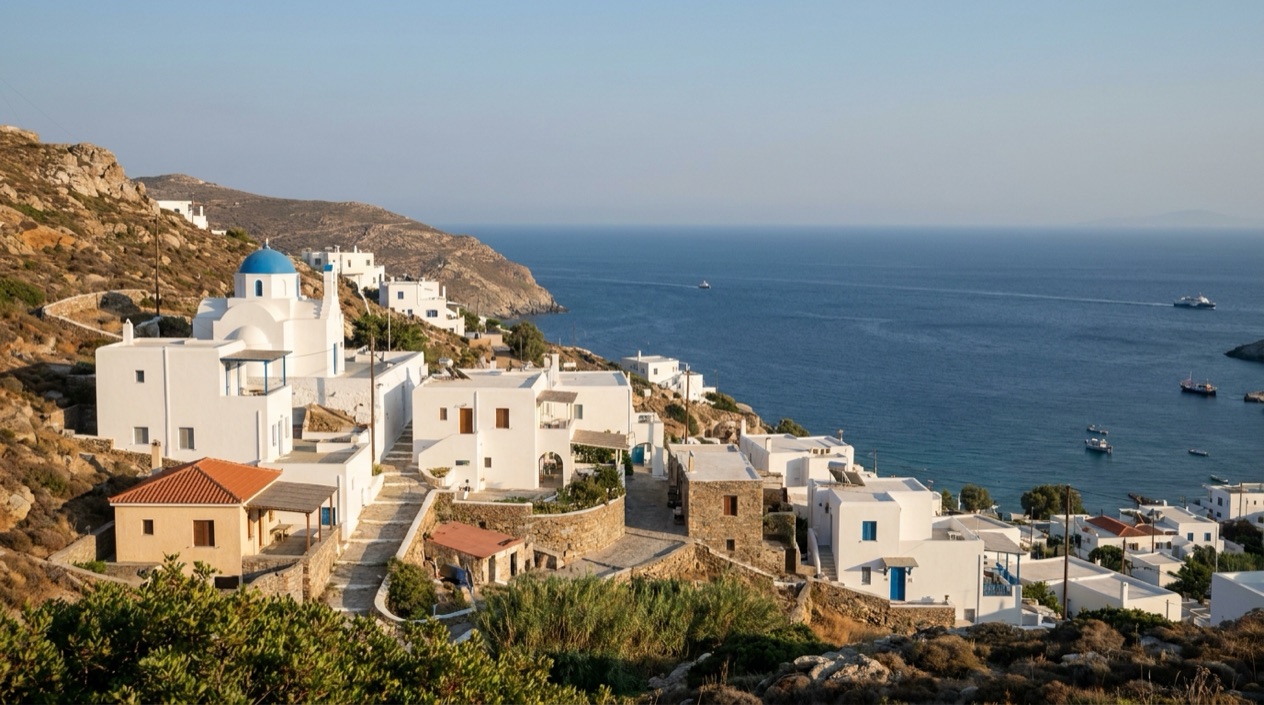
Which apps help you get around Greece?
A small kit does the job: a maps app that works offline, a translation app with a camera mode, the booking tool of whichever ferry company you sail with, and a data connection that does not cost a fortune. Greece is a country of islands and mountain roads, and the phone has to cope with all of it. The sections below sort the kit by the kind of day you are having.
What changes from place to place is the transport underneath the apps. Athens and Thessaloniki have metros and commuter trains, the rest of the mainland leans on buses, and the islands depend on boats. An app is only as useful as the network it points to, so it helps to know what that network looks like.
Getting a data connection first
Everything starts with a signal. EU citizens have no Internet roaming charges in Greece, so they can use their home SIM card as normal. Non-EU travelers have two options: buy a Greek SIM card or use a virtual SIM card loaded with prepaid data credit. The virtual option can be set up on the phone before leaving home, which means the maps and the ferry tickets work from the moment the plane lands.
Buying a physical SIM involves one step that surprises people. The three mobile carriers, Cosmote, Wind and Vodafone, are required by law to see identification before they activate a prepaid plan. Greek carriers support the GSM 900, GSM 1800 and UMTS 2100 bands, which is worth a glance at your phone’s specifications if it is an unusual model.
Hotel Wi-Fi is a useful backup but not a certainty. Some older hotels in Greece still do not use WPA2/WPA3 mixed mode security, so a modern phone may refuse to join their network. If the screen says it cannot connect, the cause is often the hotel’s setup and not your phone, and mobile data is the fallback.
Athens: metro, tram and Proastiakos
In Athens, a maps app with transit directions is the natural tool, because the city layers several systems on top of each other. Metro Line 1 is the oldest, opened in 1869 as a steam railway and electrified in 1904. It is the oldest metro line in the Athens urban area, and riding it today is a quiet reminder of how long this city has been moving people around.
The Athens Tram arrived in 2004 for the Summer Olympics and now runs two routes. Line 6 goes between Syntagma and Pikrodafni, and Line 7 between Akti Poseidonos and Asklepieio Voulas. The Proastiakos, the suburban rail, uses Athens central station as its main layover for lines to the airport, Kiato and Chalcis. The line between Athens central station and Chalcis has been electrified, allowing electric train service.
There is one more way up and down in Athens that no routing app needs to explain: the Lycabettus Funicular, one of the cable transport lines Greece lists alongside the Parnitha Funitel and the cable car on Santorini.
Thessaloniki: the driverless metro
Thessaloniki’s metro is fully automated and driverless, the first system of its kind in Greece. It is operated by Thessaloniki Metro Automatic, known as THEMA, a Franco-Italian consortium. The network has two lines and 18 stations in total, and the stretch between New Railway Station and 25 Martiou is shared by both lines, so a route that crosses it can show either line in your app.
Outside the metro, two Proastiakos commuter services leave the city. One connects the Main Railway Station with Katerini and Larissa, and the other links the city with Edessa. These are the lines to look up when a day trip beyond the city limits is on your mind.
Buses and trains beyond the big cities
Away from the two big cities, the bus does most of the work. KTEL is the national, government-subsidized network of independent businesses, and together they form a dense route system serving almost the entire country. Routes from major cities to islands close to the mainland, such as Corfu and Cephalonia, include the ferry crossing in the price of the bus ticket, so one purchase covers both legs.
Trains are a thinner proposition. Most rail traffic runs along the Athens to Thessaloniki corridor and the suburban railways around the two cities. Other lines, such as Thessaloniki to Florina, Lamia to Trikala and Thessaloniki to Serres, usually have only one or two trains per day, so a timetable check matters far more than on a metro.
If a rental car is part of the plan, there are two practical points to settle on the phone before the trip. Drivers who do not hold an EU driving licence must carry an international driver’s permit from their home country. About 90% of rental cars in Greece are manual, so an automatic is best reserved in advance.
Which one books ferries?
No single app covers Greece’s ferries as one system, and what you book depends on the company that runs your route, which in turn depends on where you are heading. The map of the ferries explains why. The Greek ferry system is basically a hub-and-spoke network, with the spokes radiating from Piraeus out to the various island groups.
Knowing which spoke your island sits on tells you which company to look for.
| Operator | Routes |
|---|---|
| Blue Star Ferries | Greek mainland and the Aegean Islands |
| ANEK Lines | Piraeus to Crete and the Adriatic Sea |
| Superfast Ferries | Adriatic Sea between Italy and Greece: Ancona and Bari in Italy, Igoumenitsa and Patras in Greece, and Bari to Corfu |
Which port in Athens, and which island group
Maps, so the departure port is worth checking before you pay for anything. A ticket that starts in the wrong port is a problem no app can fix on the quay.
The Cyclades split into groups that sit on different spokes. The Western Cyclades are Serifos, Sifnos and Milos, and the Central Cyclades are Naxos, Paros and Mykonos. In summer you can usually get from one island to another in the same group on any day, but boats between the groups, for example Naxos to Sifnos, may be significantly less frequent. A plan that hops between groups is the one to price out route by route.
Santorini, Crete and the Adriatic
Santorini is an 8-hour slow boat from Athens, and the entrance view from the boat is spectacular. That one fact shapes the booking: you are choosing a long day on deck, with the caldera appearing as you arrive, and the ticket should match that choice. Once on the island, the cable car on Santorini, also known as Thira, is one of the ways between levels.
For Crete, ANEK Lines runs passenger ferries on the Piraeus to Crete route, among others. For arrivals from Italy, Superfast Ferries connects Ancona and Bari with Igoumenitsa and Patras, and adds a link between Bari and Corfu.
When the calendar and the weather matter
Ferries in August fill up because of the National Holiday on August 15, so travelers should plan ahead if the trip falls around that date. In the other direction, the winter off-season from January to March can bring extremely rough weather on the Aegean, and boats are often kept in port for days at a time. An app notification about a cancelled sailing in those months is normal, and a spare day in the plan absorbs it.
One more thing to settle before paying: rental car terms in Greece often restrict taking the vehicle on ferries. If the plan includes a car and an island, read that clause first.
What about maps and translation?
A maps app with downloaded offline areas and a translation app that reads signs through the camera cover most of what comes up, and both are most useful when they work without a signal. Island roads, mountain villages and the lower decks of a ferry are exactly where the signal drops.
Maps that work on the road and on the ferry
Download the areas you will visit while you are on reliable Wi-Fi at the hotel, and the map keeps showing your position when the data connection fades. That matters on the mainland, where the KTEL network serves almost the entire country, and on the islands, where a bus stop may sit in a village with no sign in English. A saved pin for your hotel and one for the port are a sensible pair.
A maps app is also the place to compare ports. With Piraeus, Rafina and Lavrio all serving Athens, seeing where each one sits relative to your hotel helps when you decide where the ferry day starts. The same goes for the airports: the Greek subsidiary of Fraport manages 14 airports, including Thessaloniki, Rhodes and Santorini, and each one is a pin you may want saved.
Translation: signs, menus and timetables
Greek letters look unfamiliar at first, and a camera translator turns a taverna menu, a ferry notice or a bus timetable into English in a moment. Point it at a handwritten board of the day’s dishes and it will usually give you the gist, enough to tell a moussaka from a plate of grilled fish. Treat the result as a hint for names of dishes, because it may stumble over local spellings.
Downloading the Greek language pack ahead of time lets the app work without data. It is also worth switching on the voice mode for a conversation at a kiosk or a ticket counter, where you can hold up the phone and let both sides read the same screen.
Staying informed in English
Greek news in English is available from Greek outlets such as the Athenian-Macedonian news agency, ΕΡΤ Greek Edition, and Kathimerini English Edition. A sailing that is kept in port, a transport disruption or a change in the weather is the kind of news that shows up there before you reach the quay.
For calls home, a messaging app on mobile data does the work for travelers. Prepaid calling cards can be used at public phone boxes, though coverage varies.
Good to know before you go
Money in Greece is the euro, and the phone is a good companion, but it is worth having a backup for the day the battery or the signal gives out. A prepaid calling card costs about €1 for 45 minutes of international calling from a landline, and it usually expires 90 days after first use. Keep a screenshot of ferry tickets and hotel addresses, since a boarding pass is easier to find when it is saved on the phone and not buried in an email.
Sources
- Wikipedia, Transport in Greece (https://en.wikipedia.org/wiki/Transport_in_Greece), checked October 12, 2026
- Wikivoyage, Greece, section Connect (https://en.wikivoyage.org/wiki/Greece#Connect), checked October 12, 2026
- Wikivoyage, Greece, section Get around (https://en.wikivoyage.org/wiki/Greece#Get_around), checked October 12, 2026
To plan your stay
- Best Time to Visit Greece: September and Late May to Early June
- Arachova: Parnassus Mountain Town, Formaela Cheese, Ski Season and Saint George's Day
- American Airlines Flights to Greece: U.S. Cities, Athens Arrivals and Onward Island Flights
- Greece on a Budget: Cash Machines, Cards, Beaches and Ferries