
A taxi in Greece fills the gaps between metro, bus, ferry and train. Somewhere in that moment every visitor wonders how a taxi fits in. In Greece it is a car and a driver for the stretch the metro, the bus or the boat does not cover, and it sits alongside a wide web of other transport.
How do taxis work in Greece?
A taxi in Greece takes you from one door to another with a driver at the wheel, and it is one link in a country that also moves by metro, tram, suburban train, long-distance bus and boat.
Travelers stitch several of these together in one trip: a train into the city, a tram along the coast, a bus across the mainland, a boat out to an island. A taxi fills the gaps between them, at the airport, at a quay or at a bus station.
Athens: metro, tram and suburban trains
Athens has more rail options than visitors expect. Metro Line 1 began life as a single-track steam railway and was electrified in 1904, which makes it the oldest metro line in the Athens urban area. It still carries passengers today, so a ride on it is also a ride on a piece of the city’s history.
The Athens Tram opened for the Summer Olympics in 2004. It now has two routes: Line 6 runs between Syntagma and Pikrodafni, and Line 7 between Akti Poseidonos and Asklepieio Voulas. Syntagma is the square in front of Parliament, so the tram starts right in the middle of the sightseeing area.
The suburban railway, the Proastiakos, uses Athens central station as the main layover station for lines to Athens Airport, Kiato and Chalcis. Electric trains run on the stretch between the central station and Halkida. When you land with luggage and no fixed plan, it helps to know that a rail line and a taxi rank can both lead from the airport into town.
Thessaloniki: a driverless metro and two commuter services
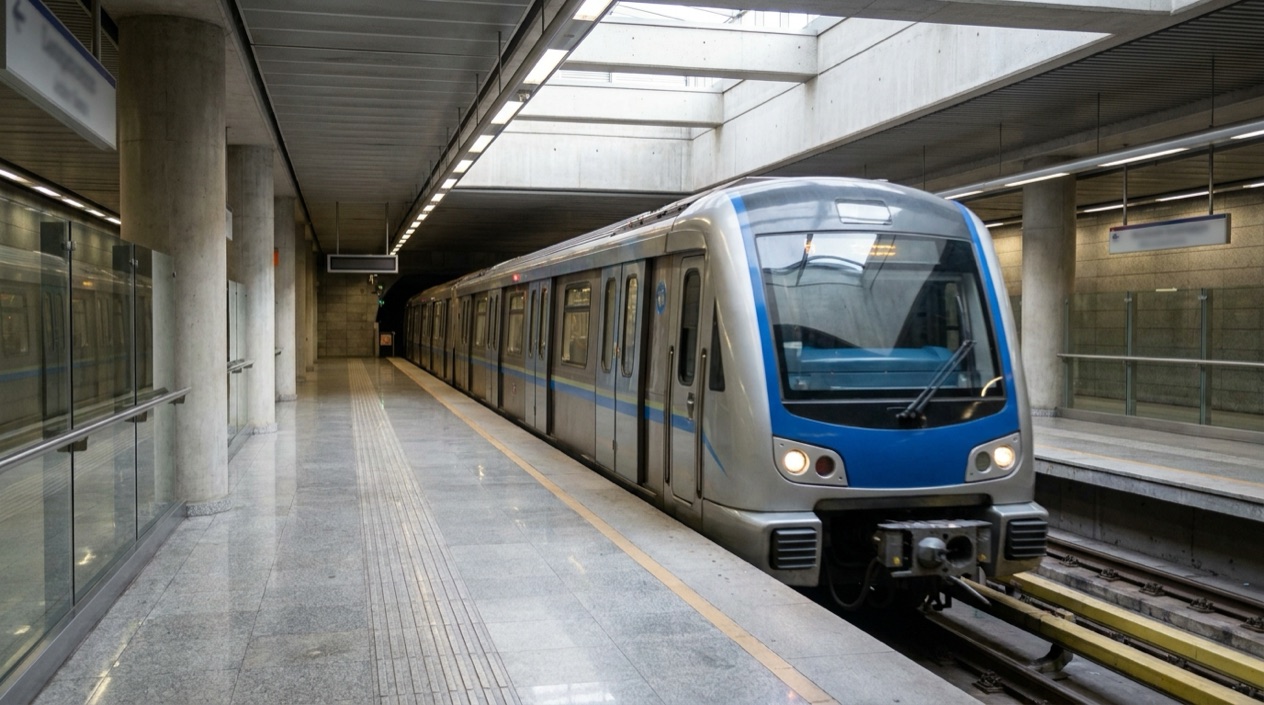
Thessaloniki has a metro with two lines and 18 stations in total. Line 1 has 13 stations and Line 2 has 16, and the stretch between New Railway Station and 25 Martiou is shared by both. The system is fully automated and driverless, the first of its kind in Greece, and it is run by a Franco-Italian consortium called THEMA.
Above ground, two Proastiakos commuter services leave the city. One connects the Main Railway Station with Katerini and Larissa, and the other links the city with Edessa. Beyond these routes, rail is thin: lines such as Thessaloniki to Florina, Lamia to Trikala and Thessaloniki to Serres usually have only one or two trains a day, so in much of the country the road takes over.
KTEL buses across the mainland
KTEL is the national government-subsidized network of independent bus businesses. Together they form a dense system of routes that serves almost the entire country, which is why the bus station is often the first place a traveler heads after a taxi ride from the center. In towns where trains do not run, KTEL is the thread that holds the map together.
For the islands nearest the mainland, the bus does more of the work than you might think. KTEL routes from major cities to Corfu and Cephalonia include the ferry crossing in the ticket, so one purchase carries you from the city to the island.
Ports, ferries and where the car ride ends
The Greek ferry system is basically a hub-and-spoke network, with the spokes radiating from Piraeus to the various island groups. Athens has three ports: the main port of Piraeus and the outlying ports of Rafina and Lavrio. For central Cyclades islands such as Tinos and Mykonos, it is often better to leave from Rafina.
Once you are among the islands, the groups matter. The Western Cyclades (Serifos, Sifnos, Milos) and the Central Cyclades (Naxos, Paros, Mykonos) sit on different spokes. In summer you can usually move between islands within the same group on any day, but boats between the groups, for example Naxos to Sifnos, may be significantly less frequent.
Companies add their own patterns. Blue Star Ferries links the Greek mainland with the Aegean islands, ANEK Lines sails mainly on the Piraeus to Crete and Adriatic routes, and Superfast Ferries works the Adriatic between Italy and Greece, with routes from Ancona and Bari to Igoumenitsa and Patras, plus Bari to Corfu. A slow boat from Piraeus to Santorini takes around eight hours, and the approach into the caldera is spectacular.
Do you tip?
Nothing in the transport rules for visitors sets a tip, so the choice stays with you and with how the ride went.
A driver who helps with heavy bags at a station, or who waits while you find your key at a hotel door, has done more than drive. A coin or two on top of the fare is a polite way to say so. If the ride was ordinary, rounding up is a perfectly good answer, and nobody expects a speech.
The same habit on other rides
The metro, the tram and the commuter trains have no one to tip, and the KTEL ticket already carries its own price. On a bus that includes a ferry crossing to Corfu or Cephalonia, the ticket covers both legs, so there is no second payment on the water to think about.
The only person who touches your luggage on most of these trips is you, until you reach the quay, the station or the curb where a taxi waits. That is where the small thank-you finds its natural place.
When a driver is more than a taxi
Some travelers hire a driver rather than a standard taxi, for a family transfer or a long mainland run. The same spirit applies: a tip is a thank-you, not a requirement. Greek hospitality is built on small, personal gestures, and a friendly word at the end of the ride is part of it.
If you rent a car instead, there is nobody to tip at all, but there are things to carry. U.S. visitors who drive must have a valid U.S. driver’s license, and insurance companies may require an international driver’s permit. Insurance companies usually want both documents, too.
How do you pay?
You pay a taxi driver at the end of the ride, once you have arrived, and the other ways of getting around in Greece each have their own moment of payment. A bus ticket is bought for the route, a ferry ticket for the crossing, and a rental car is paid for with the contract.
Keeping those moments apart makes planning smoother. A taxi ends the journey at a door. A KTEL ticket carries you along a line of independent operators, and a ferry ticket takes you out of a hub port to a particular island.
Paying for bus and ferry together
For Corfu and Cephalonia, the bus ticket is also the boat ticket. KTEL routes from major cities to these islands include the ferry crossing in the price of the bus ticket, so you pay once and the whole trip is covered.
For other islands, the boat is its own purchase, and the choice of port matters. A trip to Tinos or Mykonos may start from Rafina rather than Piraeus, and a taxi to the right port saves you from arriving at the wrong quay with a ticket in your hand.
Paying for a car and its paperwork
About 90 percent of rental cars in Greece are manual, so if you want an automatic it is advised to reserve it in advance. Rental terms in Greece often restrict taking the vehicle on ferries, which matters if your plan includes an island.
Drivers who do not hold an EU license must carry an international driver’s permit from their home country, and it is certainly required if you are involved in an accident or pulled over by police. The U.S. Embassy does not issue permits. Travelers get them in the United States from the American Automobile Association or the American Automobile Touring Alliance.
Small motorbike and ATV rental firms frequently carry no insurance and ask customers to cover the cost of all damages, and your own insurance may not cover two-wheel or ATV rentals. Greek law requires every motorcyclist to wear a helmet.
Good to know before you go
Greece has one of the highest traffic fatality rates in the European Union. On many two-lane highways slower traffic drives on the shoulder and cars pass straddling the center double-yellow line, so lane markings are a poor guide. Talking or texting on a phone while driving is illegal, and so is driving under the influence of alcohol or drugs, with random alcohol testing by police.
Ferries in August fill up around the National Holiday on August 15, and during the winter off-season from January to March the Aegean can be extremely rough, with boats often kept in port for days. Both are reasons to leave some slack around any boat connection.
Sources
- U.S. Department of State, Greece travel information, travel and transportation (https://travel.state.gov/content/travel/en/international-travel/International-Travel-Country-Information-Pages/Greece.html), checked October 12, 2026
- Wikipedia, Transport in Greece (https://en.wikipedia.org/wiki/Transport_in_Greece), checked October 12, 2026
- Wikivoyage, Greece, section Get around (https://en.wikivoyage.org/wiki/Greece#Get_around), checked October 12, 2026
To plan your stay
- Best Time to Visit Greece: September and Late May to Early June
- Arachova: Parnassus Mountain Town, Formaela Cheese, Ski Season and Saint George's Day
- American Airlines Flights to Greece: U.S. Cities, Athens Arrivals and Onward Island Flights
- Greece on a Budget: Cash Machines, Cards, Beaches and Ferries