
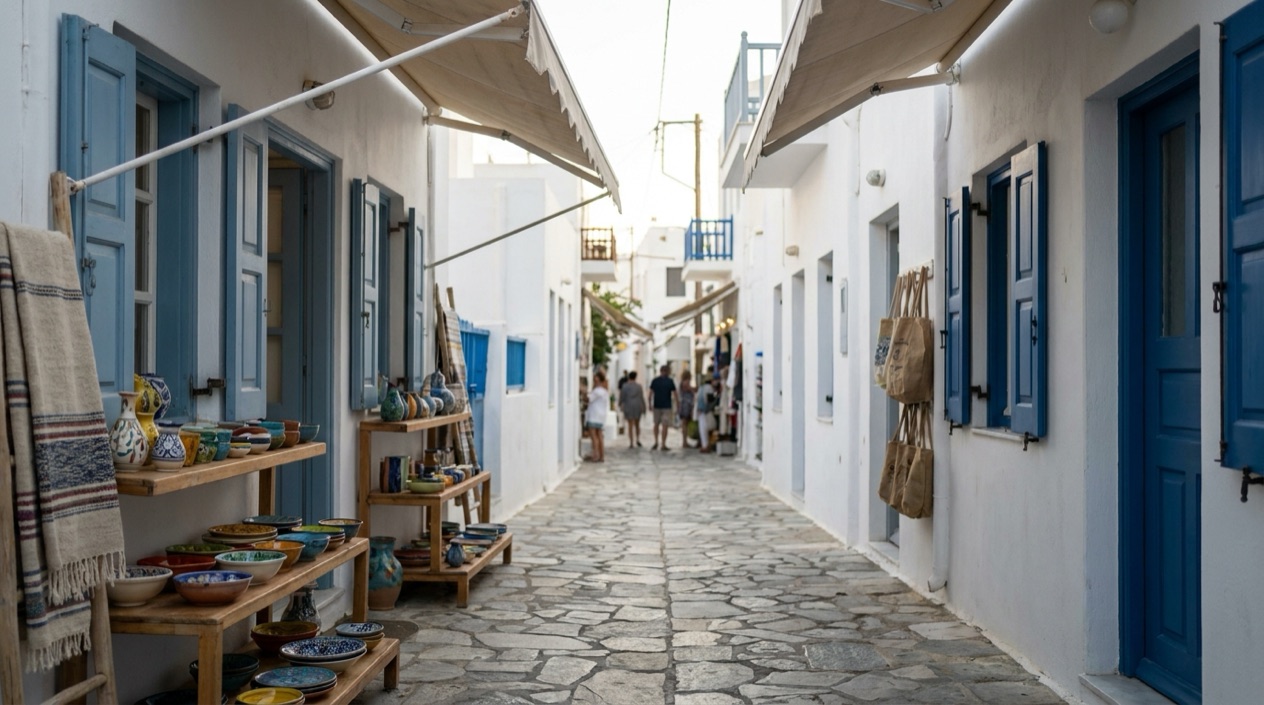
At a workshop counter on a sunlit island lane, a shopkeeper wraps a bar of olive oil soap in tissue while you wonder whether the tax on the price tag can come back to you. The question follows travelers from the sponge sellers of the harbor to the jewelry shops of the old towns.
How does tax-free shopping work in Greece?
Greece applies several rates, and the one that touches your purchase depends on what you buy and where you buy it. Knowing the rates helps you read prices with a clear head, whether you are in an Athens boutique or a village shop.
The rates are lower on the Aegean islands than on the mainland.
The rates, mainland and Aegean islands
The standard rate covers most goods, the kind of things you pick up in a clothing shop or a gift store. A middle rate and a lower rate apply to other categories, and the Aegean islands carry a reduced version of each. The table sets the three levels side by side.
| Rate level | Rest of Greece | Aegean islands |
|---|---|---|
| Standard | 24% | 16% |
| Reduced | 13% | 8% |
| Lowest (certain goods) | 6.5% | 4% |
The lowest level is the one applied to hotels, books and pharmaceutical products. In practice, a paperback bought in a bookshop and a room booked for the night sit in the lowest group, while a pair of sandals sits in the standard group.
What the island rates mean for your basket
If your trip mixes Athens with a few Aegean islands, the same souvenir can be taxed at a different rate depending on where the shop stands. That does not mean the island price is always lower, since shopkeepers set their own prices, but the tax portion inside it is smaller. The difference is felt most on larger purchases such as leather goods or jewelry.
Think of the tax as one more piece of the price rather than a separate charge. When you compare a woven bag in a mainland shop with a similar one on an island, you are comparing two prices that already include different shares of tax. Sellers in the markets of Chora towns and in the lanes of Plaka present one total, and that total is what you negotiate.
Bargaining and the final price
In Greece you can bargain on many things, especially clothing and souvenirs. Bargaining is a habit of markets and small shops, not of supermarkets or pharmacies, where the printed price stands.
Keep the exchange light and good-humored. A shopkeeper who offers you a coffee or a small gift with your purchase is following a long habit of hospitality, and a smile counts for more than a hard stare. When the total is agreed, it is the total with the tax inside it.
What do you need to show?
At the register, what you show is your way of paying: a card or cash in a form the shop will take. Cards are the simplest, because MasterCard, Visa, Maestro and Eurocard are widely accepted in retail stores, hotels and travel and transportation agencies. Some restaurants do not take them, so a few euros in your pocket for a taverna bill is a sensible habit.
Paying by card in shops
Local souvenir shops usually ask for a minimum purchase before they let you use a card. They may also refuse it on special sales or deeply discounted items, so the marked-down shirt in the basket by the door is often a cash purchase. A small shop with a handful of postcards and magnets is the place where this comes up most.
In larger retail stores the card moves through without fuss, and hotels and agencies take it too. If you plan to buy something sizable, such as a leather jacket or a piece of jewelry, using a card from a larger shop keeps the payment simple and leaves a record of what you paid.
Cash, notes and coins
Greece uses the euro, divided into one hundred cents, which Greeks call lepta (a single one is a lepto). Many businesses are reluctant to accept notes larger than €50, partly because change is scarce and partly because large notes have a history of being counterfeited. At a small kiosk or a bakery, a large note can slow things down, so smaller notes are the ones to carry.
The newsstands called períptero are good places to break a note. They sell newspapers, magazines, chilled drinks, confectionery, snacks, tobacco and ice cream, and they stand on many city corners. A cold drink or a bar of chocolate there gives you coins for the next market stall.
Getting cash from ATMs
ATMs in Greece usually charge €2.50–3 in addition to what your bank demands. That amount is added to the withdrawn sum and invoiced to your bank, so fewer, larger withdrawals cost less in fees than many small ones. Many machines may not accept five-digit PINs.
Cardholders with a long PIN are advised to change it to four digits before leaving home. Alphabank branches will exchange American Express Travellers Cheques into euros at their usual bank rates without fee or commission.
What can you buy tax free?
The things most worth carrying home are the goods Greece is known for: olive oil, soap, honey, herbs, sponges, ceramics, leather sandals, jewelry and woven textiles. Each one comes with its own rate inside the price, and the lower rates on Aegean islands apply to the goods they cover. Rather than a list of exemptions, think of a shopping route that follows the places where these things are made and sold.
Food and drink to pack
Jars of thyme honey, bags of dried oregano and sage, tins of olive oil and boxes of loukoumi (soft, powdered sweets) fill the shelves of food shops in every town. Spirits such as ouzo and tsipouro, and the sweet liqueurs made on certain islands, are common gifts. Mastiha products from Chios and pistachio sweets from Aegina are among the specialties that travelers seek out.
Shops that sell these goods often let you taste before you choose, and a few minutes at the counter gives you a sense of the difference between a mild olive oil and a peppery one. Wrap bottles well in your clothes, and choose tins or sealed jars for the suitcase.
Crafts, clothing and jewelry
Leather sandals, ceramics painted in blue and white, worry beads (komboloi), embroidered linens and silver jewelry are the classic crafts. Clothing and souvenirs are where bargaining is most often part of the exchange. A workshop where the maker is at the bench gives you a chance to see how a piece is made and to ask about it.
In the old quarters of Athens and in island Chora towns, small shops sit side by side, so comparing a few before buying is natural. Prices vary from one counter to the next, and the pace of the street invites you to walk away, come back and decide.
When the shops are open
Outside tourist resorts, shops follow a rhythm built around a long midday break. Large supermarkets are the exception. The table gives the pattern.
| Shops | Open |
|---|---|
| Outside tourist resorts (not large supermarkets) | Closed about 14:00 to 17:00, then open again until 20:00 and sometimes longer |
A morning in the shops and a late afternoon after the break is the natural way to shop in a town. In resorts the hours are different, and shops stay open through the day. The midday hours are well spent over a plate of meze in a taverna.
Good to know before you go
The U.S. State Department rates Greece Level 1: Exercise Normal Precautions.
Carry some euros in small notes and a card for the larger shops. Seashores in Greece are usually free, but some beaches around Athens charge an entrance fee.
| Fee | Amount | Who pays |
|---|---|---|
| ATM withdrawal (in addition to your bank’s charge) | €2.50–3 | Cardholder |
| Seashore entrance around Athens | €4-5 | Each person |
Sources
- Wikipedia, Value-added tax (https://en.wikipedia.org/wiki/Value-added_tax), checked October 12, 2026
- Wikivoyage, Greece, section Buy (https://en.wikivoyage.org/wiki/Greece#Buy), checked October 12, 2026
- U.S. Department of State, Greece travel advisory (https://travel.state.gov/content/travel/en/traveladvisories/traveladvisories/greece-travel-advisory.html)
To plan your stay
- Best Time to Visit Greece: September and Late May to Early June
- Arachova: Parnassus Mountain Town, Formaela Cheese, Ski Season and Saint George's Day
- American Airlines Flights to Greece: U.S. Cities, Athens Arrivals and Onward Island Flights
- Greece on a Budget: Cash Machines, Cards, Beaches and Ferries