
A shopkeeper in a narrow lane unscrews a jar of thyme honey and holds it out on a wooden spoon, while worry beads click on their hooks and bundles of dried oregano scent the doorway. Sponges hang in nets, olive oil glows in tins on the shelves, and leather sandals line the wall. Greece rewards a slow browse, from the old markets of Athens to the lanes of an island town, and what you carry home tends to be edible, wearable or simple enough to fit in a suitcase.
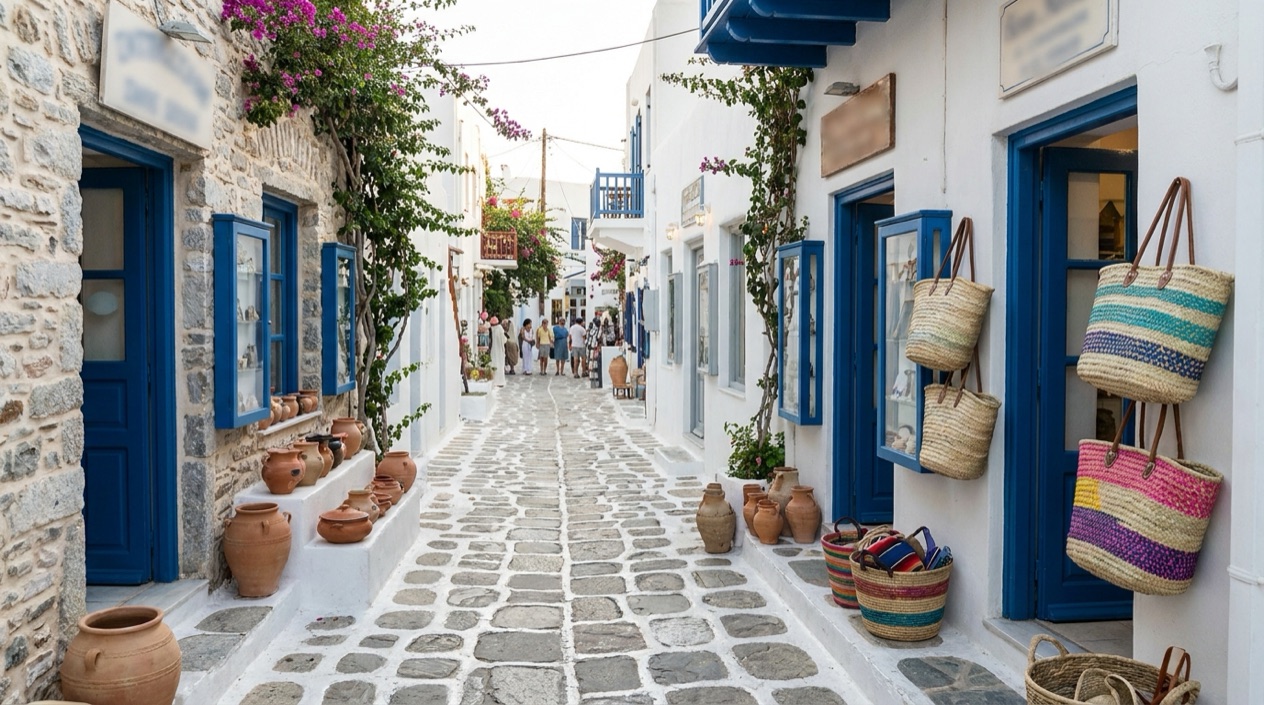
What can you buy in Greece?
You can buy food and drink, small crafts, sandals and leather, and the everyday things a Greek street sells at a kiosk. The best purchases are the ones that taste or feel like the place, so think of the pantry first and the souvenir stand second.
Prices in many shops are not carved in stone. One can bargain on many things in Greece, especially clothing and souvenirs, and it is done with a smile and a counter offer rather than a long argument. A food shop with a printed tag is another matter, and a conversation about the product is more welcome than a haggle.
Olive oil, honey, herbs and sweets
Olive oil is the obvious place to start, sold in tins, glass bottles and ceramic jugs, and many shops pour a taste on bread so you can compare. Honey comes next, with thyme honey the one people ask for by name, along with pine honey and jars with a piece of comb inside. Bundles of oregano, sage, mountain tea and dried herbs weigh almost nothing in a bag.
Sweet shops sell spoon sweets, which are fruit preserved in syrup and eaten from a small spoon beside a cup of coffee. You will also find nougat, sesame bars called pasteli, loukoumi (a soft, powdered cousin of Turkish delight) and almond sweets. Mastic, the resin from Chios trees, turns up as gum, liqueur and sweets in specialty stores. Pistachios from the island of Aegina are sold in shells in many shops.
For the table at home, look for feta in brine, jars of capers, olives, sun-dried tomatoes and bottles of ouzo, tsipouro or the local wine. Greek coffee is made in a small long-handled pot called a briki, and a briki is itself an easy gift to find in a housewares shop.
Crafts, ceramics and things to wear
Ceramics come in hand-painted bowls, plates and pitchers, with blue and white, olive green and terracotta among the colors. Weavings, embroidered cloth and woolen bags fill the shelves of folk-art shops.
Worry beads, the komboloi, are a small object with a long life in Greek cafés, where men and women click them through their fingers while they talk. They are made in amber, wood, bone and stone and cost little to carry. Natural sponges are a seaside craft, and shops near island harbors sell them in many shapes, next to olive-wood spoons, cutting boards and bowls.
Icons painted in the Orthodox style, small silver crosses and jewelry inspired by ancient designs round out the craft counters. Museum shops carry reproductions of statues and pottery, which suit travelers who want something shaped by the ancient world without hunting through market stalls.
Kiosks and everyday finds
The períptero, the kiosk on city corners, sells newspapers, magazines, chilled drinks, confectionery, snacks, tobacco and ice cream. It is a quick stop for a cold bottle on a warm walk, and a glance at its shelves shows what Greeks buy day to day.
Where are the best shopping districts?
The best shopping in Greece is found in the old market quarters of Athens, in the main streets of the larger cities and in the lanes of island towns, each with its own character. Athens gives you the widest choice in one place, while the islands tend to stock what is made or grown nearby.
Athens: Monastiraki, Plaka and Ermou Street
Monastiraki is the flea-market quarter, a tangle of lanes where shops hang sandals, leather bags and embroidered cloth outside the door, and secondhand dealers pile up brass, old records, vintage cameras and coins. It is a place to wander and to bargain, since clothing and souvenirs are the things where a counter offer is expected.
Plaka, the old neighborhood beneath the Acropolis, mixes souvenir shops with workshops for jewelry, icons, ceramics and spices. Cafés sit between the shop fronts, and you can stop for a coffee when your arms fill up. Ermou Street is the pedestrian shopping avenue of international clothing and shoe chains, a better fit for travelers who want familiar brands than a bag of crafts.
Thessaloniki and other cities
In Thessaloniki, the covered market lanes sell spices, cheese, cured meats, olives and sweets, and the city’s bakeries and pastry shops are as much a draw as its clothing streets. Bring an empty corner of the suitcase for jars and packets.
Other Greek cities follow a similar pattern, with a main pedestrian street for fashion, a market quarter for food and a few streets of craft and antique dealers. Walking from one to the next shows how a town shops, and a stop at a local bakery or a delicatessen often turns up the best things to eat on the way home.
Island towns and old quarters
On the islands, shopping happens along the harbor and up the lanes of the chora, the main town, where jewelers, sandal makers, potters and delicatessens work side by side. Rhodes has an old walled town of shops, and Chania has a harbor quarter with leather and ceramic workshops. Look for products tied to the island itself, such as local honey, herbs, cheeses, liqueurs and olive oil, because these are the things a shopkeeper can tell you about.
Shop hours follow their own rhythm. Outside tourist resorts the afternoon break shapes the day, so plan your browsing around it and spend the long gap over lunch or a swim.
| Shops | Open |
|---|---|
| Outside tourist resorts (large supermarkets excepted) | Long lunch break from about 14:00 to 17:00, then open until 20:00 and sometimes later |
How does tax-free shopping work?
Tax-free shopping in Greece starts with value-added tax, the VAT that is already built into the price on the tag, and the rate you pay depends on what you buy and where you buy it. The standard rate is high, but a number of goods and places carry a lower one.
The rates on the price tag
Most goods carry the standard rate. Hotels, books and pharmaceutical products fall under a reduced rate, which means a novel from a bookshop or sunscreen from a pharmacy carries less tax than a shirt or a pair of sandals. The rate is part of the number you see, so there is no surprise at the register.
| Goods or place | VAT rate |
|---|---|
| Standard rate | 24% |
| Aegean islands, in place of 24% | 16% |
| Aegean islands, in place of 13% | 8% |
| Aegean islands, certain goods, in place of 6.5% | 4% |
| Hotels, books and pharmaceutical products | 6.5% |
The Aegean islands
On the Aegean islands, Greece applies lower rates than on the mainland, each one stepping down from the rate that applies elsewhere. That reaches across the standard rate, the middle rate and the reduced rate for certain goods, which is why the same item can carry a different tax on a Cycladic island than in an Athens shop.
For the traveler, this matters less at the shelf than at the end of a trip, when you compare receipts from the capital and the islands. Island shops that sell olive oil, sandals, ceramics and jewelry sit inside this lower-rate system, and the price on the tag already reflects it.
Reading a receipt
A Greek receipt shows the tax amount and the rate applied, which makes it easy to see how a purchase is taxed, and it is worth keeping the paper for anything you plan to carry home. Mixed baskets, such as a book, a bottle and a bag, split across different rates, and the printed lines show how.
Pay attention to the shop as well as the goods. A small souvenir shop is not a pharmacy and a hotel bill is not a shop receipt, so the rate follows the kind of sale. A stack of gifts bought on one island and a handful of books bought in a city will not carry the same tax, even if they cost the same in euros.
Good to know before you go
Greece uses the euro, divided into cents that Greeks call lepta. Visa, MasterCard, Maestro and Eurocard are widely accepted in retail stores, hotels and travel agencies, but not in some restaurants. Local souvenir shops usually ask for a minimum purchase before they take a card and may not accept it for special sales or deeply discounted items.
Many businesses are reluctant to take notes larger than €50, partly for lack of change and partly because large notes have a history of being counterfeited. Many ATMs may not accept 5-digit PINs, so change a 5-digit PIN to 4 digits before you leave home.
| Fee | Amount | Who pays |
|---|---|---|
| ATM withdrawal, on top of your bank’s charge | €2.50–3 | Cardholder, added to the withdrawn amount and invoiced to the bank |
Sources
- Wikipedia, Value-added tax (https://en.wikipedia.org/wiki/Value-added_tax), checked October 12, 2026
- Wikivoyage, Greece, section Buy (https://en.wikivoyage.org/wiki/Greece#Buy), checked October 12, 2026
To plan your stay
- Best Time to Visit Greece: September and Late May to Early June
- Arachova: Parnassus Mountain Town, Formaela Cheese, Ski Season and Saint George's Day
- American Airlines Flights to Greece: U.S. Cities, Athens Arrivals and Onward Island Flights
- Greece on a Budget: Cash Machines, Cards, Beaches and Ferries