
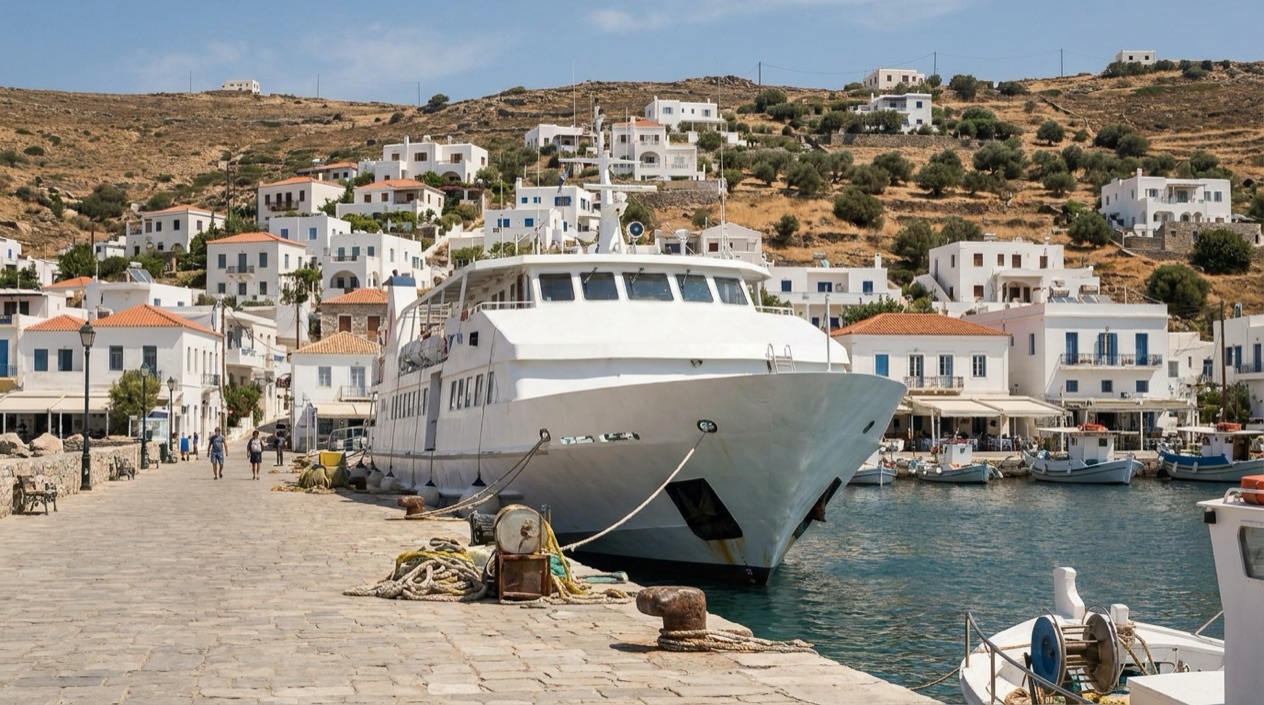
The sound is halyards slapping against masts in a harbor at dusk, while somebody on the next boat grills fish on a tiny stern barbecue and a taverna a few steps away sets out its tables. Greece has long lived on its water, and the habit of going out on it is still strong. Sailing is the sport that runs through everything here, with windsurfing and rowing close behind, and the islands of the Ionian, the Cyclades and the Saronic Gulf give it its stage.
Which water sports can you try in Greece?
Sailing comes first, because Greece borders three seas that suit it: the Aegean, the Ionian and the Mediterranean. Sailing is a popular sport in the country, which is hardly a surprise for a place where so many towns face a harbor. Windsurfing and rowing sit next to it, since Greek athletes have built an Olympic record in both.
What you actually do on the water depends less on the sport than on the sea you choose. A sheltered stretch between close islands is a different afternoon from an open crossing, and a harbor with a dozen boats is a different evening from an empty anchorage. The sections that follow sort the choices by area and season.
Sailing across three seas
Sailing in Greece is mostly island hopping under sail. You leave a harbor in the morning, pick a bay on the chart, drop anchor, swim off the stern and move on to the next village by evening. The country’s sailing areas include the Ionian Islands, the Cyclades, the Saronic Gulf Islands, the Dodecanese and the Sporades, and each has its own character, from small green islands to rocky, wind-swept ones.
Seasons shape the experience. Spring and autumn are the best times for sailing in the Aegean, while July and August can bring strong meltemi winds, reaching up to 8 Beauforts. Those summer conditions are better suited to experienced skippers.
Under sail, the days settle into a rhythm: breakfast on deck, a stretch of sailing, a swim, a late lunch of salad, grilled fish or souvlaki ashore, and an evening in a harbor watching the other crews tie up. It suits couples, friends and families sharing a boat, and anyone who likes to wake up somewhere different each day.
Windsurfing and rowing: the Greek record
The strongest proof that Greece takes the water seriously is its Olympic history. Nikolaos Kaklamanakis won a gold medal in windsurfing, and he lit the Olympic torch at the opening ceremony of the 2004 Summer Olympics in Athens. A windsurfer on a Greek bay carries some of that heritage, whether or not the board is a racing one.
Rowing has its own record. Vasileios Polymeros won the bronze medal in men’s lightweight double sculls with Nikolaos Skiathitis at the 2004 Summer Olympics in Athens. In all, Greek athletes have won 2 medals in rowing at the Olympic Games, and numerous gold medals in world and European championships in sailing and rowing.
The sailing heroes behind the sport
Sailing carries the longest list of names. Greek athletes have won 7 medals in sailing at the Olympic Games. Georgios Zaimis took gold in the Dragon class with the boat Nirefs at the 1960 Summer Olympics in Rome, sailing together with Constantine II of Greece and Odysseus Eskidioglou.
Anastasios Bountouris won bronze in the Three-Person Keelboat at the 1980 Olympics with Anastasios Gavrilis and Aristidis Rapanakis, and he became the first Greek to compete at six Olympic Games, between 1976 and 1996. Sofia Bekatorou won gold in the women’s double-handed dinghy event in the 470 class at the 2004 Summer Olympics with Emilia Tsoulfa, and she has won 4 world championships. Their stories are a good thing to have in mind when you watch local sailors in a harbor race.
Where are they best known?
Each group gives a different kind of trip, so the choice comes down to how much wind, how much company and how many miles you want.
The Ionian Islands
The Ionian Islands are ideal for novice sailors because of mild winds and short distances between islands. That makes the Ionian the natural pick for a first trip under sail, or for a family that wants to spend more time swimming than navigating. Corfu, Kefalonia, Zakynthos and Lefkada belong to this part of the country, and you can think of the sea between them as a linked chain of harbors, villages and coves.
The mood here is green and Mediterranean, with hillsides that run down to the water and small harbors where boats tie up side by side. Evenings tend to be spent in a waterfront taverna over a plate of grilled fish, a Greek salad and a carafe of the house wine.
The Cyclades, Saronic Gulf, Dodecanese and Sporades
The Cyclades are the island group travelers picture when they think of the Aegean: Santorini and Mykonos are among them. The Saronic Gulf Islands, the Dodecanese, with Rhodes among them, and the Sporades complete the list of the most popular sailing areas. All of these lie in the Aegean, so the same advice applies: spring and autumn are the best times, and July and August can bring strong meltemi winds.
Between sailing days, you can walk up to a chora, the hilltop main town of an island, for a coffee at a kafenio and a view over the boats below.
The North Aegean Islands
The North Aegean Islands are less known for sailing, but that has a practical side. The distances between islands are greater, which means fewer boats are typically present and it is easier to find anchorages. Greater distances also ask more of a crew, which is why this area appeals to people who have sailed before and want space around them.
If the busy harbors of the better-known groups are not what you are after, this is the part of the Aegean to look at on the chart. It rewards sailors who like to choose their own bay rather than follow the flotilla.
Beaches beyond the boat
Not every day on the water needs a boat. The most famous mainland beaches in Greece are found in Chalkidiki, Epirus and the Peloponnese, and they make an easy way to add a swim to a road trip. Naturist beaches are best known on Crete, Zakynthos, Rhodes, Gavdos and Antiparos.
How do you book?
Booking a water-sports trip in Greece starts with three decisions: the area, the season and the experience you bring with you. Once those are settled, the rest is a matter of fitting the trip to the sea you have chosen.
Start with the area
Pick the island group first, because it sets the character of the whole trip. The Ionian Islands suit novice sailors, thanks to mild winds and short distances.
It helps to think about what you want your evenings to look like. Some people want a harbor with tavernas and a quay full of crews, while others want a bay to themselves with the boat as the only company. The area you choose decides which of the two you get most often.
Match the season to your experience
In the Aegean, spring and autumn are the best times for sailing. July and August can bring strong meltemi winds, reaching up to 8 Beauforts, and those conditions are more suitable for experienced skippers. A traveler who has never skippered a boat has good reason to look at the shoulder months, or at the Ionian, where the winds are mild.
The choice of season and the choice of area work together, and it makes sense to settle both before anything else.
Think about the crew and the plan
A sailing holiday is a shared project, so it helps to be clear about who is coming and what each person wants from the days. Some will want to steer, others to swim, read or simply watch the islands go by. Agreeing on a rough route between islands in your chosen group, with a harbor for most evenings and the odd anchorage in between, keeps everyone happy.
Windsurfing and rowing follow the same logic on a smaller scale. Choose the bay, the season and the level you are comfortable with, and keep in mind that Greece has produced Olympic champions in both sports, which tells you something about the quality of the water and the culture around it.
Good to know before you go
Strong summer winds are the main thing to plan around. In the Aegean, the meltemi can blow hard in July and August, which is why spring and autumn are the best times for sailing there, while the Ionian Islands stay milder. Paying by card or in cash, tipping and the rest of the money questions are best settled with the operator you choose, and on land the usual habits of any harbor town apply.
Sources
- Wikipedia, Sailing in Greece (https://en.wikipedia.org/wiki/Sailing_in_Greece), checked October 12, 2026
- Wikivoyage, Greece, section Do (https://en.wikivoyage.org/wiki/Greece#Do), checked October 12, 2026
To plan your stay
- Best Time to Visit Greece: September and Late May to Early June
- Arachova: Parnassus Mountain Town, Formaela Cheese, Ski Season and Saint George's Day
- American Airlines Flights to Greece: U.S. Cities, Athens Arrivals and Onward Island Flights
- Greece on a Budget: Cash Machines, Cards, Beaches and Ferries