
On a ferry deck at the end of May, you hear Greek, Albanian, Turkish and a dozen other languages in the same line for coffee, and you start wondering who actually lives in the places you are passing. Greece is a country of modest size in people, with a population that is older than most visitors expect and gathered in a few cities, a long list of small towns and hundreds of island villages. The picture shifts sharply with the calendar, because the summer crowd changes how every island feels.
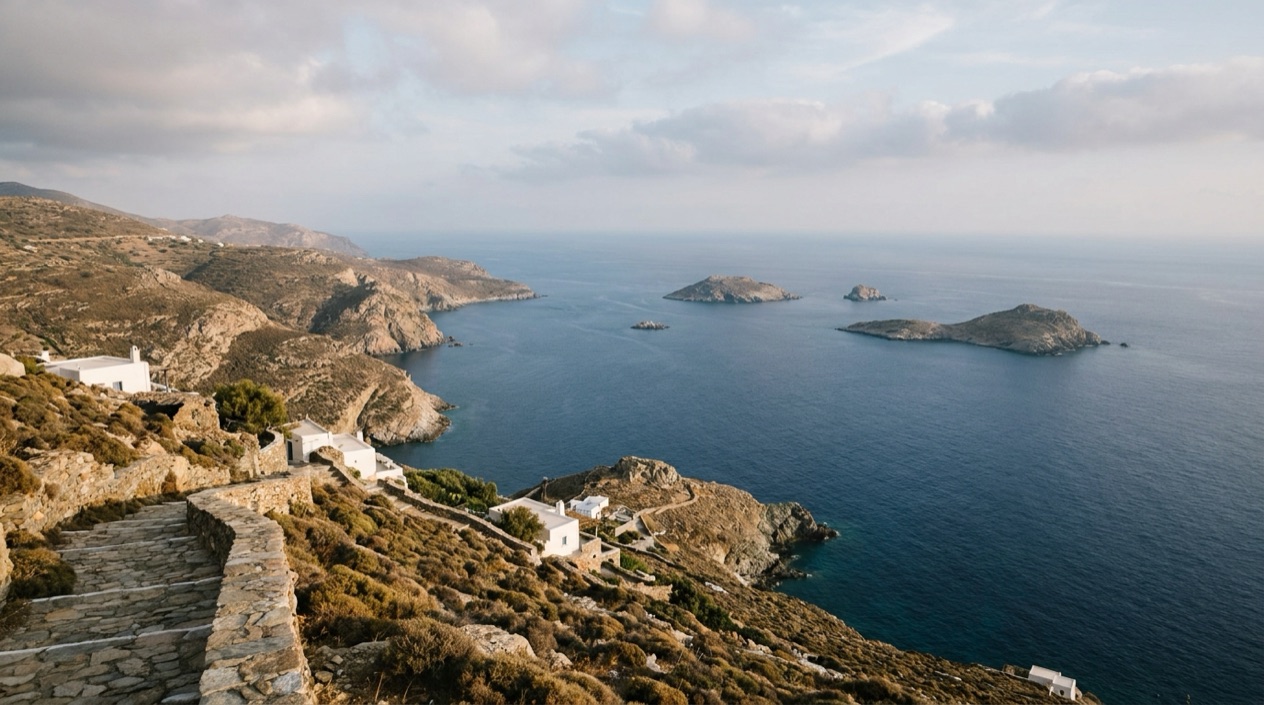
How many people live in Greece?
Greece has a relatively small population for a country with so much coastline, and what stands out is less the headcount than who the residents are: an older population, overwhelmingly Greek, with a few long-established minorities. Most visitors meet that population in ordinary places, at the bakery counter, in a kafenio (a traditional coffee house) or behind the desk of a family-run guesthouse.
| Measure | Overall | Males | Females |
|---|---|---|---|
| Life expectancy (years, 2024 estimate) | 81.9 | 79.4 | 84.6 |
| Median age (years, 2020 estimate) | 45.3 | 43.7 | 46.8 |
An older country, and what it feels like
A median age in the mid-40s means that the people running village life are, very often, grandparents and their grown children. In small towns, the square in the evening belongs to older men playing cards and women chatting on benches, while young people leave for the big cities or work the summer season on the islands and come back to their villages for the big family holidays.
Women live several years longer than men, a gap you see in the villages, where widows in dark clothes keep up the church candles and the family gardens. Long lives are part of why Greek households tend to be multigenerational, with lunch on Sunday as the anchor of the week and a grandmother at the head of the table.
Who the people of Greece are
| Group | Share of population (2011, by citizenship) |
|---|---|
| Greek | 91.6% |
| Albanian | 4.4% |
| Other | 4% |
Greek is the official language, and almost everyone speaks it, at least as a second language. That includes the Albanian community, the largest group among residents without Greek citizenship, many of whom have been part of Greek towns and farms for years. Eastern Orthodox Christianity is recognized in the constitution as the prevailing religion, which is why church bells, name days and the Easter midnight service shape the rhythm of the year.
Beyond the Orthodox majority, a Muslim minority is concentrated in Thrace and protected by the Treaty of Lausanne (1923). It consists mainly of ethnic Turks who speak Turkish. A number of Jews also live in Greece, most of them in Thessaloniki, a city whose layered past you can feel in its old quarters and its food.
What the count means for a visitor
A small resident population meets a very large flow of visitors. Roughly three quarters of all tourists arrive between May and September, and most of the rest come in April and October. In July, an island village that has a few hundred households in winter can host many times that number of guests, and its restaurants, boat docks and beach bars run on seasonal staff.
From November through February, the same places return to their residents. Visitors from more northerly climates often find the off season rewarding, with mild temperatures, few tourists and reduced prices, and you are far more likely to sit at a taverna table among locals than among other travelers.
Which are the biggest cities?
Athens, the national capital, and Thessaloniki are the two big cities that anchor Greek life, and nearly every other place you will visit is a town, a port or a village. Beyond them, the cities that matter to travelers tend to be defined by their architecture and their harbors rather than by sheer size.
Athens and Thessaloniki
Athens is where the ancient sites sit among apartment blocks, where a taverna can face a hillside of ruins and where the metro, the markets and the evening promenade all happen at city scale. It is a place of neighborhoods, each with its own café culture, its own bakery and its own Sunday habits, and most trips to the islands begin or end here.
Thessaloniki has a distinct personality, with a waterfront promenade, bakeries that sell bougatsa (a custard or cheese pastry) and a reputation for food that Greeks themselves talk about. Its Jewish community, concentrated here, is one more thread in a city that has absorbed many peoples. For many Greeks, it is the place for a long meal and an evening stroll by the sea.
Towns with a look of their own
Neoclassical architecture is the signature of Ermoupolis and Nafplion, two towns where tall, symmetrical mansions face harbors and squares. Ermoupolis has the air of a stately port, while Nafplion pairs its elegant streets with a seaside setting where you can walk the old town and then settle at a café table.
Ottoman-influenced buildings are found in Grevena and Kozani, towns that show a side of Greece many itineraries skip. On Corfu, the town is a pastel-colored mix of baroque homes and churches, a look quite different from the Aegean islands and a reminder of how many cultures have shaped Greek urban life.
Island towns and their chora
On most islands, the main town is the chora, a word for the principal settlement, often set apart from the harbor and made of lanes meant for walking. On Paros, whitewashed Cycladic homes line those lanes, and the famous whitewashed houses and blue-domed churches are characteristic only of the Cyclades, so you will not find that exact look across the rest of the country.
These island towns are small, and their character depends on the season. In summer, the squares fill with tables and the harbor with boats, and in winter the same streets belong to residents buying bread and fish. Taking a coffee in the square is a habit that works in either season.
How is the population spread?
The population is spread unevenly, concentrated in the big cities and the lowland towns, with the mountains and many islands settled thinly, and tourism adds a second map on top of it. The country’s density is modest overall, which is why a drive between towns can pass long stretches of hills, olive groves and empty coast.
Where tourism piles on top of residents
Most of Greece’s tourists and tourism industry are concentrated in Crete, the Dodecanese, the Cyclades and the Western Greek Islands. To a lesser extent, the Peloponnese and the Halkidiki peninsula in Macedonia draw visitors too. On these islands and coasts, the number of people on a summer evening is a very different thing from the number on a winter morning.
For a traveler, this means a place can feel like two destinations. The same harbor that is full of rental scooters and cruise-ship day trippers in July has fishermen mending nets and a handful of open tavernas in January. Knowing which version you are after is part of choosing your month.
Mainland towns, mountains and quieter corners
Away from the tourist coasts, life follows the farming calendar and the school year. Towns like Grevena and Kozani, with their Ottoman-influenced buildings, sit outside the usual beach itineraries, and their markets, bakeries and cafés serve local households rather than visitors. A stop there shows you how most of Greece lives for most of the year.
Thrace holds the Muslim minority, with Turkish spoken in everyday life alongside Greek, and its towns and villages have their own mosques, bakeries and customs. Villages across the country keep a cycle of saints’ days and church festivals, when former residents return from the cities and the population of a hamlet briefly swells.
How the seasons move people
The warmest time of the year starts in mid-July and generally lasts until mid-August, just when the visitor numbers are at their highest. Most Greeks avoid heavy physical activity outdoors in the strong midday sun, and you will notice cities and villages slowing down in the afternoon before coming back to life in the evening.
In shoulder months such as April and October, you still find open restaurants, running ferries and busy markets, but the balance tips back toward residents. In winter, many seasonal businesses shut, and the people you meet are the ones who live there year round, which makes for slower, more personal conversations.
Good to know before you go
Because the population is small and the season is concentrated, you will find a wide range of experiences depending on when you travel. The annual meltemi winds from the north cool Greece during the warmest period, from mid-July to mid-August, and the midday sun is strong enough that Greeks avoid heavy outdoor effort between 1 p.m. and 5 p.m. Greek is the official language, and almost everyone speaks it, so a few words of it go a long way in a village shop.
Sources
- Wikipedia, Demographics of Greece (https://en.wikipedia.org/wiki/Demographics_of_Greece), checked October 12, 2026
- Wikivoyage, Greece, section Understand (https://en.wikivoyage.org/wiki/Greece#Understand), checked October 12, 2026
To plan your stay
- Best Time to Visit Greece: September and Late May to Early June
- Arachova: Parnassus Mountain Town, Formaela Cheese, Ski Season and Saint George's Day
- American Airlines Flights to Greece: U.S. Cities, Athens Arrivals and Onward Island Flights
- Greece on a Budget: Cash Machines, Cards, Beaches and Ferries