
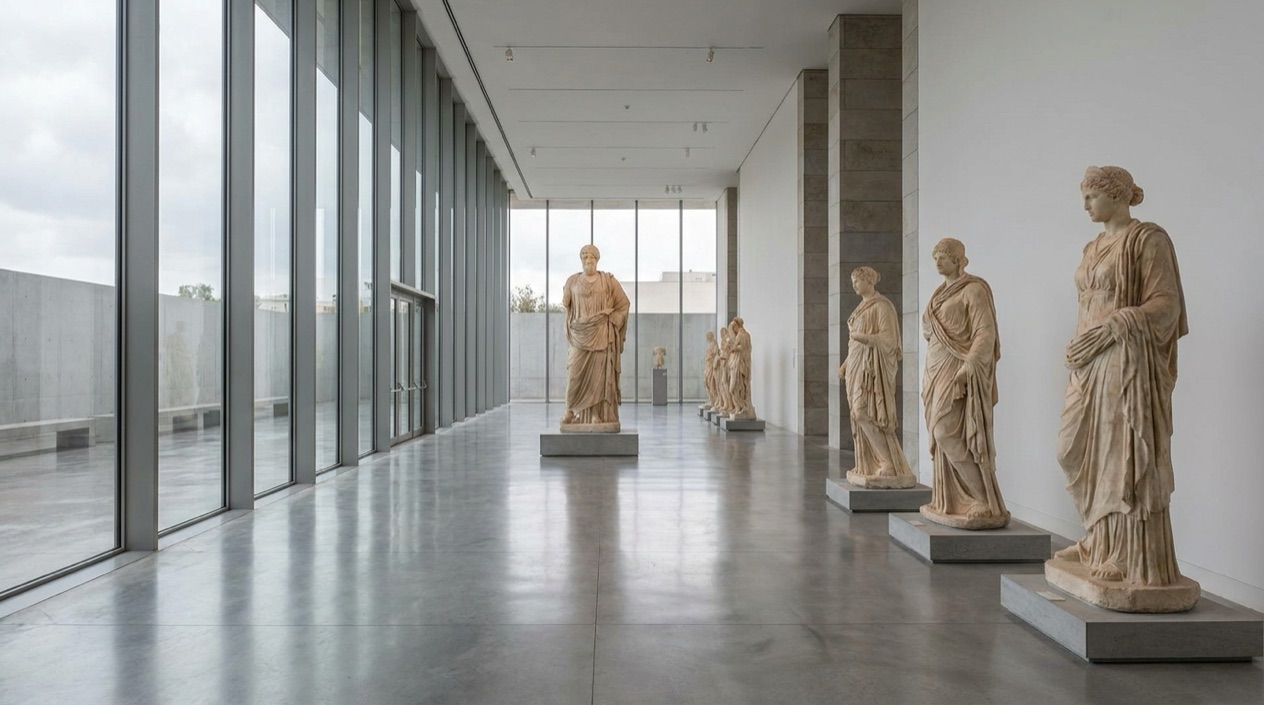
A museum in Greece often begins with a threshold: cool stone underfoot, a statue’s face turned toward you, and then a glass wall that opens onto the very ruins or hillside the objects once came from. Between the galleries of Athens, the old houses of Thessaloniki, the sanctuary museums of Phocis and Elis and the collections of Crete and Santorini, a trip can be built around what people made and believed. Here is a tour of the museums worth planning around, and how entry works.
Which museums should you visit in Greece?
The ones that explain the place you are standing in: the archaeological museums beside the ancient sites, the city museums of Athens and Thessaloniki, and the island collections that hold what the earth gave up nearby. Greece has far more than one trip can hold, so it helps to sort them by kind rather than by a long list. Some are about the ancient world, some about Byzantium, some about family houses and daily life, and one is about war.
Pairing a museum with its site works well, because the objects make sense once you have seen where they were found. Delphi, Olympia and Santorini each have a museum for this purpose, and Heraklion’s collection sits in the city that is the usual base for visiting the Minoan world on Crete.
Archaeological museums
The archaeological museum is the backbone of Greek museum-going. In Central Athens stands the Acropolis Museum, and in Thessaloniki the Archaeological Museum of Thessaloniki. Further out are the Delphi Archaeological Museum in the regional unit of Phocis, the Archaeological Museum of Olympia in Elis, the Heraklion Archaeological Museum on Crete and the Archaeological Museum of Thera on Santorini.
What you see in them is the everyday and the sacred of the ancient world side by side: marble figures, bronze offerings, painted pottery, tools, jewelry and fragments of buildings. Labels and the order of the rooms do much of the telling, so even a visitor with no background in ancient history can follow the thread from one case to the next. Allow your attention to settle on a few objects rather than trying to read every label.
Houses, cities and communities
A different pleasure lies in the museums that tell the story of people rather than temples. The Benaki Museum in Athens is classified as a biographical, city, diachronic, ethnic, ethnographic, history and historic house museum, which is a long way of saying it gathers a great deal under one roof, from the life of a household to the story of a people across time. It rewards a wander without a plan.
The Jewish Museum of Greece, in Central Athens, belongs here too, as a place for a community’s own history within the country. In Thessaloniki the Atatürk Museum is a historic house museum, and the same list classifies it as biographical, city, ethnographic and history. Walking through a house rather than a gallery changes the pace of a visit, and these rooms are a quiet counterpoint to the large archaeological halls.
Byzantium and war
Thessaloniki’s Museum of Byzantine Culture is the place to meet the Orthodox world in objects: icons, carved stone, everyday things from the Byzantine centuries. It pairs naturally with the city’s archaeological museum, which covers the earlier layers of the same ground, so the two can be seen as chapters of one story.
The Athens War Museum, in Central Athens, takes a different subject. Its listing spans military, maritime, railway, science and technology themes, so it appeals to travelers drawn to machines, uniforms and the stories behind them. It is a change of tone after days among marble and gold, and a useful option when you want something other than antiquities.
Which are best known?
The ones attached to places already on most Greek itineraries: the Acropolis Museum in Athens, the Heraklion Archaeological Museum on Crete, and the museums of Delphi and Olympia. Each one explains a site that visitors travel to see, which is why they tend to anchor a plan.
The Acropolis Museum, Athens
This archaeological museum sits in Central Athens and holds finds connected to the Acropolis. Its subject is the rock itself: the sculpture, the architectural pieces and the offerings that belonged to the sanctuary above the city. Seeing them in a gallery lets you look at carved faces and drapery at eye level, in a way the monuments on the hilltop do not allow.
It makes most sense as a companion to a visit to the Acropolis, either before it, to know what you are about to see, or after, to look closely at what you saw from a distance. Wandering between the two, you start to read the skyline of Athens differently.
The Heraklion Archaeological Museum, Crete
On Crete, this is the museum that gives the island’s ancient story its objects. It is where people come to understand the Minoan world, with painted vessels, seals, figurines and fragments that bring the palace sites around Knossos to life. The rooms move from the smallest things, such as a bead or a cup, to larger works, and the effect builds as you go.
If you plan to see Knossos, this museum is the natural partner, since many of the objects that once belonged to such places are shown here.
Delphi and Olympia
The Delphi Archaeological Museum in Phocis and the Archaeological Museum of Olympia in Elis are both archaeological museums that go with their sanctuaries. At Delphi the story is oracles, offerings and the votive gifts left at a place of prophecy. At Olympia it is the athletic games, and the statues and dedications that surrounded them.
They suit travelers who are already planning to see the sites, because the objects clarify the ruins, and the ruins give the objects a setting. Each can be a stop on a route through the mainland, with the museum and the site together telling one story.
Santorini and Thessaloniki
The Archaeological Museum of Thera, in the regional unit of Thira (Santorini), brings an island known for views and sunsets back to its ancient past. It is a way to add depth to a trip otherwise spent among cliffs, beaches and viewpoints, and it holds finds that belong to the island itself.
In Thessaloniki, the Archaeological Museum, the Museum of Byzantine Culture and the Atatürk Museum together make a small museum circuit within one city. They cover the ancient world, the Byzantine centuries and a historic house, three different registers in the same place.
How do you book?
There are no longer any combination tickets in Greece, so each site and museum charges its own separate entry fee. You pay for what you visit, one entrance at a time, rather than buying a bundle that opens several doors.
The fee itself depends on how visitors a site or museum receives. The more visitors, the higher the tier, which is why one archaeological museum may cost more than another. The table sets out the tiers, together with the reduction that applies to certain groups.
| Fee | Who pays |
|---|---|
| Sites and museums with over 200,000 visitors | Visitors to those sites and museums |
| Sites and museums with over 75,000 visitors | Visitors to those sites and museums |
| Sites and museums with over 15,000 visitors | Visitors to those sites and museums |
| Other archaeological sites and museums | Visitors to those sites and museums |
| Reduced fee, half of the amount above | EU citizens over 65, and teachers accompanying students |
Thinking about it this way helps with planning. A trip that takes in several major museums will pay several separate fees, and a day that mixes a large museum with a smaller one will see two different amounts. Since each place has its own fee, your total follows your route, and it is easy to add up before you go.
The discount is worth knowing about if you travel with a group of educators or with an older EU relative. Teachers must be accompanying students, and the age line for EU citizens is over 65.
Good to know before you go
Greece’s museums are spread across the country, so a plan is easier when you group them by place: Athens for the Acropolis Museum, the Benaki, the Jewish Museum and the War Museum, Thessaloniki for its three, and then single stops in Phocis, Elis, Crete and Santorini. Fees are charged in euros, site by site, and each museum is its own stop on the route.
Cities with several museums make good bases, since you can fit more than one into a visit. Where a museum belongs to an ancient site, as at Delphi and Olympia, the two go together in a way that makes the day hang together.
Sources
- Wikipedia, List of museums in Greece (https://en.wikipedia.org/wiki/List_of_museums_in_Greece), checked October 12, 2026
- Wikivoyage, Greece, section See (https://en.wikivoyage.org/wiki/Greece#See), checked October 12, 2026
To plan your stay
- Best Time to Visit Greece: September and Late May to Early June
- Arachova: Parnassus Mountain Town, Formaela Cheese, Ski Season and Saint George's Day
- American Airlines Flights to Greece: U.S. Cities, Athens Arrivals and Onward Island Flights
- Greece on a Budget: Cash Machines, Cards, Beaches and Ferries