
Bells and the low voice of a chanter carry out of a stone church where the walls are covered in saints with long, solemn faces, and a candle flickers in front of an icon worn dark by hands. That is a Greek monastery from the inside, a place of daily prayer that visitors are allowed to look into.
Which monasteries can you visit in Greece?
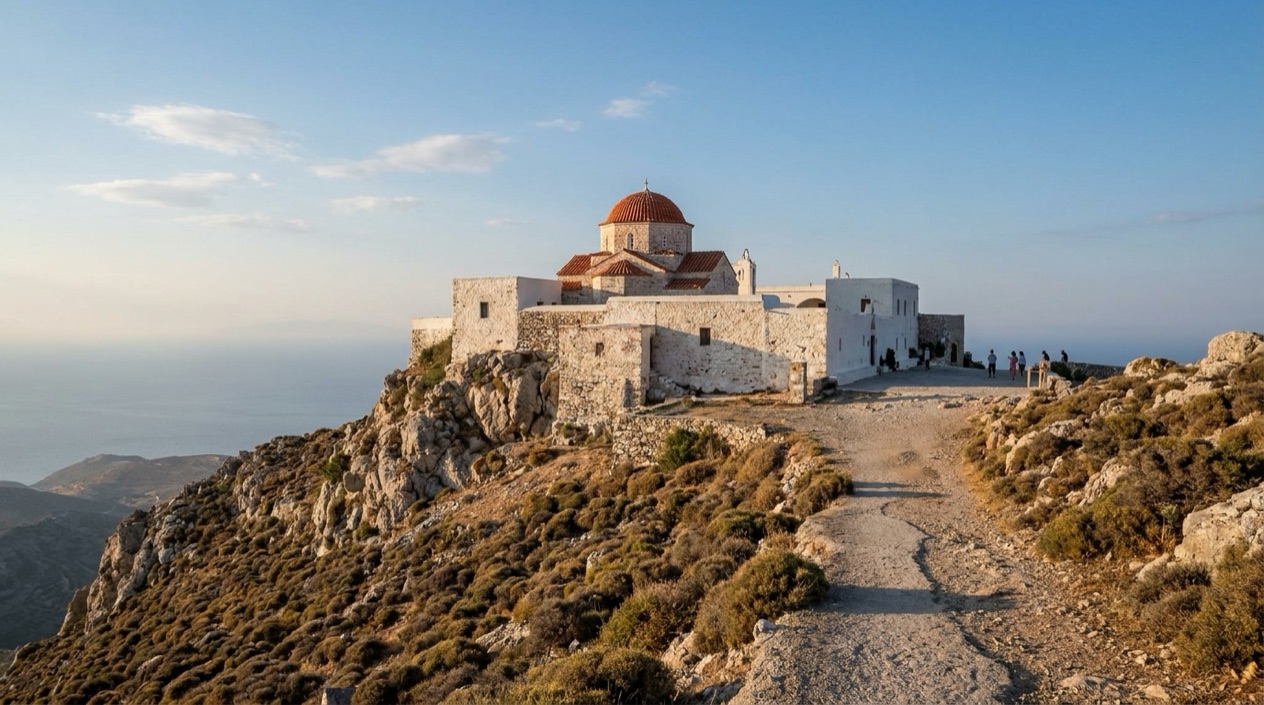
You can visit monasteries from the mainland to the islands, and the clearest place to start is Meteora, where six monasteries still stand on towering rock. Beyond it, the country holds monasteries on Crete, on Patmos, on Chios and in mountain valleys, all belonging to the Orthodox church in one of its several forms. Each has its own personality, from a fortified courtyard to a hillside cloister with a view over the sea.
The church behind them is organized in more than one way. The Church of Greece is a modern autocephalous church working within the borders of the country.
The Archdiocese of Crete is semi-autonomous under the Ecumenical Patriarchate of Constantinople, and the Church of Sinai is autonomous. When you walk into a monastery on Crete, you are therefore in a slightly different church structure than at Meteora, even though the liturgy and the icons look familiar.
Meteora, above Kalabaka and Kastraki
Meteora is a rock formation in the regional unit of Trikala, in Thessaly, in northwestern Greece. The town of Kalabaka and the village of Kastraki lie right beside it, and they are where visitors find rooms, tavernas and a view of the pillars from the street. The complex counts six monasteries that still stand, each perched on its own summit or ledge.
Reaching the top is far simpler today than it once was, thanks to steps carved into the rock during the 1920s. Before that, the way up was far more demanding.
Today you climb stone stairs, pass through a gate and arrive in a small courtyard with a church, a terrace and a view over the valley. The surrounding rock is also a draw for hikers, trail runners, mountain bikers and rock climbers from around the world, particularly during the summer.
Two of the six, Saint Nicholas Anapausas and Rousanou, are extant but no longer in active use as monasteries. They remain part of the landscape and of the story of the place, and Rousanou in particular gives a wide look at its neighbors.
Crete, Patmos and Chios
On the islands, monasteries tend to be part of the island’s own story. On Crete you meet Arkadi and Preveli, monasteries with deep links to the island’s history and to its own church, the semi-autonomous archdiocese. The courtyards are often planted with flowers and shaded by trees, and the churches inside hold carved wooden screens and gold-framed icons.
Patmos is known for the Monastery of Saint John, a fortified complex that rises over the port and the white village of the chora below. Chios holds Nea Moni, a monastery in the hills whose church is decorated with mosaics. Both are places where the island setting, the sea light and the religious life blend into one visit.
What a monastery visit feels like
A typical visit begins at a gate and a courtyard, then moves into the katholikon, the main church of the monastery. You see frescoes covering the walls and ceiling, an iconostasis (the screen of icons that separates the altar), hanging lamps and the smell of wax and incense. Some monasteries add a small museum with manuscripts, vestments and silver.
At Varlaam in Meteora, the museum is open to travelers and holds a wide array of relics and ecclesiastical treasures. If a monk or nun is present, you will often find that visitors speak softly, photograph little and let the services go on around them. Treat it as a house of prayer first and a sight second, and the visit turns out richer for it.
Which are best known?
Meteora is the group that stands out, with six monasteries on the rock and a place on the UNESCO World Heritage List since 1988. Other names that come up again and again in Greece include Arkadi and Preveli on Crete, the Monastery of Saint John on Patmos and Nea Moni on Chios, each tied to the life of its island.
Varlaam and Rousanou at Meteora
Varlaam is the monastery for anyone interested in what a monastery keeps inside. Its museum is open to travelers and displays relics and ecclesiastical treasures, from liturgical objects to sacred items. It gives context to everything you see on the rock, and it explains why these buildings were built and how they were used.
Rousanou sits 1,588 feet above sea level, and from it visitors can see the other monasteries. That is the place to understand how the pillars stand together as a group, with courtyards, walls and church roofs breaking the outline of each summit. It is no longer in active use as a monastery, which changes the feel of the visit but not the view.
Theopetra Cave and the area around Kalabaka
Not everything near Meteora is a monastery. Theopetra Cave lies 2.5 miles from Kalambaka and is now open to the public after restoration. It adds another layer to a trip to Thessaly, a chance to step away from church courtyards and into a very different kind of site.
In Kalabaka and Kastraki, the evenings are for tavernas. Expect grilled meats, feta in many forms, pies, moussaka and a glass of local wine or ouzo. After a day on stone steps, a table with a view of the rocks is a fitting place to sit.
Arkadi, Preveli, Patmos and Nea Moni
Each of these monasteries lives in its own setting. Arkadi and Preveli belong to the Archdiocese of Crete, and both carry the weight of the island’s past in their walls and courtyards. Patmos has the Monastery of Saint John above its harbor, and Nea Moni on Chios is known for the decoration of its church.
Together they show that Greek monasteries are not a single type. Some stand on rock, some on hillsides, some behind fortress walls, and some beside orchards. What links them is the church, the icons and the habit of daily prayer, which continues behind every gate.
What are the rules?
The rules depend on the site, and monasteries set their own, so what you meet at one gate may differ from the next. What stays constant is the idea that a monastery is a place of worship: visitors enter as guests in a house where prayer comes first, and voices tend to drop as they cross the threshold.
Behavior inside a monastery
Habits are simple. Visitors tend to speak quietly in the church, walk slowly and keep phones and cameras discreet around icons and services. The iconostasis, the candles and the lamps are part of living worship, and people light a candle, make the sign of the cross or bow before an icon as they pass.
Inside the walls, you follow the paths laid out for visitors and leave closed doors closed. If a service is under way, you stand at the back and watch.
Active monasteries and those no longer in use
Not every monastery works the same way. At Meteora, Saint Nicholas Anapausas and Rousanou are extant but no longer in active use as monasteries, while the other four continue as monastic communities. The difference shows in the feel of the visit, with more of a museum atmosphere in the former and a house of prayer in the latter.
The route up the rock also shapes the visit. The steps carved into the stone in the 1920s turned a hard ascent into a stair, and you reach each gate on foot. The terraces are places to stop and look out over the valley between one monastery and the next.
Admission at archaeological sites and museums
Archaeological sites and museums in Greece follow a scale based on visitor numbers, and there are no longer any combo tickets, so each site charges a separate entry fee. Entrance fees are halved for EU citizens over 65 and for teachers accompanying students.
| Site category | Admission |
|---|---|
| Over 200,000 visitors | €20 |
| Over 75,000 visitors | €15 |
| Over 15,000 visitors | €10 |
| Other sites and museums | €5 |
Good to know before you go
Greece uses the euro, and the fee scale above is the reference for archaeological sites and museums. Around Meteora, the rock itself is part of the visit, with the stone steps leading from one gate to the next and the terraces open to the valley. Summer brings hikers, climbers and cyclists to the same pillars, so the paths are shared. A day at Meteora pairs naturally with an evening in Kalabaka or Kastraki.
Sources
- Wikipedia, Greek Orthodox Church (https://en.wikipedia.org/wiki/Greek_Orthodox_Church), checked October 12, 2026
- Wikipedia, Meteora (https://en.wikipedia.org/wiki/Meteora), checked October 12, 2026
- Wikivoyage, Greece, section See (https://en.wikivoyage.org/wiki/Greece#See), checked October 12, 2026
To plan your stay
- Best Time to Visit Greece: September and Late May to Early June
- Arachova: Parnassus Mountain Town, Formaela Cheese, Ski Season and Saint George's Day
- American Airlines Flights to Greece: U.S. Cities, Athens Arrivals and Onward Island Flights
- Greece on a Budget: Cash Machines, Cards, Beaches and Ferries