
Somewhere in the middle of this trip you are standing at the foot of a rock tower in Thessaly, looking up at a monastery set on its summit, and the capital with its crowded streets feels like another country. The route runs in a loop.
It starts in Athens, goes up through the mainland’s sacred and rocky places, then crosses to the islands of the Cyclades and ends on Crete. It is written for first-time visitors who want more than the Acropolis and a beach.
Is 14 Days enough for Greece?
It is enough to link five very different places, not enough to see the country. Fourteen days let you taste the capital, the ancient oracle, the monasteries on the rocks, two Cycladic islands and the largest island in Greece, and that is a full trip once you add the moving between them.
The route is built around contrast. Athens gives you the city, the museums and the ancient sites. Delphi, which was considered the navel of the Earth in antiquity, gives you a sacred place on the slope of Mount Parnassus.
Meteora gives you monasteries crowning the rock towers above the town of Kalabaka. Then the sea takes over: Naxos for an island with mountains and farmland, Santorini for the caldera, and Crete for a whole world of its own.
What the route leaves out is large. Rhodes, the fourth largest Greek island, and Lesbos, the third largest, are not on it. Neither is Euboea, which is separated from the mainland by a narrow strait, nor the rest of the Cyclades, nor the northern mainland beyond Thessaly. Mykonos, the island nicknamed the island of the winds, stays off the list as well, though it appears in the section on adapting the route.
The trip also trades depth for variety. Each stage gets a couple of days, which is enough to see its main places and sit through a few long meals, but not enough to wander without a plan. If you would rather see fewer places, drop one of the island stops rather than shaving every stage.
A few things shape the whole trip. The mainland stages are a loop by road, the Cyclades are reached by sea, and Crete is far enough south that it feels like a separate holiday at the end. Pick the season with the islands in mind, since the weather in Athens changes a great deal between winter and midsummer, as the table in the section on adapting the route shows.
The itinerary stage by stage
Days 1 and 2: Athens
Athens opens the trip with the city itself. You walk up to the Acropolis and the Parthenon, spend time in the museums, and give an evening to the Plaka, the neighborhood of old streets, historic landmarks and lively shops that the city’s own tourism guide counts among its top attractions. It gets crowded, so it suits a slow wander more than a checklist.
Eat the way the city does: souvlaki and gyros from a counter, then a taverna dinner of meze, moussaka and grilled meat, with ouzo or a glass of wine. The metro runs from 5:30 a.m. to 00:30 a.m., and on Friday and Saturday nights lines 2 and 3 stay open later, which helps if dinner runs late. Bus passengers cannot use the front door to get on or off.
Sleep in central Athens, near the Plaka or the metro, so that the first two evenings need no planning. The next stage leaves the city by road.
Days 3 and 4: Delphi
Delphi lies on the southwestern slope of Mount Parnassus in Phocis, central Greece. In antiquity it held the most important oracle of ancient Greece and was a spiritual meeting place for the Greeks. You walk the sacred precinct on its hillside and visit the museum that holds what was found there. The site has been a UNESCO World Heritage Site since 1987.
The modern town of Delphi lies very close to the archaeological site and spreads across two streets lined with traditional small houses, hotels and tavernas. That makes the evening simple: you sleep in the town itself, eat in a taverna on one of those two streets, and have the next day to return to the ruins or to look at the mountain around you. From here the route continues by road to Thessaly and the rock towers.
Days 5 and 6: Meteora and Kalabaka
Meteora is an area in Thessaly, in northwestern Greece, in the regional unit of Trikala. The monasteries on top of the rock towers are what make it special, and six of them still stand as part of the complex that UNESCO added to its World Heritage List in 1988. You spend your days looking at them from the roads and viewpoints and visiting the ones you choose.
Base yourself in Kalabaka, the town built at the foothills of the rocks on the left bank of the Pinios river, or in the village of Kastraki nearby. Kalabaka is the gateway to the formations, with hotels and tavernas within reach of the towers. The evenings are for grilled meat, salads and feta in a town taverna.
Day 7: Back to Athens and the port
Day 7 is a travel day. You return by road to the Athens area and spend the night in or near the port you will sail from. Ferries between the mainland and the Cyclades are run by companies such as Blue Star Ferries, which serves more than 20 destinations in Greece, and Golden Star Ferries, which sails from the mainland to the Cyclades.
Keep this day light. A last walk in the city and an unhurried dinner before the sea leg is enough.
Days 8 to 10: Naxos
Naxos is the largest island of the Cyclades and the most fertile, with Zas, the highest mountain in the group, rising on it. Its area is 170 square miles, so there is room for villages, farmland and long beaches to fill three days. The port town of Chora is too small for cruise ships, and it is the natural base for your stay.
Spend the days exploring the island by whatever way you choose to get around, then return to Chora for dinner. Order the dishes of the Cyclades: grilled fish, local cheeses, and vegetables from the island’s farms. Stay in the port town, where the evenings are within reach on foot.
Days 11 and 12: Santorini
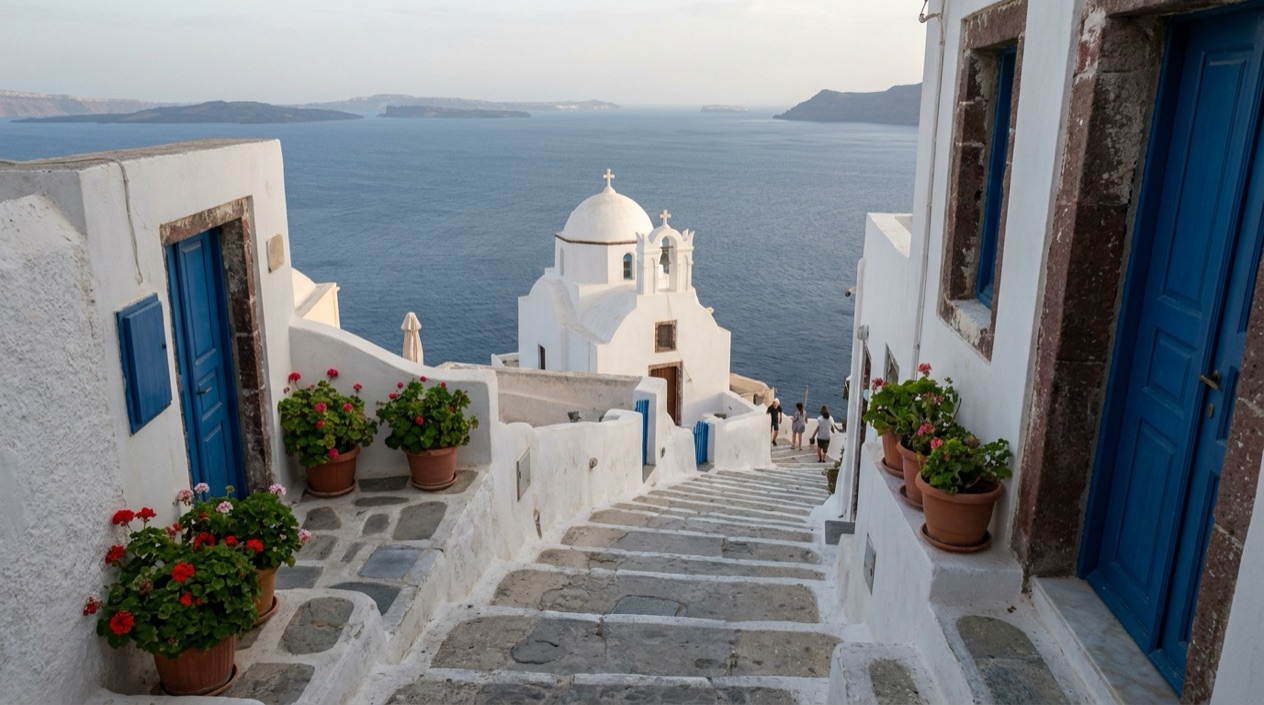
Santorini sits in the southernmost Cyclades, in the Aegean Sea, and was known in ancient times as Thera. It is the largest island of a small, circular archipelago formed by the Santorini caldera, and it has an active volcano, a wild natural wonder that you can look at from the island. Visitors can stay on the caldera rim.
Use the two days for the caldera edge and the island’s villages, and for the table: tomato fritters, fava, and white wine from the island’s vineyards. Sleep on the caldera if you want the view from your room. The next stage takes you to Crete.
Days 13 and 14: Crete
Crete is the largest Greek island by area and population, at the southern edge of the Aegean, with a coastline of 650 miles. Heraklion, where the airport sits 3.1 miles east of the center, is the natural place to land and to sleep. In two days you can see the city and taste the island’s cooking.
Order the dishes of Crete: dakos, a barley rusk topped with tomato and cheese, gamopilafo, a rich wedding rice, and kalitsounia, small cheese pastries. The last day is for what you saved: a museum, a market, one more meal. The trip ends at the airport.
Getting between stops
| Leg | How |
|---|---|
| Athens to Delphi | By road |
| Delphi to Meteora (Kalabaka) | By road |
| Meteora to Athens | By road |
| Athens to Naxos | By sea, on a ferry line between the mainland and the Cyclades |
| Naxos to Santorini | By sea |
| Santorini to Crete (Heraklion) | Onward to the island where Heraklion Airport serves the city |
The mainland stages run by road, and the route is a loop that brings you back to Athens before the sea crossing. Between the mainland and the Cyclades the lines named earlier, Blue Star Ferries and Golden Star Ferries, serve the routes. ANEK Lines operates mainly on the Piraeus to Crete and Adriatic Sea routes, a line to know about for Crete.
Distances help you picture the geography. Santorini lies about 120 miles southeast of the mainland, and Crete is about 62 miles south of the Peloponnese. Heraklion Airport, the second busiest in Greece after Athens, is the landing point for the last stage.
Within Athens, the metro and the buses cover the city, with the hours given in the first stage. Elsewhere the road is the way you move between towns and sites on the mainland.
What to book before your 14 Days in Greece
Settle the pieces that tie the route together first: the ferry from the mainland to the Cyclades, which links the mainland stages to the islands, and the leg to Crete. Then the lodging, especially in Kalabaka for Meteora, in Delphi town and, if you want it, in the caldera on Santorini. The sites and monasteries each set their own hours and admission, which are worth confirming for the ones you choose.
Adapting the route
The route bends to the season, and the weather in Athens shows how much the year changes. In July the air is hot and the rain nearly absent, while in January it is cool and wet enough to want a rain jacket. April and October sit between the two, with warm days and a few wet ones.
| Athens | Average high (°F) | Average low (°F) | Precipitation (in) | Days with rain |
|---|---|---|---|---|
| January | 56.3 | 44.4 | 2.17 | 7.5 |
| April | 68.4 | 53.2 | 1.10 | 5.5 |
| July | 91.8 | 74.1 | 0.28 | 1.6 |
| October | 75.2 | 61.0 | 1.09 | 3.9 |
By season
In midsummer the heat of Athens is the thing to plan around, so sun protection and plenty of water matter for the Acropolis and Delphi. For the islands, the best time to visit Mykonos is mid-May through June or September through mid-October, while July and August are extremely crowded. That is a good guide for the islands in general: late spring and early autumn are the seasons to aim for.
In winter the days are cooler and the rain days are many, so pack a rain jacket and warm layers, and keep the island stages light. The Aegean is wind-exposed, and Mykonos is nicknamed the island of the winds, so a sea crossing in the Cyclades is something to hold loosely. Wildfires and heat are matters for the summer months, and you should follow local announcements when you are in the country.
Shorter and longer
For a shorter trip, cut a whole stage rather than shaving each one. Dropping Santorini and Crete gives you Athens, Delphi, Meteora and Naxos, a trip that needs only one sea crossing. Or keep Athens, the islands and Crete, and leave the mainland loop for another visit.
For a longer trip, add days where the route is thinnest. A third day in Meteora lets you take the monasteries one by one. More time on Naxos, with its 170 square miles of villages and farmland, rewards a slower pace. You could also add Mykonos, lying between Tinos, Syros, Paros and Naxos, with an area of 33.0 square miles and a high point of 1,119 feet.
For a slower or family trip
A slower trip keeps fewer bases. Stay in Athens for the first stage, in Kalabaka for both Meteora days, in Chora on Naxos and in Heraklion, and the packing and unpacking nearly disappear. Skip Delphi or Santorini and the route loses a stage, not its shape.
With children, the stages with a clear object to look at tend to hold attention: the rock towers of Meteora, the volcano of Santorini, a meal of dakos and kalitsounia on Crete. Let the travel days stay light, and give the island stages the open time.
Good to know before you go
The currency is the euro, and amounts in Greece, from a taverna bill to a ferry ticket, are set locally. In the Cyclades the wind is part of the setting, since Mykonos carries the nickname island of the winds. In the capital, the Plaka is crowded, so give it time and attention.
Sources
- Wikipedia, Ancient Greece (https://en.wikipedia.org/wiki/Ancient_Greece), checked October 12, 2026
- Wikipedia, ANEK Lines (https://en.wikipedia.org/wiki/ANEK_Lines), checked October 12, 2026
- Wikipedia, Blue Star Ferries (https://en.wikipedia.org/wiki/Blue_Star_Ferries), checked October 12, 2026
- Wikipedia, Fast Ferries (https://en.wikipedia.org/wiki/Fast_Ferries), checked October 12, 2026
- Wikipedia, Golden Star Ferries (https://en.wikipedia.org/wiki/Golden_Star_Ferries), checked October 12, 2026
- Wikipedia, Greek islands (https://en.wikipedia.org/wiki/Greek_islands), checked October 12, 2026
- OASA, Athens urban transport (https://www.oasa.gr/en/), checked October 12, 2026
- Athens Transport, public transport guide (https://www.athenstransport.com/english/), checked October 12, 2026
- This is Athens, the official Athens tourism site (https://www.thisisathens.org/), checked October 12, 2026
- Santorini official guide (https://www.santorini.gr/), checked October 12, 2026
- Visit Greece (GNTO), Santorini (https://www.visitgreece.gr/islands/cyclades/santorini/), checked October 12, 2026
- Wikipedia, Santorini (https://en.wikipedia.org/wiki/Santorini), checked October 12, 2026
- Visit Greece (GNTO), Mykonos (https://www.visitgreece.gr/islands/cyclades/mykonos/), checked October 12, 2026
- Wikipedia, Mykonos (https://en.wikipedia.org/wiki/Mykonos), checked October 12, 2026
- Wikivoyage, Mykonos (https://en.wikivoyage.org/wiki/Mykonos), checked October 12, 2026
- Visit Greece (GNTO), Naxos (https://www.visitgreece.gr/islands/cyclades/naxos/), checked October 12, 2026
- Wikipedia, Naxos (https://en.wikipedia.org/wiki/Naxos), checked October 12, 2026
- Wikivoyage, Naxos (https://en.wikivoyage.org/wiki/Naxos), checked October 12, 2026
- Heraklion airport information (https://www.heraklion-airport.info/), checked October 12, 2026
- Visit Greece (GNTO), Crete (https://www.visitgreece.gr/islands/crete/), checked October 12, 2026
- Wikipedia, Crete (https://en.wikipedia.org/wiki/Crete), checked October 12, 2026
- Meteora, official information (https://www.meteora-greece.com/), checked October 12, 2026
- Visit Greece (GNTO), Meteora (https://www.visitgreece.gr/mainland/thessaly/kalabaka/), checked October 12, 2026
- Wikipedia, Meteora (https://en.wikipedia.org/wiki/Meteora), checked October 12, 2026
- Visit Greece (GNTO), Delphi (https://www.visitgreece.gr/mainland/central-greece/delphi/), checked October 12, 2026
- Wikipedia, Delphi (https://en.wikipedia.org/wiki/Delphi), checked October 12, 2026
- Wikivoyage, Delphi (https://en.wikivoyage.org/wiki/Delphi), checked October 12, 2026
- Hellenic National Meteorological Service (HNMS), climatological normals 1991-2020 for Elliniko station (https://www.emy.gr/climatic-data), monthly mean daily maximum and minimum; rain from the ECMWF ERA5 reanalysis, 1991-2020, grid cell of Athens (Open-Meteo), checked October 12, 2026
- ECMWF ERA5 reanalysis 1991-2020, grid cell of Athens (Open-Meteo), checked October 12, 2026
- Plan de the (duree choisie by the redaction)
To plan your stay
- Best Time to Visit Greece: September and Late May to Early June
- Arachova: Parnassus Mountain Town, Formaela Cheese, Ski Season and Saint George's Day
- American Airlines Flights to Greece: U.S. Cities, Athens Arrivals and Onward Island Flights
- Greece on a Budget: Cash Machines, Cards, Beaches and Ferries