
Halfway through the week, you are sitting at a table in Naxos town with a plate of fried zucchini, a bowl of olives and a carafe of the local wine, while the evening passenger boats slide into the harbor. The route behind you is the marble of Athens, and the one ahead drops into the volcanic bowl of Santorini. This is a seven-day island-hopping trip for first-time visitors to Greece: a capital, three Cycladic islands and a lot of time at the table.
Is 7 Days enough for Greece?
Seven days is enough for a first taste of Greece, as long as you accept that it is a taste: one city and three islands, with the rest of the country left for another trip. It starts in Athens, moves into the Cyclades, and keeps each stop long enough to eat a proper dinner and walk the old town without checking the clock.
Mykonos lies between Tinos, Syros, Paros and Naxos, so Naxos is a neighbor rather than a distant destination. Santorini is the southernmost member of the group, and it is the island that gives the week its finish: a place where you can stay on the caldera rim, beside an active volcano.
What the route leaves out is large. Crete, the biggest Greek island, has its own mountains, coastline and cooking and deserves a trip of its own.
The mainland holds Delphi, where the ancients placed the navel of the Earth and the most important oracle of the Greek world, and Meteora, where monasteries stand on top of rock towers above the town of Kalabaka. Each of these is a different kind of journey, by road rather than by sea, and cramming them into the same week would turn the trip into a series of transfers.
If you have to choose between more islands and more days on each one, choose the second. The pleasure of the Cyclades is in the slow parts: the second coffee at a kafenio (the traditional coffeehouse), the long lunch of meze, the wander through the lanes of a chora, the main town of an island, with no destination in mind.
A week with three islands leaves room for all of that. A week with five leaves room for the ferry terminal.
The season matters to the shape of the week. Mykonos is best from mid-May through June and from September through mid-October, and it is extremely crowded in July and August. The same logic of shoulder months applies to the whole route, and the section on adapting the route below says what the weather in Athens does across the year.
The itinerary stage by stage
Days 1 and 2: Athens
Start in Athens, where the first day goes to the Acropolis and the neighborhoods at its foot. The Parthenon is the sight everyone has in mind, and standing beside it with the modern city spread out below is the right way to begin a Greek week.
Afterward, drop into the Plaka, the old quarter of narrow lanes, historic landmarks and lively shops. It is a top attraction and it gets crowded, which is part of its atmosphere: tavernas set tables in the lanes, and souvenir shops sell sandals, olive oil and sponges.
Day 2 is for food and for the ancient city beyond the Acropolis. Order souvlaki (grilled meat on a skewer) or a gyros wrapped in pita from a counter, then sit down in the evening to moussaka, a Greek salad with a slab of feta and a plate of meze.
Finish with loukoumades, the warm honey doughnuts. You can sleep in the Plaka area or near Syntagma Square, both of which put the metro within reach.
The move to the islands is by sea, from the mainland into the Cyclades. Spend the last Athens evening packing light, since island hopping rewards a single small bag.
Days 3 and 4: Mykonos
Mykonos is nicknamed the island of the winds, and you notice it as soon as you step off the boat: shutters rattle, laundry snaps, and the sea has a restless surface. The chora is a tangle of lanes that seems designed to lose you, which is the point. Wander without a map past chapels, bougainvillea and small galleries, then settle at a harbor table for grilled fish or a plate of local cheeses.
Day 4 can be spent on the island’s beaches, or simply at a café watching the harbor. The wind can make the sea livelier on some coasts than others, so pick your stretch of sand on the day. This is also the stop for people-watching: Mykonos is the glamorous end of the trip, with a late dinner culture and bars that stay open after midnight.
Sleep in or near the chora if you want to walk to dinner, or on one of the island’s beaches if you would rather wake up beside the water. The next stage is by sea to its neighbor Naxos.
Day 5: Naxos
Naxos is the largest and most fertile island of the Cyclades, and it feels like it: the dinner plates are heavy with local vegetables, cheeses and potatoes, and the interior is green with orchards and farms. Its mountain, Zas, is the highest in the whole island group. The port at Chora is too small for cruise ships, so the town keeps the scale of a harbor village, with a waterfront lined with tavernas.
Use the day to walk the old town, the kind of place where a cat naps on every doorstep, and then to head out to a village in the hills or to a beach. Try a taverna that serves what the island grows: grilled meats, a plate of fried vegetables, a wedge of local cheese and a glass of the local spirit, often a citrus-flavored liqueur.
Sleep in town. The next morning’s move is by sea to Santorini, the southernmost island of the Cyclades.
Days 6 and 7: Santorini
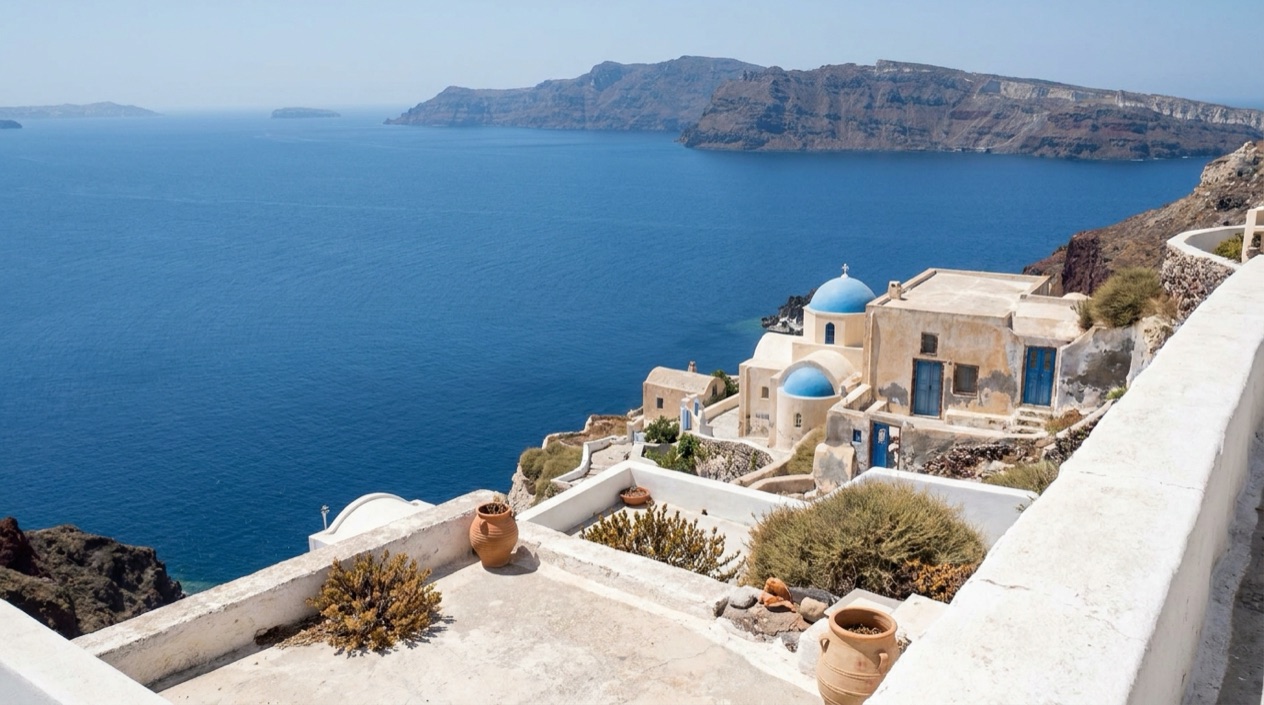
Santorini, known in ancient times as Thera, is the largest island of a small, circular archipelago formed by the caldera. The volcano is still active, and the view over the flooded crater is what travelers come for. You can stay on the caldera rim, in hotels perched on the rim, and waking up with the crater beneath your balcony is the high point of the week.
Spend day 6 walking the rim from village to village, with a stop for a plate of local tomato fritters, fava (a yellow split-pea purée) and fresh fish. Santorini wines, grown in volcanic soil, are a good reason to linger at a table. On day 7, take a last coffee above the crater before the trip ends.
Getting between stops
| Leg | How |
|---|---|
| Within Athens | Metro, tram or bus |
| Athens to Mykonos | By sea, from the mainland into the Cyclades |
| Mykonos to Naxos | By sea, between two neighboring Cyclades |
| Naxos to Santorini | By sea, to the southernmost of the Cyclades |
| Athens to Crete (optional extension) | By sea, on the Piraeus–Crete route |
| Athens to Delphi or Meteora (optional extension) | By road |
Several companies serve the mainland and the islands. Blue Star Ferries links the Greek mainland with the Aegean Islands and serves more than 20 destinations. Golden Star Ferries, founded in 2011 and headquartered on Andros, operates from the mainland to the Cyclades. ANEK Lines, begun by residents of Crete in 1967, runs mainly on the Piraeus–Crete and Adriatic routes, which makes it relevant only if you add Crete to the trip.
Inside Athens, the metro runs from 5:30 a.m. to half past midnight, and on Friday and Saturday nights lines 2 and 3 stay open later. The tram, opened for the Summer Olympics, has two routes: Line 6 from Syntagma to Pikrodafni and Line 7 from Akti Poseidonos to Asklepieio Voulas. On Athens buses, passengers cannot use the front door to get on or off.
Flights come into the picture if you extend the trip to Crete. Heraklion Airport is the second busiest in Greece after Athens, located east of the center of Heraklion in the area of Alikarnassos. Crete is also reachable by sea from Piraeus. Delphi and Meteora are mainland destinations, reached by road, and they make a different trip from the island chain described here.
What to book before your 7 Days in Greece
Settle three things first: the sea crossings that link Athens with the Cyclades and the islands with one another, since the whole route hangs on them; the Athens sites you want to see, starting with the Acropolis; and the rooms on Santorini, where a caldera stay is the centerpiece of the week. Mykonos is the island where the season changes the trip most, so fix your dates around its best months.
Adapting the route
The weather in Athens frames the trip, and the numbers shift a great deal between winter and summer. January brings cool days and the most rain of the four months shown, so a rain jacket belongs in the bag. April is mild with fewer wet days. July is hot and almost dry, and sun protection becomes the main packing item. October is warm with a few showery days.
| Athens | Average high (°F) | Average low (°F) | Precipitation (in) | Days with rain |
|---|---|---|---|---|
| January | 56.3 | 44.4 | 2.17 | 7.5 |
| April | 68.4 | 53.2 | 1.10 | 5.5 |
| July | 91.8 | 74.1 | 0.28 | 1.6 |
| October | 75.2 | 61.0 | 1.09 | 3.9 |
A shorter or longer week
With less time, drop Naxos and spend the extra day on Mykonos or Santorini. The route then becomes Athens, Mykonos and Santorini, with two long stays and one less boat. It keeps the most recognizable pictures of the Cyclades and leaves breathing room.
With more time, the natural additions are on the mainland. Delphi lies on the southwestern slope of Mount Parnassus, with a modern town of small houses, hotels and tavernas beside the archaeological site, a UNESCO World Heritage Site since 1987.
Meteora is in Thessaly, with six extant monasteries on the rock towers, listed by UNESCO in 1988, and the town of Kalabaka at its foot as the gateway. Both go before the islands, as a road trip out of Athens.
Crete is the other extension. It is the largest Greek island, with Mount Psiloritis as its highest peak and a table that includes dakos (barley rusk with tomato and cheese), gamopilafo (a rich wedding rice) and kalitsounia (small cheese pastries). Give it its own week rather than a stop in this one.
By season and for families
Mykonos is extremely crowded in July and August, so the shoulder months from September to mid-October or from mid-May to June give the island a different pace. Summer is hot in Athens, so spend the city days around the museums and tavernas and keep the Acropolis for a moment when you are ready for the heat.
For families, fewer moves help: stay two nights on each island instead of one, and let children set the pace on the beaches. Mykonos and Santorini suit adults who like late dinners, while Naxos, with its farms, cheeses and tavernas on the waterfront, makes the quieter base for a slower trip.
Good to know before you go
Greece uses the euro. The Cyclades are open to the wind, and Mykonos earns its nickname, so a light layer is useful on the water and at the beach even in warm months. The island lanes are uneven underfoot and often steep, so comfortable shoes serve you better than anything else you pack. Keep the plan loose on the last day so one delayed crossing does not cost you the end of the week.
Sources
- Wikipedia, Ancient Greece (https://en.wikipedia.org/wiki/Ancient_Greece), checked October 12, 2026
- Wikipedia, ANEK Lines (https://en.wikipedia.org/wiki/ANEK_Lines), checked October 12, 2026
- Wikipedia, Blue Star Ferries (https://en.wikipedia.org/wiki/Blue_Star_Ferries), checked October 12, 2026
- Wikipedia, Fast Ferries (https://en.wikipedia.org/wiki/Fast_Ferries), checked October 12, 2026
- Wikipedia, Golden Star Ferries (https://en.wikipedia.org/wiki/Golden_Star_Ferries), checked October 12, 2026
- Wikipedia, Greek islands (https://en.wikipedia.org/wiki/Greek_islands), checked October 12, 2026
- OASA, Athens urban transport (https://www.oasa.gr/en/), checked October 12, 2026
- Athens Transport, public transport guide (https://www.athenstransport.com/english/), checked October 12, 2026
- This is Athens, the official Athens tourism site (https://www.thisisathens.org/), checked October 12, 2026
- Santorini official guide (https://www.santorini.gr/), checked October 12, 2026
- Visit Greece (GNTO), Santorini (https://www.visitgreece.gr/islands/cyclades/santorini/), checked October 12, 2026
- Wikipedia, Santorini (https://en.wikipedia.org/wiki/Santorini), checked October 12, 2026
- Visit Greece (GNTO), Mykonos (https://www.visitgreece.gr/islands/cyclades/mykonos/), checked October 12, 2026
- Wikipedia, Mykonos (https://en.wikipedia.org/wiki/Mykonos), checked October 12, 2026
- Wikivoyage, Mykonos (https://en.wikivoyage.org/wiki/Mykonos), checked October 12, 2026
- Visit Greece (GNTO), Naxos (https://www.visitgreece.gr/islands/cyclades/naxos/), checked October 12, 2026
- Wikipedia, Naxos (https://en.wikipedia.org/wiki/Naxos), checked October 12, 2026
- Wikivoyage, Naxos (https://en.wikivoyage.org/wiki/Naxos), checked October 12, 2026
- Heraklion airport information (https://www.heraklion-airport.info/), checked October 12, 2026
- Visit Greece (GNTO), Crete (https://www.visitgreece.gr/islands/crete/), checked October 12, 2026
- Wikipedia, Crete (https://en.wikipedia.org/wiki/Crete), checked October 12, 2026
- Meteora, official information (https://www.meteora-greece.com/), checked October 12, 2026
- Visit Greece (GNTO), Meteora (https://www.visitgreece.gr/mainland/thessaly/kalabaka/), checked October 12, 2026
- Wikipedia, Meteora (https://en.wikipedia.org/wiki/Meteora), checked October 12, 2026
- Visit Greece (GNTO), Delphi (https://www.visitgreece.gr/mainland/central-greece/delphi/), checked October 12, 2026
- Wikipedia, Delphi (https://en.wikipedia.org/wiki/Delphi), checked October 12, 2026
- Wikivoyage, Delphi (https://en.wikivoyage.org/wiki/Delphi), checked October 12, 2026
- Wikipedia, Island hopping (https://en.wikipedia.org/wiki/Island_hopping), checked October 12, 2026
- Wikipedia, Transport in Greece (https://en.wikipedia.org/wiki/Transport_in_Greece), checked October 12, 2026
- Hellenic National Meteorological Service (HNMS), climatological normals 1991-2020 for Elliniko station (https://www.emy.gr/climatic-data), monthly mean daily maximum and minimum; rain from the ECMWF ERA5 reanalysis, 1991-2020, grid cell of Athens (Open-Meteo), checked October 12, 2026
- ECMWF ERA5 reanalysis 1991-2020, grid cell of Athens (Open-Meteo), checked October 12, 2026
- Plan de the (duree choisie by the redaction)
To plan your stay
- Best Time to Visit Greece: September and Late May to Early June
- Arachova: Parnassus Mountain Town, Formaela Cheese, Ski Season and Saint George's Day
- American Airlines Flights to Greece: U.S. Cities, Athens Arrivals and Onward Island Flights
- Greece on a Budget: Cash Machines, Cards, Beaches and Ferries