
You step off the ferry into a crowd of people holding hand-lettered signs, and someone says “room, room, nice room” before your bags touch the quay. Elsewhere, a laptop is open in a city café and a hotel’s email reply has just arrived. Both ways of finding a bed are normal in Greece, and rooms here have a character of their own: compact, with a balcony, and clean.
What are Greek hotel rooms like?
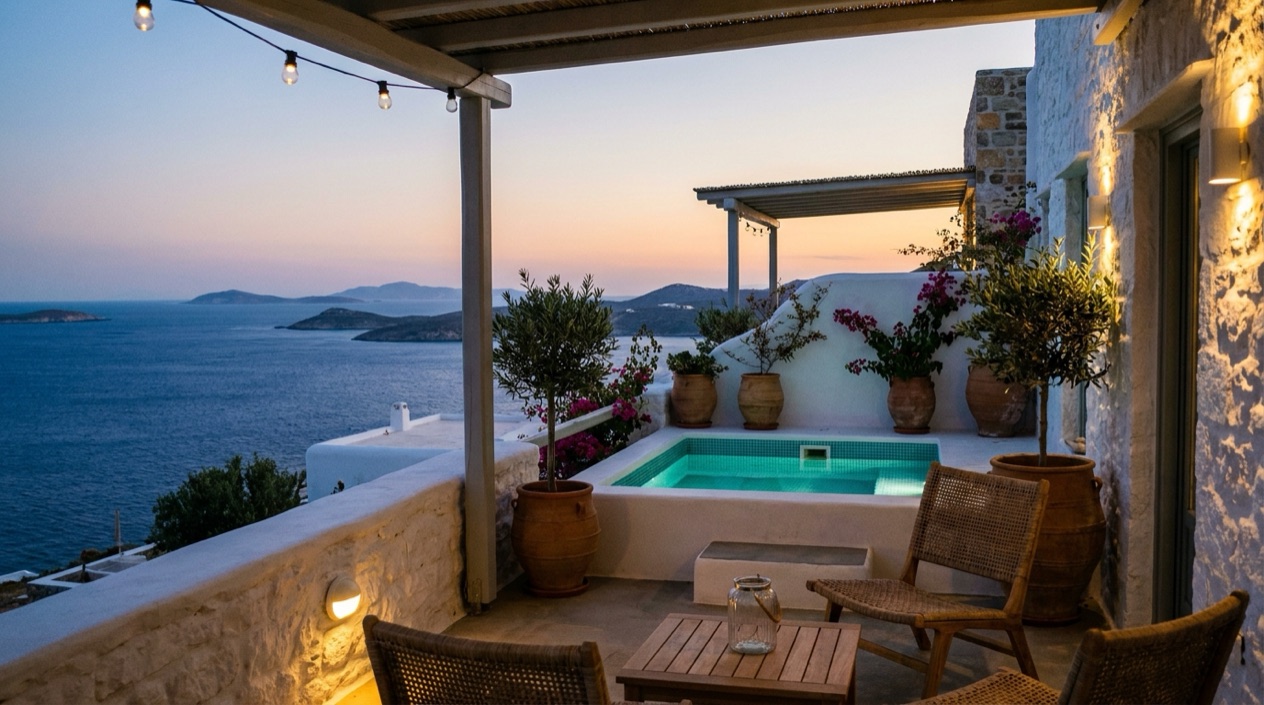
Greek hotel rooms tend to be small, clean and built around a balcony, and the simpler the place, the more it feels like a room in someone’s family home. That is the pattern in Athens and the other big cities, and it is just as true on the islands. Expect a place to sleep, a place to shower and a place to sit outside, with less floor space than an American chain hotel gives you.
Comfort comes from small things rather than size: a bed made with crisp sheets, a cold drink on the balcony in the evening, shutters that close out the sun. Taking a room as it is, and not measuring it against a big-box hotel back home, is the surest way to enjoy it.
Small bathrooms and storage
Bathrooms in Greek hotels, especially on the islands and in Athens and other big cities, are small. The shower is often a hand-held sprayer rather than a fixed head, and the whole bathroom can get wet when you use it. Some of the most basic places lack a shower curtain altogether, so the floor takes the splash and you plan around it.
Storage is the other pinch point. Closets are often inadequate, and sometimes there is only a wardrobe. A suitcase that stays open on a stand or a chair is a normal arrangement, and a traveler who unpacks only what is needed for a few days will find the room works well.
Balconies and verandas
Greek hotels typically have a balcony, though it is sometimes tiny. Others have a veranda, either private to your room or a large one shared by all the rooms along the same floor. This is where a Greek stay really happens: breakfast bread and coffee in the morning, a glass of wine or ouzo at the end of the day, and a place to hang a damp towel.
A shared veranda has its own pleasures. You nod to neighbors from other countries, trade tips about a beach or a taverna, and watch the street or the harbor below. A tiny balcony still holds a chair and a small table, which is often all you need.
Cleanliness and the simpler places
Standards of cleanliness in Greek hotels are usually good, even in the simpler places. A modest family-run room with a plain tiled floor and a ceiling fan can be spotless, and the owner may well sweep the entrance every morning. The price of a room says little about how well it is kept.
More luxurious accommodation can usually be found in cities and on the more popular islands. If you want that level of comfort, you will find a wider choice in those places. Between the plain room and the polished resort lies a large middle ground of small hotels, pensions and studios, where travelers end up and are content.
What are the check-in rules?
Getting into a Greek room depends on how you found it: a booking made by email ahead of time, or a room found on the spot when you arrive. Both routes work, and each has its own rhythm. Booking ahead gives you a name and a confirmation to show at the desk, while walking in lets you see the room before you agree to it.
Walking in without a reservation
Walk-in accommodation can usually be found without too much trouble on all but the most crowded islands. You arrive, look at a few rooms, and pick the one that suits you. This suits a loose itinerary, where you decide on one island or town as you go and stay as long as you like it.
The exceptions matter. On the most crowded islands, rooms can be difficult to find at the peak of the season, and even in the shoulder season on weekends and major holidays. If your dates fall in those windows, a room reserved ahead removes the worry of arriving with nowhere to go.
Rooms offered at the port
At many island harbors, people with rooms to let meet the boats and offer them to arriving passengers. Prices for rooms offered at the port can be negotiated, and prices in the range of €20-25 for a room or even a studio are not uncommon in mid-season. The conversation is friendly, and a counteroffer is part of it.
A studio is often just a room with a small kitchen corner. Ask to see the room before you agree, and look at the balcony, the bathroom and the bed. Settling the price for your whole stay at the start avoids any confusion on the last morning.
Booking by email
Most Greek hotels, even the smaller ones, have websites and will take bookings by email. Write with your dates, the number of guests and any question about the room, and expect a short, practical reply.
If an email goes unanswered, trying the other channel is reasonable before you look elsewhere.
What should you know before you book?
Before you book a Greek hotel, ask about the things that change how a room feels: the quality of the place, the air conditioning, the season and the kind of lodging. A few questions in your first email save surprises at the door.
Check the quality in reliable sources
For a luxurious hotel in a city or on a popular island, check independent reviews before booking. Travelers should check the hotel’s quality in reliable sources rather than rely on its own description. Photos can be flattering, and a small bathroom or a tiny balcony looks larger on a screen than it does in person.
A review that mentions a hand-held sprayer or a narrow closet is telling you what you will actually live with.
Ask about air conditioning
Most Greek rooms have air conditioning, but if it is important to you, ask before booking. Some rooms in old traditional buildings with thick stone walls may not need it. Those rooms have their own charm, with deep window recesses, cool floors and a feeling of being tucked inside the building.
If you sleep better in a cooled room, one line in your email settles the question. If you are drawn to a stone house, ask how the room is kept comfortable, and let the owner explain.
Crowded islands and busy weekends
The easy-going walk-in approach has limits. On the most crowded islands, finding a room at the peak of the season is difficult, and the same can happen on weekends and major holidays in the shoulder season. On those dates, a confirmed reservation means you get off the boat knowing where you will sleep.
Elsewhere you can leave a night or two open. Travelers fix the first and last nights and keep the middle flexible, which allows a change of plan if a town or a beach turns out to be a favorite.
Villas for a bigger budget
Renting a villa provides luxurious accommodation, normally near or on the beach, with more space and a great view. It is a choice for those with a bigger budget, and it changes the nature of the stay: you cook, you sit on your own terrace and you set your own pace.
Compared with a hotel room, a villa answers the problems of small bathrooms and tight closets. A hotel gives you a front desk and a daily rhythm, and the choice between the two comes down to the kind of trip you want.
Good to know before you go
Room prices in Greece are quoted in euros, and it is worth settling the amount in the same currency when you negotiate at the port. Keep a little patience for the small things, a hand-held shower or a modest closet, and the balcony and the cleanliness will make up for them. Greek hotels are best when you take them as they are: small, tidy and open to the air.
Sources
- Wikivoyage, Greece, section Sleep (https://en.wikivoyage.org/wiki/Greece#Sleep), checked October 12, 2026