
Walkers in Greece talk about the first sip of cold water from a village fountain, the clink of goat bells somewhere above the path, and the plate of salty feta and ripe tomatoes waiting at the end of the day. The country is known for its beaches, but a good part of it is mountain, ravine and forest. Four areas stand out for people who travel on foot: Mount Olympus, the gorges of Crete, the national parks of Epirus and the Rhodope Mountains.
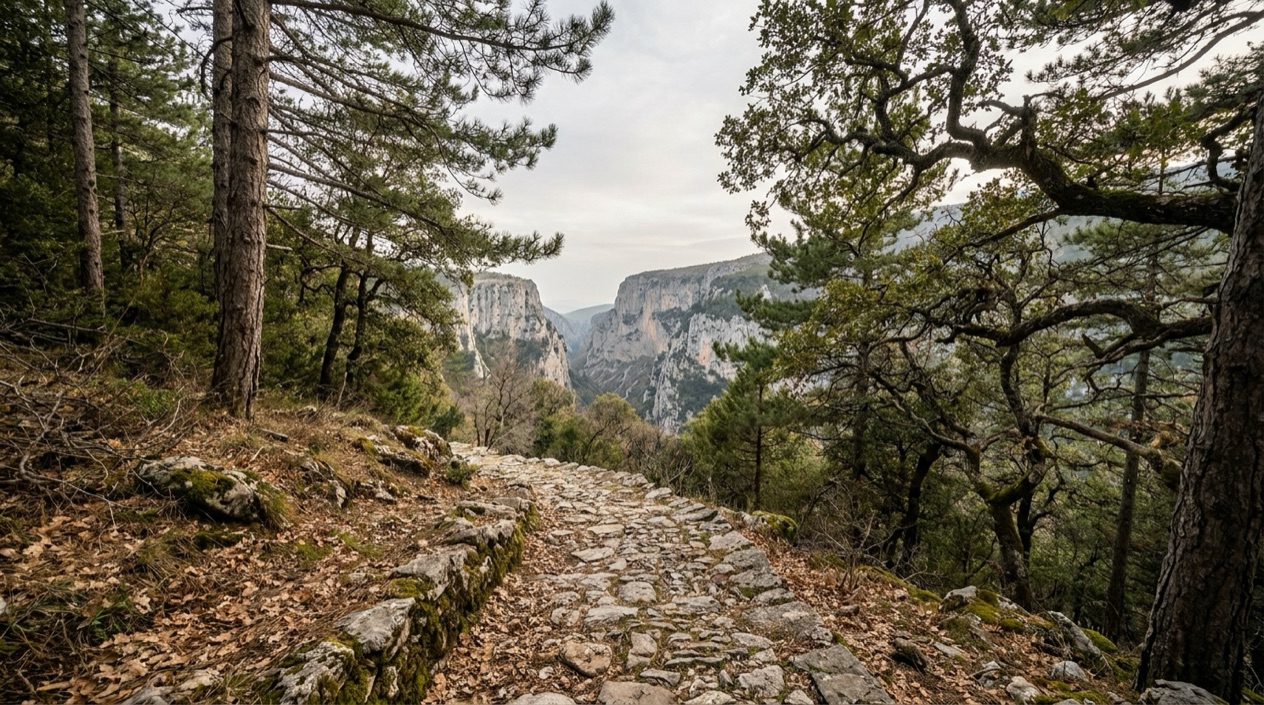
Where can you hike in Greece?
The most popular hiking areas in Greece are Mount Olympus, the gorges in Crete, the national parks in Epirus and the less-known Rhodope Mountains. Each one gives you a different kind of country: a mythic summit, a rocky cleft running down toward the sea, protected woodland and river valleys, and a range that visitors to Greece never think about.
That variety is the reason to plan a walking trip around a region rather than around the whole country. Pick the landscape that appeals to you, then build the rest of the trip around it, with a few nights in a mountain village, a stretch of coast or a city on the way.
Mount Olympus
Olympus is the mountain of the ancient gods, the place where Zeus held court in the old stories, and that mythology follows you on the way up. Walkers who come here are often drawn as much by the legend as by the scenery, and the name alone gives the landscape a weight that few other Greek mountains carry.
Expect forest, rock and the changing feel of a high mountain, where the world below shrinks as you climb. Afterward, the villages near the mountain are the natural place to sit down to a meal of grilled meat, cheese pies and salads.
The gorges of Crete
Crete is known for its gorges, deep cuts in the rock that lead walkers between steep walls toward the island’s southern waters. Walking one is a different experience from a coastal stroll. The light shifts, the stone rises on both sides, and the vegetation changes as you move along the bottom of the ravine.
Think of dakos (barley rusks topped with tomato and soft cheese), the local raki poured after a meal, and tavernas where plates of wild greens called horta arrive without being asked for.
The national parks of Epirus
Epirus is the region to look at if you want protected landscape rather than a single famous summit. Its national parks give you forest, rivers and mountain scenery, and they offer a more varied kind of walking, in which the route is often a way of moving between stone villages and wild country.
Pies with thin, hand-rolled pastry and wild greens, and slow-cooked meats from a village kitchen, are the dishes to look for when you come down off the trail.
The Rhodope Mountains
The Rhodope Mountains are the less-known hiking area of the group, and that is part of their appeal. They suit walkers who prefer to explore a range that has not been turned into a standard itinerary, and who enjoy the feeling of heading somewhere off the usual map of Greece.
Going there means stepping away from the image of blue water and white-washed islands. You trade it for forest and mountain country, where the pace is set by the walking itself and the evenings by whatever the local kitchen puts on the table.
Which trails are best known?
The best-known walking in Greece belongs to its famous places rather than to one single long trail: the slopes of Mount Olympus, the gorges of Crete and the national parks of Epirus lead the list, with the Via Egnatia as a route that carries history. Choosing among them is mostly a question of what you want around you while you walk.
Olympus and the gorges: the names everyone knows
Olympus and the Cretan gorges are the two places that come up first when Greece and walking are mentioned together. One is built on legend and altitude, the other on rock walls and the sense of descending through the island’s interior.
They make a good pair for a trip that covers both the mainland and an island, because they give very different experiences. The mountain asks you to look up, and the gorge asks you to look around you. After either, a long lunch at a village taverna with grilled vegetables, olives, bread and a jug of house wine is the usual reward.
The Via Egnatia in northern Greece
The Via Egnatia in northern Greece is part of the pilgrimage route to Jerusalem. It is a different kind of trail from the mountain and gorge walks, one whose interest lies in the history of the people who traveled along it and in the places connected to it.
Religious tourism in Greece is centered on Mount Athos and on the sites the Apostle Paul visited during his travels, especially Philippi. Travelers who care about this side of the country can read the landscape through that thread, and a trip in northern Greece can follow the old route through places that carry that story.
Epirus, a region of parks
In Epirus the best-known walking is organized around the national parks rather than around one celebrated path. That makes the region good for a flexible trip, where you can spend a few days moving between villages and the surrounding countryside and let the landscape decide the route.
It is also a region that lends itself to the slower side of travel. You walk, you stop in a village, you eat, and you walk again. The food of the region, with its pies, cheeses and mountain stews, is a reason to come in itself.
What should you know before you go?
The main thing to know is that Greek hiking is regional: you choose Olympus, Crete, Epirus or the Rhodope, and then plan the trip around that one place. Treating the country as a single walking destination leads to a lot of travel and not much time on the trail.
Choosing a region
Start with the kind of scenery that draws you. A summit with a mythic name points to Olympus. Rock-walled ravines that open toward the sea point to Crete. Protected forests and river country point to the parks of Epirus, and an off-the-radar mountain range points to the Rhodope.
Once the region is chosen, the rest of the trip falls into place around it. Olympus and the Rhodope sit on the mainland, Crete is an island with its own beaches and food, and Epirus combines mountain country with a mainland coast. Each has a different feel when you step off the trail, and that is worth thinking about as much as the walk itself.
Pairing a hike with the sea
The most popular sailing areas include the Ionian Islands, the Cyclades, the Saronic Gulf Islands, the Dodecanese and the Sporades, and the Ionian Islands are described as ideal for novice sailors thanks to mild winds and short distances.
For a quieter-minded plan, the North Aegean Islands are less known for sailing, but the distances between islands are greater, so fewer boats are typically present and anchorages are easier to find.
Beyond the trail
Greece rewards a trip that mixes landscapes. Crete, Zakynthos, Rhodes, Gavdos and Antiparos are the islands best known for naturist beaches, and the mainland beaches of Chalkidiki, Epirus and the Peloponnese are among the most famous in the country, so a walking trip does not have to leave the coast behind.
In the cities, football offers another way to spend an evening. Olympiakos plays at Karaiskakis Stadium in Piraeus, and AEK Athens, Panathinaikos and PAOK of Thessaloniki are among the clubs of the Super League. A match is an easy way to see a different side of Greek life after days among mountains.
Good to know before you go
Greece uses the euro, and a trip built around hiking is often a trip through villages, so it helps to think of each region as its own small journey rather than one continuous route. Mountain and gorge country can be tiring to cover on foot, so give each region its own days rather than trying to see them all at once.
Once you know which of the four areas you want, the rest is a matter of picking a base nearby and letting the local table, the nearby coast and the trail itself fill the days.
Sources
- Wikivoyage, Greece, section Do (https://en.wikivoyage.org/wiki/Greece#Do), checked October 12, 2026
To plan your stay
- Best Time to Visit Greece: September and Late May to Early June
- Arachova: Parnassus Mountain Town, Formaela Cheese, Ski Season and Saint George's Day
- American Airlines Flights to Greece: U.S. Cities, Athens Arrivals and Onward Island Flights
- Greece on a Budget: Cash Machines, Cards, Beaches and Ferries