
A mask pressed against your face, a first breath through the snorkel, and the bottom of a Greek cove slides into focus: rock ledges, dark patches of seagrass, a small school of fish turning all at once. Above you a fishing caique knocks gently against its mooring and the village taverna is already setting out chairs.
Greece is a country of islands and long coastlines, and the sea is as much a part of a trip here as the ruins and the food. This is the story of where travelers go under the surface, which islands people name first, and what to pack for it.
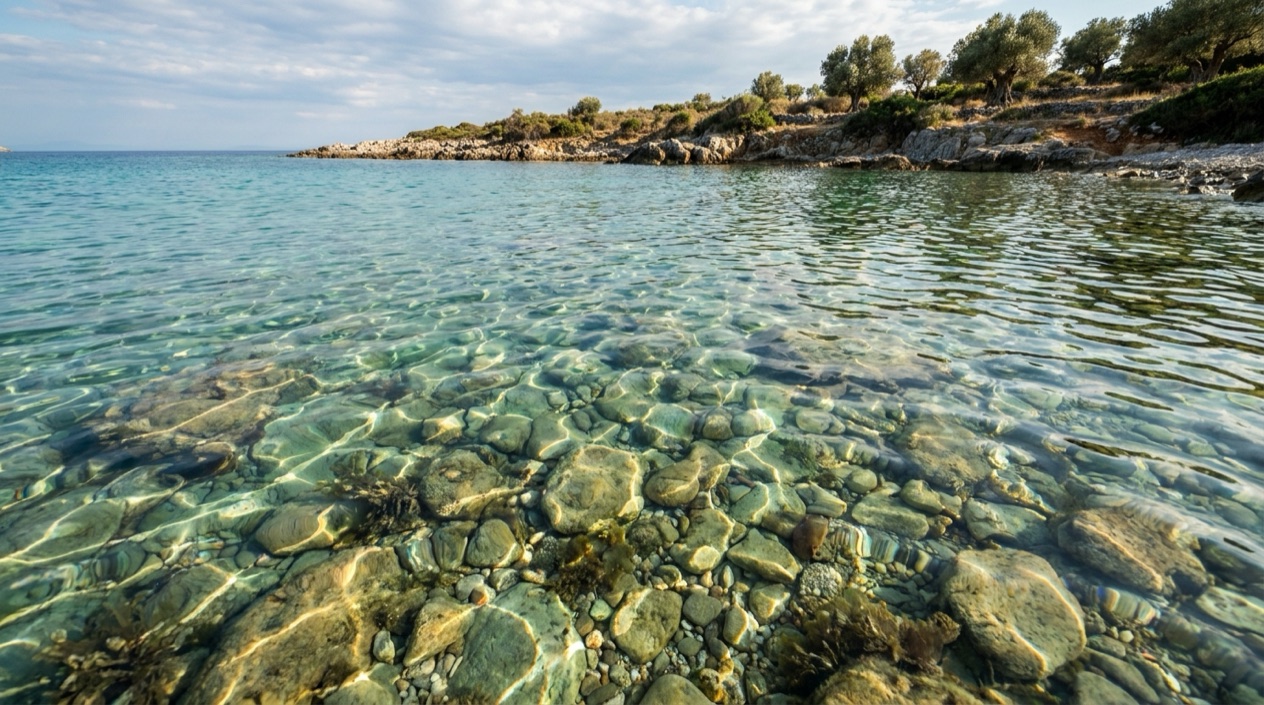
Where can you dive and snorkel in Greece?
You can dive and snorkel along the coasts of the Greek islands and the mainland, anywhere a rocky shore drops into the water, and the islands are where people begin. The country is made of island groups, each with its own character under the surface as well as above it: the Ionian Islands, the Cyclades, the Saronic Gulf Islands, the Dodecanese and the Sporades are the sailing areas that travelers name most often, and the North Aegean Islands sit apart from them.
Snorkeling asks very little of you. You walk into the water from a beach or a rock shelf, put your face down and look.
What you tend to see in the Mediterranean is quieter and subtler than a tropical reef: boulders furred with algae, meadows of seagrass, sea urchins wedged into cracks, and fish such as wrasse and damselfish moving through the shallows. With patience you may also spot an octopus tucked into a crevice or a larger fish hanging in deeper water.
Rocky coves and sea caves
Much of the Greek coastline is rock, and that shapes the diving. Cliffs continue below the waterline in ledges, walls and boulder slopes, and in places the sea has carved caves and arches that divers swim into with a light.
Light moves through the water in shafts, and the ceilings are often colored with encrusting life. Some islands are known for this kind of scenery, and it is the reason that people prefer a boat trip along a cliffy shore to a day on one beach.
If you are snorkeling rather than diving, the same logic applies at a smaller scale. Look for the places where rock meets water, at the end of a bay or along the base of a headland, because that is where fish gather and where there is something to look at. Sandy stretches of seabed are less rewarding to float over than a rocky edge.
Wrecks, history and the sea floor
A country with this much maritime history has left a good deal on the sea floor. Ships from the last century lie in various waters, and the ancient world traded across these same stretches of sea, so amphorae and other remains turn up in Greek waters.
Visitors should treat anything old they see as something to look at and leave where it is. Wrecks are a diver’s subject, usually reached by boat with a dive center, while snorkelers are better served by shallow reefs and rock walls close to shore.
Sailing to find your own water
Another way to snorkel is to put the boat first. The Ionian Islands are ideal for novice sailors, thanks to mild winds and short distances between islands. The Cyclades, the Saronic Gulf Islands, the Dodecanese and the Sporades are also among the most popular sailing areas. Anchoring in a bay and swimming off the stern gives you a snorkeling spot that no road reaches.
The North Aegean Islands are less known for sailing, but the distances between islands are greater, so fewer boats are typically present and it is easier to find anchorages. For the Aegean as a whole, spring and autumn are the best times to sail, since July and August can bring strong Meltemi winds, reaching up to 8 Beauforts, which suit experienced skippers better. Wind shapes how a day on the water feels, so it is worth thinking about before you plan a boat day in those months.
Which islands are best known?
The islands people mention first for time in the sea are Crete, Zakynthos, Rhodes and the island groups of the Cyclades and the Sporades. Not all of them are known for the same reason, and the right one depends on whether you want a place to dive, a place to snorkel off a beach, or a base for a sailing week.
Zakynthos and the Ionian Islands
Zakynthos, in the Ionian, is known for its coastline of cliffs, sea caves and rock arches, and for the loggerhead turtles that nest on its shores. Turtle nesting is a protected matter, so what you do here is watch from a respectful distance and treat any sighting as a lucky chance, never a promise. Boat trips along the coast take in the caves, and swimmers slip off the boat into the water beside them.
The wider Ionian group suits people who like a gentler pace on the water. Mild winds and short distances between islands make it the area that novice sailors are pointed to, and it is a natural fit for a week of coves, swims and snorkeling stops from a hired boat. Zakynthos also appears among the islands popular for naturist beaches, in case that matters to your plans.
Crete
Crete is the largest of the islands in the common imagination, and it has a long coastline that runs from busy resort beaches to remote shores reached only by boat or on foot. It is among the places best known for naturist beaches, and the gorges that cut down to the sea are the hiking areas people talk about. For the water, think of Crete as a place with many options, from a morning swim and snorkel off a town beach to a boat trip to a more remote stretch.
Because the island is large, the conditions on one coast are not those of another, and a day’s plan is worth shaping around where you are staying rather than trying to cross the island for a single swim. Pair the sea with the rest of the island: a gorge walk, a lunch of grilled fish, a glass of raki at a kafenio, the traditional coffeehouse.
Rhodes and the Dodecanese
Rhodes is the best known island of the Dodecanese and is also on the list of islands popular for naturist beaches. The Dodecanese as a group are among the popular sailing areas, which means boats and anchorages are part of how the islands are seen. Swimmers and snorkelers can pair a beach day with the walled old town, where stone lanes lead to small cafés and shops selling sponges and olive-oil soap.
The Dodecanese have a long tradition of sponge gathering, and you will see natural sponges for sale on some of the islands. They are a souvenir that ties the shop shelf back to the sea you have just been swimming in.
The Cyclades, the Saronic Gulf and the Sporades
In July and August, Aegean sailors have to think about the Meltemi, so boat days depend on the wind. The Saronic Gulf Islands, close to Athens and Piraeus, are also among the popular sailing areas.
The Sporades are another of the popular sailing areas, and among them Alonissos is known for a marine park that protects the sea around it, where Mediterranean monk seals live. Seals are rare and shy, so treat the park as a place to enjoy sea and shoreline, not as a place where an animal is guaranteed to appear.
What do you need?
For snorkeling you need a mask, a snorkel and a pair of fins, plus a swimsuit and a towel, and that is the whole kit. A mask that fits your face matters more than any other piece, because a leaking mask ruins a swim. Try it on by pressing it to your face without the strap and breathing in through your nose: if it holds, it fits.
Gear for a day in the water
- A mask that fits and a snorkel with a comfortable mouthpiece.
- Fins, which help in deeper water and over rocky edges.
- Water shoes, useful where the entry into the sea is over rock.
- A rash guard or a light shirt, since a long float in the sun burns the back of the neck and the shoulders.
- Sunscreen and a hat for the time out of the water.
- A waterproof bag for phone and keys on a boat day.
Rocks and sea urchins are part of the Greek shoreline, which is why water shoes are such a sensible addition. They also make it easier to walk over pebbles to the water.
If you want to dive
Diving is a step beyond snorkeling. Divers bring their certification card and logbook, and beginners can look for an introductory dive with an instructor on islands that have dive centers. Wrecks, caves and drop-offs are the kind of thing divers go after, and the dive center tells you what the conditions allow on a given day.
Think about the wind as well. In the Aegean, July and August can bring strong Meltemi winds, which affect boats and the way the sea feels, and spring and autumn are the best times to sail there. Plan a boat-based day with that in mind and leave room to change it.
Combining the sea with the rest of Greece
Few people come to Greece only for the water, and the country makes it easy to mix. The mainland has famous beaches in Chalkidiki, Epirus and the Peloponnese, while hikers head for Mount Olympus, the gorges of Crete and the national parks of Epirus.
After a long swim, the Greek table is the reward: grilled fish, octopus, a plate of meze to share, a salad of tomatoes and feta, and a cold glass of something with ice. A taverna on the waterfront is the natural place to dry off.
Good to know before you go
Sea days in Greece run on sun and wind, so a hat, sunscreen and a plan that bends with the weather are worth more than any gadget. In the Aegean, the Meltemi can blow hard in July and August, and the Ionian Islands are the area known for mild winds. Keep cash and cards for the small waterfront places where you will want to stop after a swim, and treat wildlife, nesting beaches and anything on the sea floor with the care they ask for.
Sources
- Wikivoyage, Greece, section Do (https://en.wikivoyage.org/wiki/Greece#Do), checked October 12, 2026
To plan your stay
- Best Time to Visit Greece: September and Late May to Early June
- Arachova: Parnassus Mountain Town, Formaela Cheese, Ski Season and Saint George's Day
- American Airlines Flights to Greece: U.S. Cities, Athens Arrivals and Onward Island Flights
- Greece on a Budget: Cash Machines, Cards, Beaches and Ferries