
You sit down at a taverna table and, before anyone has asked what you want, a basket of bread and a glass of water arrive. At the end of the meal a small plate of something sweet shows up that you never ordered.
Those little gestures set the rhythm of eating in Greece, where meals are slow, shared and built around hospitality. Good manners here come down to a few habits: let the table set the pace, ask what the fish costs before you order it, and expect a couple of small extras on the bill.
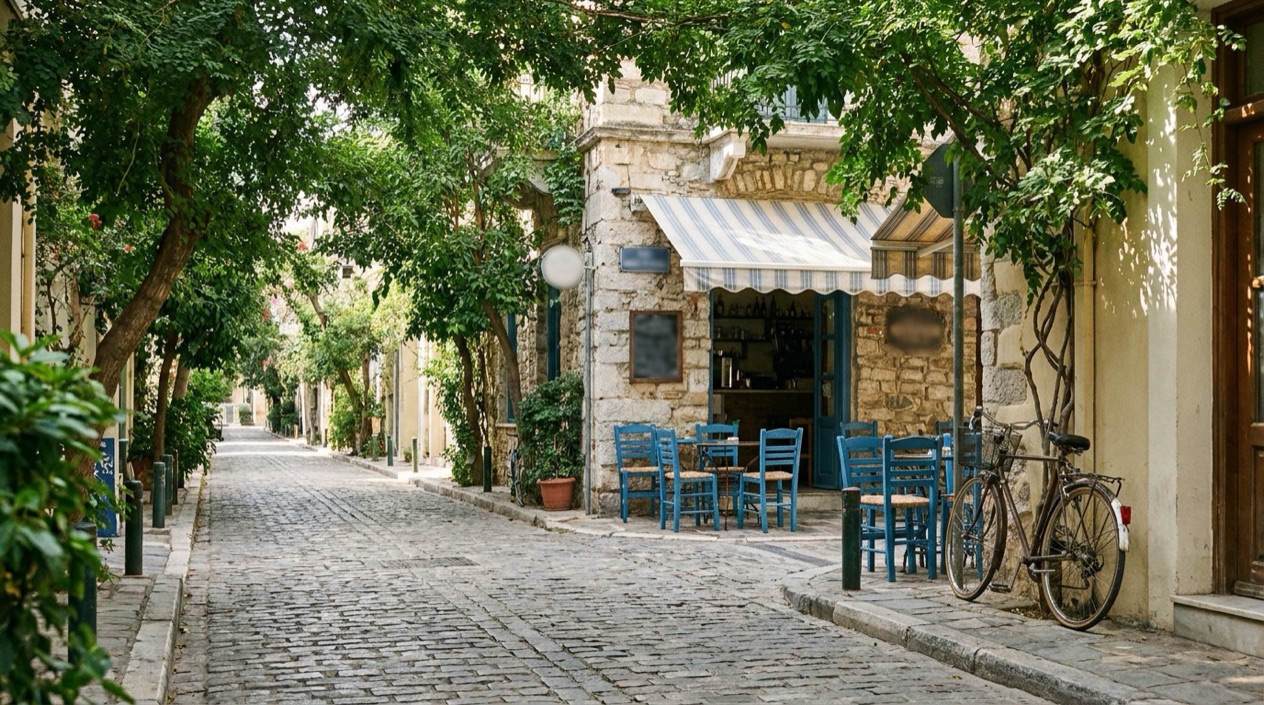
What are the dining rules in Greece?
The dining rules in Greece are mostly habits of hospitality, together with a few legal points about smoking, seafood labeling and fire. Nobody expects you to know every custom, but knowing the rhythm of a meal makes a table feel like yours from the first minute.
A Greek meal is rarely a sequence of individual plates. Dishes land in the middle of the table, people reach across with their forks, and the order in which things arrive is loose. Order a few plates at a time rather than everything at once, and let the table fill gradually.
Bread, water and the free sweet
It is customary to be served water and bread soon after you are seated. You did not ask for them and you are not being upsold. They are part of welcoming you, and they give you something to nibble while you read the menu and decide.
The custom has a mirror image at the end. When you ask for the bill, a small free dessert often arrives with it, which in many places means a bowl of fruit, a sweet spoonful or a little cake. Accept it with a smile. It tells you the kitchen is glad you came, and it is a reason not to rush out the moment the plates are cleared.
Reading a restaurant before you sit down
A few signals warn you that a place is aimed squarely at passing tourists rather than at people who live nearby. Desserts listed on the menu, large photo posters of food outside, and waiters calling out to people on the sidewalk are all bad signs for authenticity. So is a waiter who takes plates away while you are still sitting there, since a Greek table is meant to be left cluttered until you are done.
None of this means you cannot eat well in such a place. It just helps you decide whether to keep walking. A side street taverna with a handwritten menu and a table of regulars is often a better bet than a corner spot with a glossy laminated one.
What arrives on the plate
Greek salad is traditionally dressed with nothing but olive oil, tomato, cucumber, onion, olives and a slab of feta on top. Vinaigrette or lettuce show up only in the most tourist-oriented restaurants, so if your salad comes with a bottled-style dressing, you know what kind of place you are in.
Genuine Greek yogurt has 10% fat, which makes it thicker and richer than the typical supermarket cup. Ordered with honey and walnuts, it is a dessert in itself. Baklava, the other sweet you will meet at almost every counter, is made of tissue-thin layers of pastry with honey, cinnamon and chopped walnuts. Both are best treated as the end of a meal or a pause in the afternoon, not a side dish.
Vegetarians and vegans will find plenty to eat on a Greek menu, since beans, greens, baked vegetables and cheese dishes are everyday food. Restaurants catering strictly to vegans and vegetarians, however, are practically non-existent outside Athens and Thessaloniki, so in villages and on the islands you build a meal from the regular menu.
Smoking, frozen seafood and a rude gesture
Smoking is prohibited by law in all public places, restaurants and cafeterias included. A hotline, 1142, exists to report people and establishments that break the ban, which tells you the rule is meant seriously even if you see an ashtray here and there.
By law, frozen seafood must be marked as such on the menu. If a dish of octopus or squid is not marked, you can reasonably read that as fresh, and if you are unsure, a waiter can answer in a sentence.
One small gesture to keep out of your repertoire: holding up your palm with the fingers extended outward is rude. Known as the mountza, it is akin to giving someone the middle finger. Waving a waiter over with an open hand held that way is a mistake, so catch their eye and nod instead.
When do people eat?
Greeks eat lunch in the afternoon and dinner well into the evening, noticeably later than most Americans are used to. If you sit down at an American hour, you will often find yourself among other travelers.
| Meal | Time |
|---|---|
| Lunch for Greeks | 14:00-15:00 |
| Dinner for Greeks | 21:00-23:00 |
| Earliest opening of tourist establishments | 12:00 |
Lunch as the main event
Lunch is the meal where families and coworkers sit down for something substantial. Cooked dishes like baked beans, stuffed vegetables, stews and grilled meats are what fill the tables, along with salads and bread. Restaurants that cater to visitors open their doors earlier so that travelers on a different clock can eat, which is why you can find a seat at midday even when locals have not yet arrived.
If you want to eat among Greeks, plan to arrive when the room is filling. A table of locals lingering over coffee after lunch is a good sign. You can enjoy the same dishes at an earlier hour, but the atmosphere changes noticeably as the afternoon goes on.
Dinner and the long evening
Dinner runs deep into the evening, and a table is yours for as long as you want it. Nobody turns tables quickly in a taverna, and nobody brings the bill until you ask. That is the reason the free dessert appears at the end: the check is a request, not a hint.
Dinner in Greece is built from many small plates, so a group might start with dips, fried zucchini, grilled cheese and a salad, then move to grilled fish or meat, and finish with fruit or sweets. Pace yourselves. A first round of meze (small shared dishes) can easily be enough to fill you, and the main plates come at the speed of the conversation.
Coffee, sweets and snacks between meals
Between meals, the rhythm runs through cafes and kafenia, the traditional coffeehouses where locals nurse one cup for a long time. A pastry shop counter with trays of baklava is a fine place to stand for a minute with something sweet, and a bowl of thick yogurt with honey works as a light stop at any hour.
Fast food exists too, and a Greek chain such as Goody’s is a popular choice when you want something quick. It is a different kind of stop from a taverna, and nobody expects you to linger, which makes it a handy fallback when you cannot wait for a late dinner.
How does the bill work?
The bill in a Greek restaurant is built from what you ordered, a cover fee charged per person in many places, and fresh fish priced by weight. Knowing those three pieces keeps the total from surprising you.
| Charge | Amount |
|---|---|
| Cover fee, per person | €0.30 to €2 |
| Hamburger with Coke at Goody’s | €3-5 |
The cover fee
It is common for restaurants to charge a cover fee officially, per person, and it is the reason the bread arrives without being asked for. It shows up on the bill as its own line, and the amount differs from place to place.
A modest cover fee is simply part of eating out. If a restaurant’s charge tends toward the top of the range, consider eating elsewhere. A place that asks for that much for bread and a table is probably counting on visitors who do not look at the check.
Fresh fish by the kilogram
Fresh fish in Greece is sold by the kilogram and can be very expensive. The menu gives a price for the weight, and the fish you choose is weighed before it is cooked, so the final number depends on the size of the one you pick. A whole fish arrives at the table grilled with olive oil and lemon, and it is a pleasure.
Budget diners should ask the cost of their portion before ordering. It is an ordinary question, and a good waiter will answer it directly. If the number is higher than you expected, ask about another fish or choose something from the grill.
Asking for the bill and splitting it
Because nobody hurries you, the bill comes only when you ask for it. Catch the waiter’s eye, make a small writing motion in the air, or just say you would like the check. The small free dessert that comes with it is part of the ritual, so do not be surprised when a plate you did not order lands in front of you.
Shared dishes make splitting by item awkward, and in a group it is common simply to divide the total. Looking over the bill for the cover fee line and for any fish priced by weight takes a moment and tells you whether everything matches what you ate.
Budget meals and the fast-food option
If a taverna dinner is more than you want to spend, Goody’s, a popular fast food chain, sells a hamburger with Coke for the amount in the table. It is a different experience, with no bread basket and no sweet at the end, but it is one way to keep a day’s food costs in check.
Good to know before you go
Greek restaurants run on a set of small, steady customs: water and bread first, a sweet with the bill, and a table that stays yours. If you are cooking outdoors yourself, remember that during the fire ban every outdoor activity that could cause a forest fire is prohibited, including campfires, barbecues and fireworks.
The fine for causing a forest fire can be €200,000, and if you see a fire, call 112. At the table itself, the smoking ban applies inside restaurants and cafeterias, so step outside if you want a cigarette.
Sources
- Wikivoyage, Greece (https://en.wikivoyage.org/wiki/Greece), checked October 12, 2026
To plan your stay
- Best Time to Visit Greece: September and Late May to Early June
- Arachova: Parnassus Mountain Town, Formaela Cheese, Ski Season and Saint George's Day
- American Airlines Flights to Greece: U.S. Cities, Athens Arrivals and Onward Island Flights
- Greece on a Budget: Cash Machines, Cards, Beaches and Ferries