
A bike leaning against the wall of a village kafenio, a coffee going cold while someone studies a map, and beyond the last house a road that bends toward either mountains or sea: that is how a ride in Greece often starts. The country gives a cyclist mainland regions with beaches and national parks, gorges on Crete, and island groups scattered across several seas. Spring and autumn are the seasons the Aegean favors most.
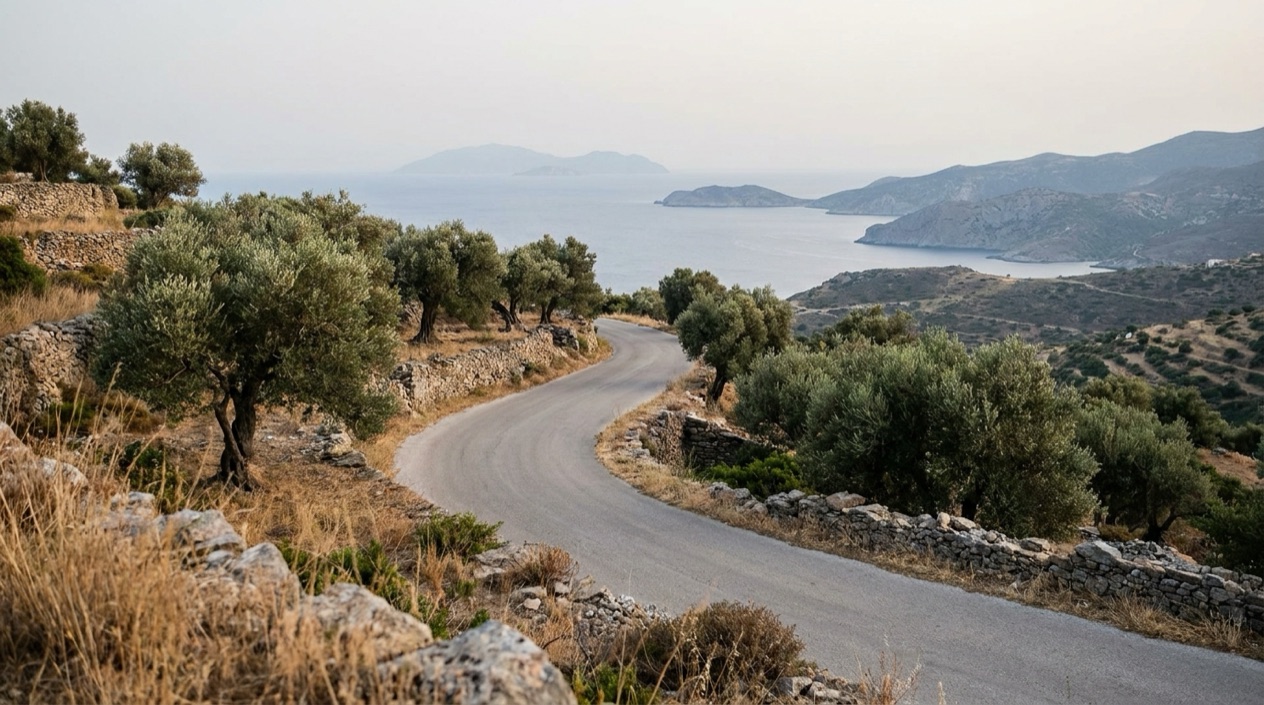
Where can you cycle in Greece?
You can build a cycling trip around almost any region of Greece, from the beach coasts of the mainland to the mountains of the north and the islands of the Aegean and the Ionian Sea.
Think of each region as a base. You arrive, ride out in the cool of the day, stop where a village square offers a table under a plane tree, and come back for a taverna dinner of grilled fish or slow-cooked lamb. Planning around a handful of bases suits the country better than trying to cover everything in one line on the map.
The mainland coasts: Chalkidiki, Epirus and the Peloponnese
Chalkidiki, Epirus and the Peloponnese hold the most famous mainland beaches in Greece, and that makes them natural regions for a ride that ends in the water. Chalkidiki spreads into peninsulas with pine-edged shores. Epirus pairs its coast with inland mountains and villages. The Peloponnese adds ancient sites, orange groves and small harbor towns where fishermen mend nets in the afternoon.
The pleasure here is the mix. You can spend a morning among ruins or stone villages, then swim, then sit over a plate of grilled octopus and a glass of ouzo or local wine. Autumn suits this kind of trip well, since the sea is still swimming-warm after the summer and the roads belong less to holiday traffic.
Mountains and gorges: Olympus, Crete, Epirus and the Rhodope
The most popular hiking areas in Greece are Mount Olympus, the gorges of Crete, the national parks of Epirus and the less-known Rhodope Mountains. For a cyclist these are the places where the landscape turns serious: forests, rock walls, river valleys and villages that still keep a kafenio open for the old men and their backgammon boards.
Ride around these areas and walk into them. Many a cyclist locks the bike for a day and follows a footpath into a gorge or a park, then rolls on to the next village for a pie of wild greens or a bowl of beans. The Rhodope Mountains, less visited than the others, reward anyone who likes a region with few other travelers on the road.
The islands as bases
Crete, Zakynthos, Rhodes, Gavdos and Antiparos are the islands best known for naturist beaches, which tells you something about their shores: each has coves and stretches of coast worth a detour. Crete offers gorges and a long list of villages, Rhodes a walled old town, Zakynthos a coast that meets the Ionian Sea, and Antiparos and Gavdos a smaller scale.
An island base lets you unpack once and ride out in a different direction each day, returning to the same harbor for dinner. Rest days can be spent at the beach, or in a town with a good bakery for spinach and cheese pies and a coffee frappé on the waterfront.
Which routes are best known?
The routes that carry the biggest reputation in Greece are the trails and corridors that travelers already follow on foot or by boat, and a cyclist can read the country through them. The Via Egnatia in northern Greece is part of the pilgrimage route to Jerusalem, a line across the north that has moved travelers for a very long time.
The Via Egnatia and the northern pilgrim trail
The Via Egnatia belongs to the north of the country and is part of the pilgrimage route to Jerusalem. Followed as an idea rather than a single marked line, it links the Greek north with places of faith, among them Philippi, one of the sites the Apostle Paul visited on his travels.
What you see along such a corridor is the quieter Greece: farm towns, village churches, markets selling cheese and peppers, and old stones standing in fields. It is a way to travel for riders who like history underfoot and a theme to follow, more than a beach to reach.
Olympus, Crete’s gorges and the Epirus parks
Mount Olympus, the gorges of Crete and the national parks of Epirus are the mountain landscapes most often named for outdoor travel in Greece. They make good anchors for a route, because each gives you a destination and a reason to stop: a trailhead, a park entrance, a gorge mouth.
Build a ride that approaches one of them, spend a day on foot inside it, and move on. In Crete that means gorges and villages with raki poured at the end of a meal. In Epirus it means park country and stone-built settlements. On Olympus it means a mountain that has shaped Greek stories about the gods for as long as they have been told.
Mount Athos and Philippi as stops of faith
Mount Athos and the sites of the Apostle Paul’s journeys, especially Philippi, are the centers of religious tourism in Greece. For a rider drawn to monasteries and ruins, they give a route a purpose beyond scenery.
Philippi can anchor a day among ancient stones, while Athos stays a place to understand from a distance and read about before you go. A ride in this part of the country pairs well with a late lunch of grilled meat or beans and a slow evening in a town square.
A rest day in Piraeus or Thessaloniki
On a rest day, Greek football offers a different way to feel a city. Olympiakos plays at Karaiskakis Stadium in Piraeus, while AEK Athens and Panathinaikos play in Athens and PAOK in Thessaloniki. Fourteen clubs play in the Super League and sixteen in Super League 2.
Even without a ticket you pick up the mood: club colors in shop windows, fans arguing over a coffee, jerseys on the ferries. It is a good way to see what a big Greek city does with its evenings once the bike is parked.
Can you bring a bike on ferries?
A trip that crosses the sea is part of cycling in Greece, because the island groups, from the Ionian to the Cyclades, the Saronic Gulf, the Dodecanese and the Sporades, are the places travelers sail between. Each operator and each route sets its own terms for carrying a bike, so the exact answer belongs to the line you choose.
The island groups you can link
The Ionian Islands, the Cyclades, the Saronic Gulf Islands, the Dodecanese and the Sporades are the most popular sailing areas in Greece. Each group has its own character, and each invites a trip built around a few islands instead of a rushed tour of many.
A cyclist looking at that map sees bases: unpack on one island, ride its roads, and carry on to the next. Harbors in Greece are social places, with cafés, bakeries and fish tavernas along the quay, so the waiting and the arriving become part of the day rather than a gap in it.
Seasons and wind at sea
The best times for sailing in the Aegean are spring and autumn. July and August can bring strong Meltemi winds, reaching up to 8 Beauforts, which suit experienced skippers better than casual travelers. That wind shapes how the Aegean feels in high summer, with a sea that can be lively and a breeze that follows you ashore.
For a cyclist, spring and autumn also frame the season that matters on land. They are the months the sea itself favors, and they are good moments to plan a trip that includes island crossings.
Ionian and North Aegean waters
The Ionian Islands are ideal for novice sailors because of mild winds and short distances between them. The North Aegean Islands are less known for sailing. The distances between them are greater, which means fewer boats are typically present and anchorages are easier to find.
Read as a map of the sea, this suggests two moods. The Ionian is a region of close neighbors, and the North Aegean of farther, quieter islands, where a trip feels more like an expedition.
Good to know before you go
Spring and autumn are the seasons the Aegean favors, while July and August can bring strong Meltemi winds, so the shoulder months suit a trip that mixes rides and island crossings. Plan around a few regions rather than the whole country: Chalkidiki, Epirus and the Peloponnese on the mainland, then the island group that appeals most. Mountain areas such as Olympus, the Crete gorges and the Rhodope reward a day on foot between rides.
Sources
- Wikivoyage, Greece, section Do (https://en.wikivoyage.org/wiki/Greece#Do), checked October 12, 2026
To plan your stay
- Best Time to Visit Greece: September and Late May to Early June
- Arachova: Parnassus Mountain Town, Formaela Cheese, Ski Season and Saint George's Day
- American Airlines Flights to Greece: U.S. Cities, Athens Arrivals and Onward Island Flights
- Greece on a Budget: Cash Machines, Cards, Beaches and Ferries