
On the whitewashed steps of Oia, hundreds of phones rise at once toward the caldera, and the whole village seems to lean the same way. Down in Athens, lines of visitors file toward the Acropolis, while a few islands away a ferry unloads at a port with hardly a soul waiting. Greece shows both faces, and which one you meet depends on the island you pick and the month you travel.
Which places are most crowded in Greece?
Santorini is the place where the pressure is clearest, because the island has put an actual limit on it. Athens and its Acropolis, along with island towns such as Mykonos, are the other names where the weight of tourism gathers. Each of these places has its own reasons, and seeing them helps you choose how to visit.
Santorini and the caldera villages
Santorini has about 15,000 residents, and before the cap it was receiving up to 18,000 tourists in a single day. That is more visitors than people who live on the island, and it explains the feeling in the narrow lanes along the rim, where the view across the caldera draws everyone to the same few railings.
The limit that now applies is on cruise ship visitors, set at 8,000 per day. Oia is the village most associated with the panoramic caldera view, so it is where the effect of the cap is felt most directly.
If you want Santorini without the press of bodies, look at what else the island holds. Ancient Thera sits on a ridge of the steep Messavouno mountain, a ruined hilltop town with a very different mood from the cliff-edge villages. Wandering there gives you the island’s history and its views without the line of people at the sunset railings.
Athens and the Acropolis
Athens is where most trips to Greece begin, and the Acropolis is the reason people come. The city’s visitor numbers were lifted by the 2004 Summer Olympic Games, which put Athens in front of the world, and by Eurovision in 2006. The New Acropolis Museum then added its own pull to the flow of tourists.
The result is a city where the ancient sites, the museum and the old neighborhoods around them share a large audience. Greece counts 21 UNESCO World Heritage Sites, among the most in Europe, and the Acropolis is the one that travelers fold into a first visit. Seeing it among other travelers is part of the experience here, much as it was for the Roman visitors who once toured Athens, Corinth and Thebes to see the centers of Greek philosophy and science.
Mykonos and the island resorts
Mykonos belongs on any list of islands where tourism is the main business. It is ranked among the most LGBT-friendly destinations in Europe and the world, a reputation it shares with Skiathos, and that draws travelers from many countries to the same chora (the main town) and the same stretches of coast.
The island resort model goes back to the 1960s and 1970s, when mass tourism began to flourish in Greece and large-scale construction of hotels and other facilities followed. Many island economies still run on that legacy, which is why a season here can feel so concentrated into a few months.
When are crowds worst?
Crowds are heaviest between May and September, the months when approximately 75% of all tourist visits to Greece happen. That single stretch carries three quarters of the year’s travelers, which is why a trip in these months feels so different from one at any other time.
The May to September stretch
Within this window, the islands and the big archaeological sites are where the concentration shows. Ferries to the Cyclades fill with travelers heading for the same handful of ports, village squares turn into long tables of diners, and the viewpoints that appear on every postcard gather their share of cameras.
Santorini’s numbers give a sense of the scale. A daily total of up to 18,000 tourists, on an island of 15,000 residents, is what a peak day looked like before the cap on cruise visitors. The limit is a response to exactly this season, when the caldera rim is the thing everyone wants to see.
How the pattern was built
The calendar is not an accident. Mass tourism in modern Greece began to flourish in the 1960s and 1970s, and hotels went up to receive it. The model that grew from it was built around the months of sea and sun, so the infrastructure, the ferry schedules and the rhythm of island life all follow the same season.
Later boosts, from the Olympic Games in Athens to the arrival of the New Acropolis Museum, fed visitors into a country already organized around a summer peak. The city of Thessaloniki, European Youth Capital in 2014, shows that attention has also reached places beyond the classic island circuit.
What the rest of the year looks like
If three quarters of visits fall between May and September, the other months share what remains. October, today’s month, sits just outside that window, along with the colder part of the year, and the country keeps working through them. Ski towns, thermal springs and city streets all have their season when the beach crowds are gone.
The mood on the islands changes with the calendar, and the rest of Greece does not stop. Mainland towns, mountain villages and the capital carry on, which is the opening for anyone who wants Greece without the summer crush.
How do you avoid them?
The most direct way is to travel outside May to September, and the second is to choose places that the summer rush does not define. Greece gives you plenty to work with, from mountain towns to ancient hilltops to islands reached by shorter ferry rides.
Travel outside the peak months
With about 75% of tourist visits packed into May to September, the other months are the plain answer. Choosing them changes the experience of every site and village in the country, because the same places are shared among far fewer travelers.
Winter opens doors that summer keeps shut. The main ski destinations are Arachova, Kalavryta, Karpenisi and Metsovo, mountain towns where the season is about snow and fires in the hearth instead of beaches. Greece also has 752 thermal springs, many classified as therapeutic, and soaking in one suits a cold day far better than a hot one.
Choose the less obvious island
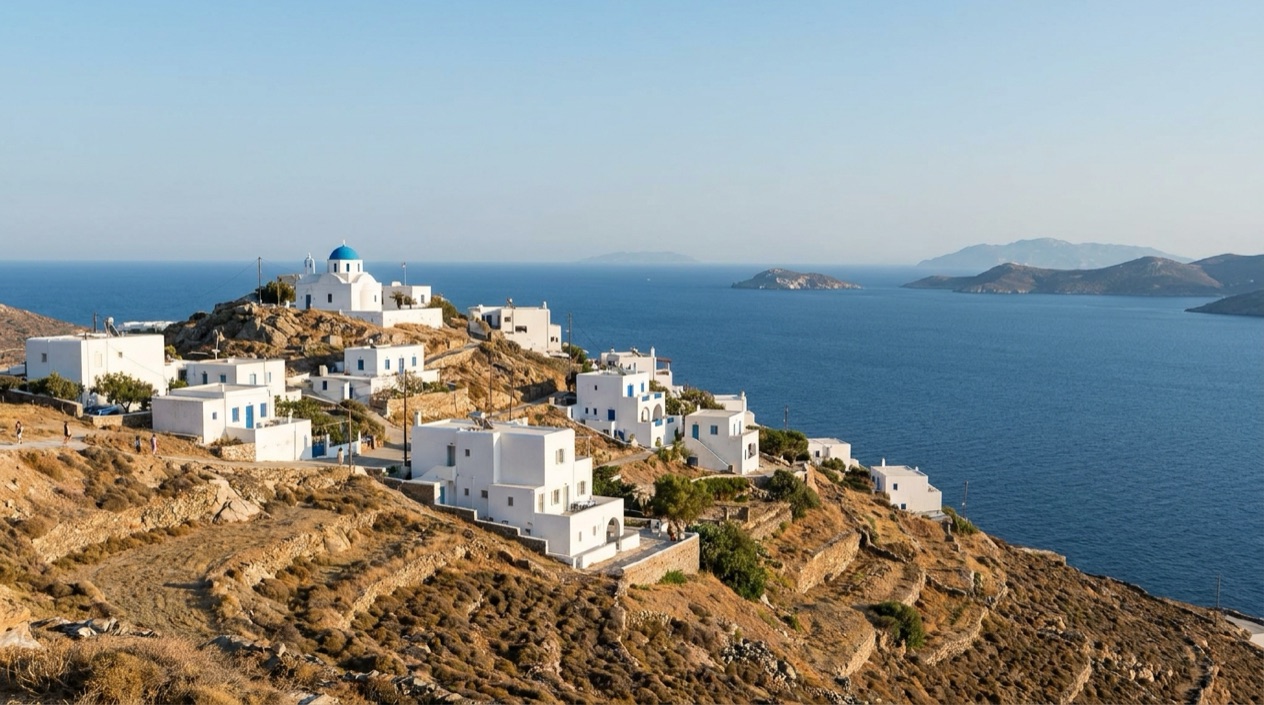
Not every island is Santorini. Syros is linked to Piraeus by a ferry that takes only 2.5 hours, so it can be reached from the Athens port without a long crossing. Its capital, with its own character, gives you a Cycladic town where the story is not told through a single viewpoint.
The point is to match the island to what you want. If the caldera view is the draw, Santorini still delivers it, now under a cap on cruise visitors. If you would rather eat in a harbor taverna and walk a town, an island like Syros offers that.
Go beyond the famous views
Spreading your stops across the mainland and the islands means you see more of it and share each place with fewer people.
On Santorini itself, Ancient Thera on the ridge of Messavouno gives you a different view of the island than the Oia panorama does. Thessaloniki, once European Youth Capital, offers a city stay with its own streets and its own food, away from the Athens-and-islands loop.
Good to know before you go
Greece rewards a flexible plan: a stay built around a mountain town, a thermal spring or a lesser-visited island can feel quite different from the summer picture. Eating in a taverna with a plate of meze (small shared dishes) and a glass of ouzo is part of the country in any month, so you lose nothing by traveling when fewer people do.
Sources
- Wikipedia, Overtourism (https://en.wikipedia.org/wiki/Overtourism), checked October 12, 2026
- Wikipedia, Tourism in Greece (https://en.wikipedia.org/wiki/Tourism_in_Greece), checked October 12, 2026
To plan your stay
- Best Time to Visit Greece: September and Late May to Early June
- Arachova: Parnassus Mountain Town, Formaela Cheese, Ski Season and Saint George's Day
- American Airlines Flights to Greece: U.S. Cities, Athens Arrivals and Onward Island Flights
- Greece on a Budget: Cash Machines, Cards, Beaches and Ferries