
At the door of a Greek church, a caretaker sometimes hands a wrap to a visitor in shorts, and the line behind them shuffles forward past the candle stand and the smell of beeswax and incense.
What is the dress code at Greek churches and monasteries?
The dress code is simple in outline: dress codes for churches in Greece sometimes require women to cover their shoulders and both sexes to cover their knees. The word “sometimes” matters. Some doors ask nothing of you, and others are firm, so the safest habit is to dress for the stricter case before you leave your hotel and not to count on being waved through.
In practice that means a little planning on days when you intend to step inside a church. A pair of shorts that ends above the knee will not do, and neither will a sleeveless top or a strappy sundress worn alone. Long trousers, a skirt that falls below the knee, or a loose linen dress all work, and a light scarf or shirt in your bag handles the shoulders in seconds.
What the rule asks of women and of men
For women, the guidance has two parts: shoulders covered and knees covered. A short-sleeved shirt satisfies the first, and a long skirt or lightweight pants satisfy the second. A shawl that you drape over a tank top and take off again when you step outside is the classic solution for a day that also includes the beach.
For men, the guidance is about the knees. Swim trunks and short shorts are the usual problem, and long, light trousers solve it. A man in a sleeveless shirt is wise to carry a shirt with sleeves, since dress habits at monasteries tend to lean toward the conservative side.
Borrowing clothing at the door
At the entrance of churches and monasteries in Greece, especially those receiving most tourist traffic, appropriate clothing is usually available to borrow. You pick it up going in and drop it off on the way out. These are generally wraps and long cover-ups, handy if you arrive in shorts after a morning at the shore and did not plan to visit a church at all.
A borrowed wrap is a fallback, not a plan. It is shared by visitors, it may not fit well, and a small church off the main route may have nothing to lend. Carrying your own layer keeps the visit relaxed, and returning the loaner at the exit is part of the courtesy.
Why the rule exists
Greek churches are not only monuments. The Church of Greece uses the Byzantine Rite for its liturgy, and the buildings you wander into are working places of worship, where a villager may be lighting a candle or crossing herself before an icon while you stand nearby. Covering up is a way of acknowledging that you are a guest in someone’s prayer space.
Seen that way, the dress code stops feeling like a hurdle. It is the same small gesture you would make entering a mosque or a synagogue elsewhere, and in most cases it takes less than a minute to put right.
Which sites enforce it?
The places most likely to ask are the churches and monasteries that receive the most tourist traffic, since that is where loaner clothing is kept at the entrance. Beyond that, the rule applies to Orthodox places of worship across the country, and the differences between them are less a matter of which church than of how visitors walk through its door.
Meteora’s monasteries
Meteora is a rock formation in the regional unit of Trikala, in Thessaly, in northwestern Greece, near the town of Kalabaka and the village of Kastraki. Its complex of six extant monasteries was added to the UNESCO World Heritage List in 1988, and it is the setting where dress habits come up most often, because you are walking into buildings perched on the rock and used for worship.
Two of the six, Saint Nicholas Anapausas and Rousanou, are extant but no longer in active use as monasteries. The Monastery of Rousanou stands 1,588 feet above sea level, and from it visitors can see the other monasteries. Access to the top of Meteora is currently much simpler thanks to steps carved into the rock during the 1920s, so you climb a stone stair to the gate, a good moment to have your layer already in your bag.
At Varlaam Monastery the museum is open to travelers and holds a wide array of relics and ecclesiastical treasures. Dress for the monastery as a whole, with knees and shoulders covered, and treat the museum rooms as part of the same sacred setting.
City cathedrals and major churches
The headquarters of the Church of Greece are the Metropolitan Cathedral of Athens and Petraki Monastery, both in Athens. A cathedral that serves as the seat of the church is a place where services are held and where worshippers come in daily, so the same dress habits apply, with covered knees for everyone and covered shoulders for women.
The primate of the Church of Greece is Ieronymos II of Athens, who holds the title Archbishop of Athens and All Greece. You are unlikely to meet him, but the title is a reminder that these are not museum pieces. Metropolitan sees in Thessaloniki, Corinth, Philippi and Athens go back to the early centuries of Christianity, and the congregations that gather there are the continuation of that history.
Island chapels and the Church of Crete
The territory of the Church of Greece excludes Crete, the Dodecanese and Mount Athos. The Church of Crete remains under the direct jurisdiction of the Ecumenical Patriarchate of Constantinople, and the Archdiocese of Crete is semi-autonomous. That is a point of church organization and not a reason to dress differently: the guidance on knees and shoulders is the same habit to carry to a church or monastery on Crete or Rhodes.
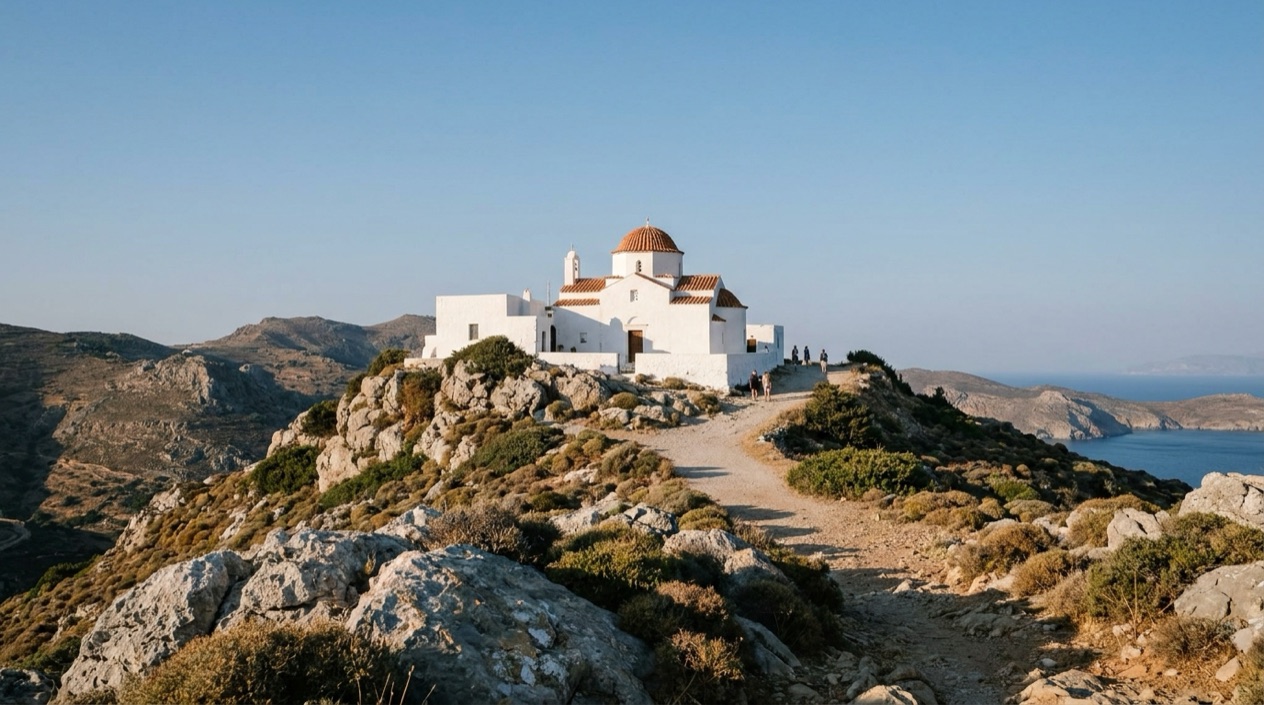
On islands, a small whitewashed-looking chapel by the road may be open and unattended, with no loaner clothing at all. That is where your own scarf or light shirt earns its place in the daypack.
What should you bring?
Because loaner clothing is usually available at the busiest entrances, you can get by without them, but carrying your own is more comfortable than wearing a shared wrap.
- A lightweight scarf, shawl or button-up shirt that covers the shoulders and folds small.
- Long, light trousers or a skirt or dress that falls below the knee.
- A tote or daypack where the cover-up stays within reach, so you can put it on at the gate.
- Shoes you can walk in over stone steps, especially if your plan includes the stair at Meteora.
Dressing for a day that mixes beach and church
Greek days often combine water and worship. A sarong that works as a beach wrap can double as a knee cover, and a loose cotton shirt over a swimsuit takes care of the shoulders. Put the layer on before you reach the door, not in the entrance, and take it off when you step back out into the sun.
Beachwear belongs at the beach. On the subject of what is accepted where, topless sunbathing is not accepted outside the tourist areas, and while Greece has nudist beaches on all shores of the mainland and on most of the islands, where nudism is tolerated, that tolerance does not carry over to towns, villages or anywhere near a church.
Small courtesies inside
Once you are inside, the habits are the ones you would expect in any place of worship: lower your voice, step around people who are praying, and treat the icons and candles with care. Smoking is prohibited by law in all public places in Greece, so a cigarette is out of the question at the door and in the courtyard alike.
One gesture is worth leaving at home. Holding up your palm with your fingers extended outward is rude in Greece, known as the Mountza, and is akin to giving someone the middle finger. A wave to a caretaker should be a small, relaxed one, with the hand loose.
Good to know before you go
A church visit rarely needs more than a layer in your bag and a little attention to where you are. In summer, when Greece is under a fire ban, every outdoor activity that could cause a forest fire is prohibited, including campfires, barbecues and fireworks, so a candle belongs inside the church and nowhere else. If you see a fire, call 112. The fine for causing a forest fire can be €200,000.
Sources
- Wikipedia, Church of Greece (https://en.wikipedia.org/wiki/Church_of_Greece), checked October 12, 2026
- Wikipedia, Greek Orthodox Church (https://en.wikipedia.org/wiki/Greek_Orthodox_Church), checked October 12, 2026
- Wikipedia, Meteora (https://en.wikipedia.org/wiki/Meteora), checked October 12, 2026
- Wikivoyage, Greece, section Respect (https://en.wikivoyage.org/wiki/Greece#Respect), checked October 12, 2026
To plan your stay
- Best Time to Visit Greece: September and Late May to Early June
- Arachova: Parnassus Mountain Town, Formaela Cheese, Ski Season and Saint George's Day
- American Airlines Flights to Greece: U.S. Cities, Athens Arrivals and Onward Island Flights
- Greece on a Budget: Cash Machines, Cards, Beaches and Ferries