
You are standing at a períptero, the street kiosk that sells chilled drinks, ice cream and newspapers, and the person behind the window waves at your card and nods at the coins in your hand. That small moment explains how money works in Greece. Cards are taken in many shops and hotels, but a pocketful of euros still gets you through kiosks, tavernas and the odd souvenir stall.
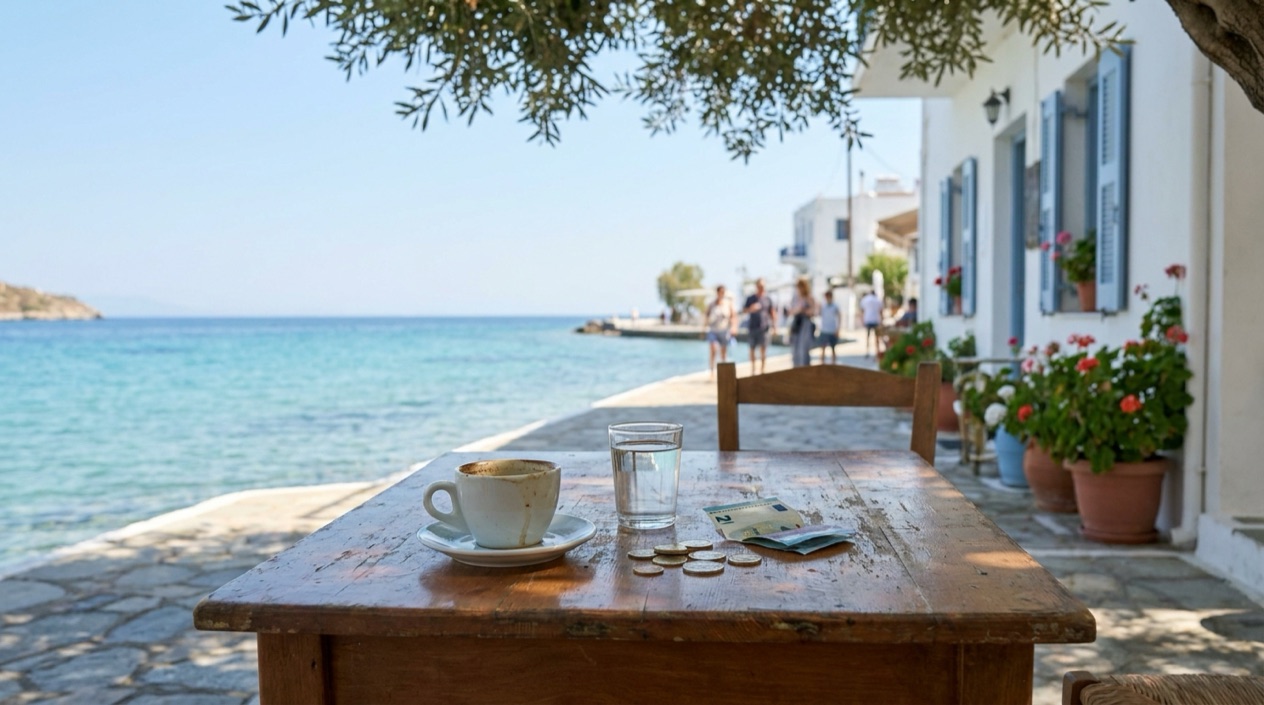
Do you need cash in Greece?
Yes, some cash is worth having, because card acceptance has gaps and small purchases are easier with notes and coins. Greece uses the euro, the same currency as the rest of the eurozone, and each euro is divided into 100 cents. In Greece the cents go by the name lepta (a single one is a lepto), so you may hear the word at a counter when someone counts out your change.
The card side of the picture, and where the cash comes from, follow in the next two sections.
The notes and coins you will handle
Euro banknotes and coins come in the denominations listed here. Every coin has a common side showing its value against a map of Europe, and a national side with an image chosen by the country that issued it. Greek-issued coins and coins from any other eurozone country are legal tender everywhere in the eurozone, so the change in your pocket may come from several countries.
| Type | Denominations |
|---|---|
| Banknotes | €5, €10, €20, €50, €100, €200, €500 |
| Coins | €2, €1, 50c, 20c, 10c, 5c, 2c, 1c |
Commemorative €2 coins, such as the one Greece issued for its Summer Olympics, are legal tender across the eurozone too. Collector coins are different. They are legal tender only in the country that issued them, so a shiny coin from a collector set is not something to spend at a Greek till.
Large notes and the problem of change
Many businesses in Greece are reluctant to accept notes larger than €50. Part of the reason is a scarcity of change, and part is that larger notes have a history of being counterfeited. A small café or a kiosk handed a big note may simply shake its head, and the sale is not worth the awkward counting.
In practice this shapes how you carry money. Smaller notes and a few coins make a morning coffee, a bus snack or a bottle of water from the períptero painless, while the biggest notes tend to stay in the wallet until you reach a place that has change to give. The períptero itself is a good reminder of what small cash is for: newspapers, magazines, chilled drinks, candy, snacks, tobacco and ice cream, all passed through a window.
Shop hours and the midday break
Cash in hand matters most when shops are open, and the rhythm of Greek shopping differs from what many Americans expect. Outside tourist resorts, and apart from large supermarkets, shops stop for a long break in the afternoon and then open again for the evening. Plan a shopping errand around that gap rather than into it.
| Shops | Hours |
|---|---|
| Outside tourist resorts, except large supermarkets | Long break from about 14:00 to 17:00, then open again until 20:00 and sometimes even longer |
The break is a reminder that the usual pace of the country is not that of a mall at home. Resort areas and large supermarkets do not follow the same pattern, so the same street can feel quite different from one town to the next.
Bargaining, souvenirs and small purchases
In Greece one can bargain on many things, especially clothing and souvenirs. That is a habit rather than a rule, and it fits the world of notes and coins well, since a price talked down is often settled in cash. Bargaining is a conversation, not a fight, and a smile and a counteroffer are the usual tools.
Souvenir shops bring cards into the picture again. Local ones usually require a minimum purchase before they let you pay by card, and they may refuse it for special sales or deeply discounted items. If you plan to pick up ceramics, olive oil soap or a woven bag, a few notes make the whole exchange simpler.
Where can you withdraw cash?
You withdraw cash at ATMs, which hand out euros against your debit card, and the main things to know are the fee and the PIN. The process is the usual one: insert the card, choose a language, enter the PIN, pick an amount and take the cash and the receipt. What differs from home is what the machine adds on top.
The ATM fee
ATMs in Greece usually charge €2.50–3 in addition to what your bank demands. The fee is added to the amount you withdraw and then invoiced to your bank, so it shows up on your statement as part of the withdrawal and not as a separate line at the machine.
Because the charge applies to each withdrawal, a handful of small withdrawals costs more in fees than one or two larger ones. The sensible approach is to decide roughly how much cash you want for a stretch of days, take it in a single transaction, and rely on cards for everything else. Your own bank may add its own charges, which are separate from the machine’s fee, so it helps to know your bank’s terms before you leave.
Check your PIN before you fly
Many ATM machines in Greece may not accept 5-digit PIN numbers. Travelers whose cards have a 5-digit PIN are advised to change it to 4 digits before leaving home. It is a ten-minute task with your bank, and far easier to sort out in your own kitchen than from a hotel room in a different time zone.
This matters more than it seems. A card that works perfectly well at home can look broken at a machine that will not read a longer PIN, and a refused withdrawal on arrival is a poor start. Having a second card from a different account is another way to keep options open, though a new PIN is the cleanest fix.
Exchanging travelers checks
If you still carry American Express Travellers Cheques, branches of the Greek bank Alphabank will exchange them into euros at their usual bank rates, without fee or commission. This covers both euro cheques and US$ cheques from American Express. It is a narrow service, tied to one bank and one issuer, so it does not extend to other brands of cheque.
For most travelers the question will not come up, since debit cards and ATMs have taken over this job. For anyone with a drawer of old cheques, though, it is a straightforward way to turn paper into spending money without a deduction at the counter.
After the withdrawal
Once the cash is in your hand, remember the earlier point about large notes. Businesses prefer to avoid anything above €50, so smaller notes are the more useful ones to hold. If you end up with a few big ones, a hotel desk or a larger shop is a likelier place to break them than a kiosk or a small café.
Keep some coins as well. Lepta and small euro coins disappear quickly into the pockets of your bag, yet they are what pay for a newspaper or a cold drink from a kiosk window without fuss.
Which cards are accepted?
MasterCard, Visa, Maestro and Eurocard are widely accepted in Greece, in retail stores, hotels and travel and transportation agencies. The gap is restaurants, since some of them do not take cards at all. That means a card can handle your hotel bill and a shopping trip, while a taverna dinner may call for the notes in your wallet.
Where a card works
Retail stores, hotels and travel and transportation agencies are the places where the four networks are widely taken. A hotel desk handing you a bill, a travel agency selling a seat or a shop with a till are all typical settings for tapping or inserting a card. Using one there spares you the fee at a cash machine and keeps your euros for smaller things.
Carrying more than one card from more than one network widens your options. A Visa and a MasterCard cover two of the four names, and a Maestro debit card adds a third. If one is declined or missing from a till’s list, another may go through.
Restaurants, kiosks and the cash gap
Not every restaurant accepts cards, so it is a good habit to have euros ready when you sit down to a meal of souvlaki, a plate of meze or a Greek salad with feta. Asking at the start whether cards are taken saves an awkward moment when the check arrives.
Kiosks work the same way as small restaurants in this respect. A períptero sells chilled drinks, snacks and ice cream across a narrow window, and the purchase is small enough that notes and coins are the natural payment. Think of cash as the tool for the little things and the card as the tool for the bigger ones.
Souvenir shops and minimums
Local souvenir shops usually require a minimum purchase before allowing you to use your card. They may also decline it for special sales or deeply discounted items. If you are buying one small trinket, cash is the easier route, and a larger basket of gifts is more likely to clear the minimum.
This is also where bargaining comes back in. Clothing and souvenirs are the things people haggle over most, and a price that has been negotiated down is exactly the kind that shops prefer to settle with notes rather than a card.
Good to know before you go
A few euros in small notes, a debit card with a 4-digit PIN and a credit card from one of the main networks cover most situations. Transfers in euro between European Union countries are treated as domestic transactions and carry domestic costs, which is useful if you move money around within the eurozone. Sailors have their own obligation, since boats arriving in Greek waters pay the TEPAI boating tax for each calendar month they stay.
| Fee | Amount | Who pays |
|---|---|---|
| Seashore entry around Athens (many beaches) | €4-5 | Each person |
Seashores in Greece are usually free, so the charge around Athens is the exception to remember, and it is one more reason to keep a few coins and small notes handy.
Sources
- Wikipedia, Euro (https://en.wikipedia.org/wiki/Euro), checked October 12, 2026
- Wikivoyage, Greece (https://en.wikivoyage.org/wiki/Greece), checked October 12, 2026
To plan your stay
- Best Time to Visit Greece: September and Late May to Early June
- Arachova: Parnassus Mountain Town, Formaela Cheese, Ski Season and Saint George's Day
- American Airlines Flights to Greece: U.S. Cities, Athens Arrivals and Onward Island Flights
- Greece on a Budget: Cash Machines, Cards, Beaches and Ferries