
You are standing at a cash machine on an Athens square with a line forming behind you, and the screen shows a fee you did not expect. That small moment is where a Greek budget is won or lost. Spending in Greece depends less on a single big choice than on a handful of habits: how you pull out cash, where you swim, what you eat on the go and how you cross the water.
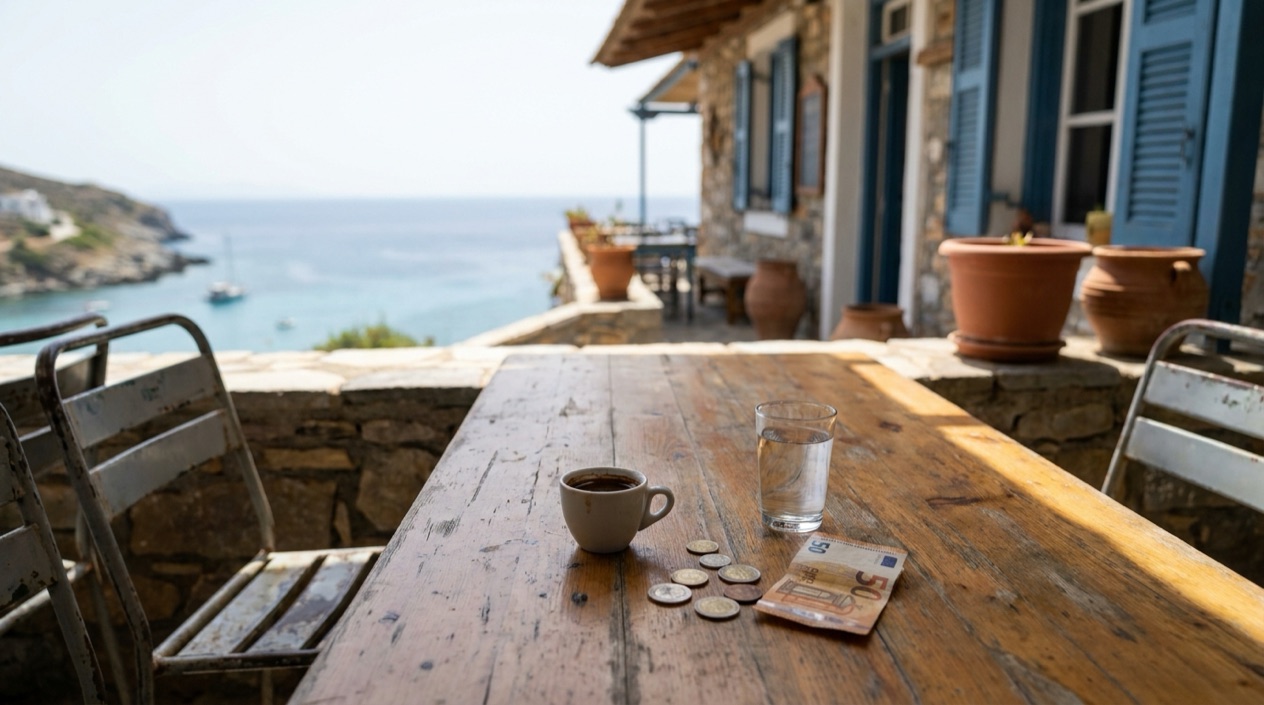
Is Greece expensive?
What a Greek trip costs depends on many small choices, and the first ones are about money itself. The country uses the euro, divided into cents that Greeks call lepta (one is a lepto), and it is in the handling of those coins and notes that surprise charges appear.
Two charges are worth knowing before you land. They are small on their own, but they repeat across a vacation, so they are worth planning around.
| Charge | Amount | Where |
|---|---|---|
| Cash machine fee, added to your own bank’s charge | €2.50–3 | ATMs in Greece |
| Seashore entry, per person | €4-5 | Many seashores around Athens |
Cash machines and your PIN
The cash machine fee is added to the amount you withdraw and then invoiced to your bank, on top of whatever your bank demands. Fewer, larger withdrawals mean fewer of those fees, which is a habit worth adopting from the first day.
Many machines in Greece may refuse a five-digit PIN, so travelers whose cards carry one are advised to change it to four digits before leaving home. A card that cannot get cash at a machine in a village square is a real nuisance, and the fix takes a few minutes at your bank.
Cards in shops, hotels and restaurants
MasterCard, Visa, Maestro and Eurocard are widely accepted in retail stores, hotels and travel and transportation agencies. Restaurants are the exception, since some of them do not take cards, so a little cash in your pocket keeps a taverna dinner from turning awkward at the end of the meal.
Local souvenir shops usually ask for a minimum purchase before they let you pay by card, and they may refuse a card for special sales or deeply discounted items. A single magnet or a small bag of herbs is better paid in coins.
Notes, change and travelers cheques
Many businesses in Greece are reluctant to accept notes larger than €50, partly because change is scarce and partly because large notes have a history of being counterfeited. A kiosk clerk or a bakery counter handed a big note on a Monday morning may simply hand it back. Ask the bank or the cash machine for smaller denominations when you can. If you still carry American Express Travellers Cheques in euros or in U.S. dollars, branches of Alphabank will exchange them into euros at their usual bank rates, without fee or commission.
Where can you save money?
You save most where Greek habits leave room to negotiate or to skip a charge: in the markets, on the shoreline and at the street kiosk. Each of these is a small gain, and together they change the shape of a day.
Bargaining on clothing and souvenirs
In Greece one can bargain on many things, especially clothing and souvenirs. In a market street lined with leather sandals, linen shirts, painted ceramics and woven bags, a friendly back-and-forth over the price is part of the exchange rather than a confrontation.
Keep it light and keep it smiling. A question like whether the shopkeeper can do better on two items bought together is a natural way in. Because souvenir shops often want a minimum before accepting a card, paying cash also gives you more room to settle on a figure.
Swimming at free seashores
Seashores in Greece are usually free, which makes a swim, a towel on the shore and a picnic from a grocery store one of the most economical ways to spend a day. Around Athens the picture changes, since many seashores there charge a fee per person, as shown earlier.
So when you plan a beach day near the capital, count the entry in your budget. On the islands and elsewhere on the mainland coast, the free seashore is the usual rule, and a day with nothing to pay for becomes a real possibility.
Kiosks, bakeries and street food
The períptero, the newsstand that sits on city corners across Greece, sells newspapers, magazines, chilled drinks, confectionery, snacks, tobacco and ice cream. A cold bottle of water and a packet of something sweet from one of these kiosks costs far less thought than a stop at a café terrace, and they appear at almost every junction.
Beyond the kiosk, the everyday Greek bite is easy to assemble from a counter. A souvlaki skewer wrapped in pita, a gyros with tomato, onion and tzatziki, a tiropita pastry filled with feta or a sesame koulouri bread ring all turn into lunch on the move. Sharing several meze plates (small dishes of dips, fried zucchini, grilled cheese and olives) among a table also lets a group taste more without ordering a main for everyone.
Fitting your day to the shop schedule
Outside tourist resorts, and apart from the large supermarkets, shops usually take a long lunch break that starts around 2 p.m. and runs until about 5 p.m. They then reopen and stay open until 8 p.m., sometimes even later.
Knowing this saves you from a wasted trip across town to a closed door. Do your supermarket shopping for water, fruit and bread when the larger stores are open, and keep small-shop errands for the evening stretch, when the streets fill again.
What are the cheapest ways to travel?
The choices that matter most concern the sea, whether you cross it on a ferry or sail it on a boat of your own.
Ferries and the seasons
From January to March, Aegean weather can be extremely rough, and ferries are often kept in port for days at a time. A tight itinerary that depends on leaving an island on a given day can come apart in those months, and every extra night in a hotel is money you had not planned to spend.
The opposite pressure arrives in summer. Ferries in August fill up because of the National Holiday on August 15, so travelers should plan ahead. A flexible schedule outside that week gives you more room to move, and fewer rushed decisions about how to get from one island to the next.
Arriving by your own boat
A boat arriving in Greek waters must pay the TEPAI boating tax on the day of arrival, and the fine for not paying is high. The tax is due for each calendar month the boat stays in Greece, so a longer cruise means paying again as the calendar turns.
Paperwork depends on the flag. A boat with an EU flag arriving directly from a Schengen country does not need to check in, but it must carry an updated crew list. A boat flying a flag from outside the EU must check in at a port of entry, visit customs, buy a transit log and have it stamped by the port police at every harbor it visits.
Every boat in Greece also needs liability insurance that explicitly states the coverage is in accordance with Greek laws. A policy without that wording can leave a skipper with a bigger bill than any harbor fee.
Good to know before you go
Carry a little cash for the restaurants that do not take cards, and keep your notes small so that kiosks and bakeries can make change. Leave a few coins for the kiosk and the bakery counter, since lepta and small euro pieces go a long way in everyday buying. Plan ferry crossings with the rough winter weather and the August holiday rush in mind, and let the shop break in the afternoon shape your errands.
Sources
- Wikivoyage, Greece (https://en.wikivoyage.org/wiki/Greece), checked October 12, 2026