
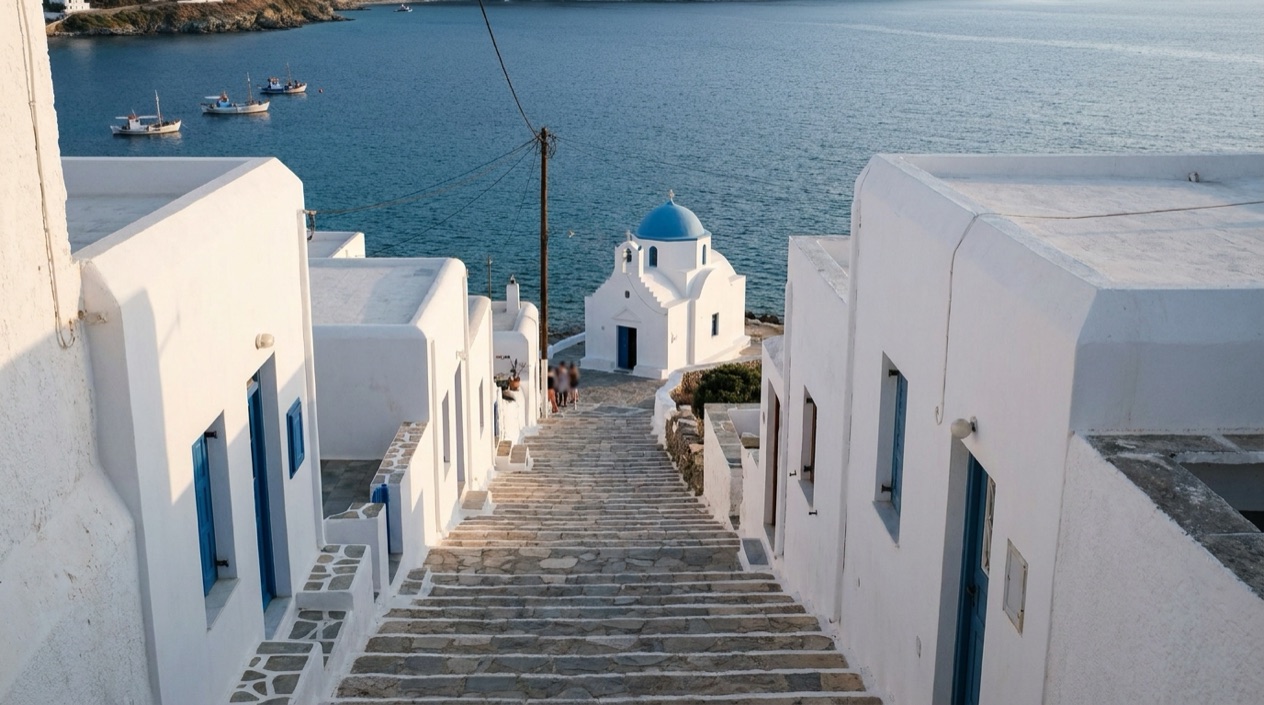
Hundreds of steps down to a harbor, a ferry horn echoing off the rock, a plate of grilled octopus set on a taverna table while the Aegean darkens. It is meant for anyone who wants to choose a handful of experiences and shape a trip around them.
What should be on a Greece bucket list?
A good list mixes stone, water and altitude: an ancient site you walk through, an island view you stop for, a stretch of sea you sail or swim, and a mountain you climb. Greece suits that mix because all four sit within one country, and a trip can touch each of them without repeating itself.
Treat them as a menu rather than a checklist, since one or two done properly will leave a stronger memory than six done in a rush.
Ancient Greece in stone
Greece counts 21 UNESCO World Heritage Sites, among the most in Europe and the world, and that is the reason ancient places head most lists. The Acropolis and the Parthenon in Athens come first for travelers, and Delphi, Olympia, Mycenae, Epidaurus and Knossos on Crete follow. Each one has its own character: a hillside sanctuary, a stadium, a citadel, a theater, a palace.
Visiting ancient places is an old habit. Roman travelers already came to Athens, Corinth and Thebes after Greece became a Roman province, drawn by the centers of philosophy and science. The New Acropolis Museum in Athens now adds to the flow of visitors, and it is a natural companion to the rock itself, since it gathers the finds that tell you what you are looking at on the hill.
The caldera view from Oia, and Ancient Thera
Santorini gives the picture people carry in their heads: the panoramic view of the caldera taken from Oia, with the sea filling the drowned crater below. Fira, the whitewashed capital of the island, sits right on the edge of a high cliff, so walking its lanes means constantly glancing over a drop to the water.
For a second layer, Ancient Thera lies on a ridge of Messavouno mountain. It is a different Santorini, built of old walls and open sky instead of cafés and terraces. Pair the two and you see the island both as a view and as a place where people once lived on a ridge above the sea.
Turtles on Zakynthos
The National Marine Park on Zakynthos is the primary nesting ground for loggerhead sea turtles in the Mediterranean. That alone earns it a line on a nature-minded list. You may spot turtles in the water, and the season and the conditions decide how many, so treat any sighting as a bonus rather than a promise. Zakynthos is also one of the islands with naturist beaches, along with Crete, Rhodes, Gavdos and Antiparos, which is worth knowing if that is part of your picture of an island summer.
Underground on Samos
The Tunnel of Eupalinos on Samos is a subterranean aqueduct about a mile long, built in the 6th century BC. It is an unusual entry among the usual temples and theaters, a piece of engineering rather than a monument, and it gives the list a change of texture. On an island of beaches and villages, it is a reason to step into the story of how ancient communities got their water.
Which experiences are best known?
Each has its own region and its own rhythm, and each rewards a little research before you pick a base.
Beaches on the mainland and the islands
People think of islands first, but the most famous mainland beaches are found in Chalkidiki, Epirus and the Peloponnese. That gives you a way to have a beach week without a ferry ticket, and to combine sand with a drive through villages, olive groves and ruins that sit nearby.
On the islands, the choice widens. Crete, Zakynthos, Rhodes, Gavdos and Antiparos are the islands most associated with naturist beaches, while others are known for lively beach bars, quiet coves or long strands. Read about the particular beach before you go, since each one has its own character and its own rules of the road to reach it.
Sailing the islands
The most popular sailing areas are the Ionian Islands, the Cyclades, the Saronic Gulf Islands, the Dodecanese and the Sporades. The Ionian Islands suit novice sailors because of mild winds and short distances between them, which makes the first week on a boat less demanding than elsewhere.
In the Aegean, spring and autumn are the best times to sail. July and August can bring strong meltemi winds, reaching up to 8 Beauforts, and those conditions suit experienced skippers better. The North Aegean Islands are less known for sailing, but the distances between them are greater, so fewer boats are usually out and anchorages are easier to find.
Hiking and mountains
The most popular hiking areas are Mount Olympus, the gorges of Crete, the national parks of Epirus and the lesser-known Rhodope Mountains. Together they show a Greece far from the beach: forest, rock, river valleys and high ground.
Olympus draws people for its name as much as for its summit, the Cretan gorges for the way they cut through the island, and Epirus for its parks and villages. The Rhodope Mountains suit someone who wants the same kind of walking with a sense of discovery.
Pilgrimage and faith
The centers of religious tourism are Mount Athos and the places the Apostle Paul visited on his travels, especially Philippi. The Via Egnatia in northern Greece is part of the pilgrimage route to Jerusalem. For a traveler interested in the Orthodox world, in Byzantine roads or in early Christian history, these names form a thread that links northern Greece together.
How do you fit them into a trip?
Fit them by choosing one region and one season, then picking two or three items that sit close together instead of chasing the whole list. Greece is a country of islands and mountains, so a plan that crosses the whole map spends more time moving than seeing.
Choosing the season
Tourism in Greece typically peaks between May and September, when approximately 75% of all tourist visits happen. That is the window for beach weeks and island hopping. If your list leans toward sailing, spring and autumn are the better seasons in the Aegean, and today, in mid-October, that autumn window is exactly what you would be planning around.
If your list includes snow, Arachova, Kalavryta, Karpenisi and Metsovo are the main ski destinations. They give the country a winter identity of mountain villages and slopes, far from the sea that fills most brochures.
Building around Athens and the Saronic and Cycladic islands
Athens works as the start of many lists, with the Acropolis, the New Acropolis Museum and the football culture of the capital. Olympiakos plays at Karaiskakis Stadium in Piraeus, while AEK Athens and Panathinaikos are also based in Athens, and PAOK plays in Thessaloniki. Fourteen clubs play in the Super League and 16 in Super League 2, so a match can become part of a city stay.
Piraeus is also the port for the islands. Syros is linked to Piraeus by a ferry that takes 2.5 hours, which makes it a realistic add-on to an Athens stay. From there you can think of the Cyclades as a chain, with Santorini and Mykonos as the names that anchor most plans. Skiathos and Mykonos are also ranked among the most LGBT-friendly destinations in Europe and the world.
Building around the mainland and the north
A mainland trip lets you stack ancient sites, beaches and mountains without boarding a ferry. Epirus offers national parks and hiking, and Chalkidiki offers more beach time.
In the north, Thessaloniki, which was European Youth Capital in 2014, can be paired with the Via Egnatia, Philippi and Mount Athos for a faith-oriented route. Farther into the mountains, the Rhodope range offers the quieter hiking option.
Slowing down with thermal springs
Greece has 752 thermal springs, many classified as therapeutic. They are an easy way to add a rest day to a list full of climbs and ferry rides, and a reason to take a different kind of trip altogether, built around baths and recovery rather than sightseeing. Once you know which region you are in, look for a spring nearby and fold it into the route.
Good to know before you go
Prices are in euros, and sites and museums charge by how visitors they receive, with no combo tickets any more, so each site is paid for separately. Entrance fees are halved for EU citizens over 65 and for teachers accompanying students. On boats in the Aegean, remember that the meltemi shapes July and August.
| Archaeological sites and museums | Who pays |
|---|---|
| With over 200,000 visitors | Each visitor |
| With over 75,000 visitors | Each visitor |
| With over 15,000 visitors | Each visitor |
| Other sites | Each visitor |
| Any site, EU citizens over 65 or teachers with students | Eligible visitors |
Sources
- Wikipedia, Tourism in Greece (https://en.wikipedia.org/wiki/Tourism_in_Greece), checked October 12, 2026
- Wikivoyage, Greece, section Do (https://en.wikivoyage.org/wiki/Greece#Do), checked October 12, 2026
- Wikivoyage, Greece, section See (https://en.wikivoyage.org/wiki/Greece#See), checked October 12, 2026
To plan your stay
- Best Time to Visit Greece: September and Late May to Early June
- Arachova: Parnassus Mountain Town, Formaela Cheese, Ski Season and Saint George's Day
- American Airlines Flights to Greece: U.S. Cities, Athens Arrivals and Onward Island Flights
- Greece on a Budget: Cash Machines, Cards, Beaches and Ferries