
Rows of striped umbrellas, a speaker playing something low, a waiter carrying a Greek salad and a frappé across the sand to a lounger with a view of the water. That scene belongs to the Greek summer, and it shows up on islands and on stretches of the mainland coast.
What is a beach club in Greece?
A beach club in Greece is a stretch of shoreline where a business sets out loungers and umbrellas, then serves drinks and food to the people lying on them. It sits somewhere between a public beach and a seaside restaurant. You come for the water, and the staff bring the rest to your spot.
The menu usually follows the Greek table. Think of a plate of meze to share, grilled fish, fresh salads with feta, and cold coffee frappé or a glass of ouzo as the day goes on. Some clubs lean toward lounge music and cocktails, while others feel like a taverna that happens to have its feet in the sand. The mood changes from island to island and from one cove to the next.
The loungers and the daily rhythm
The core of the experience is the lounger itself. You settle in under an umbrella, order when you feel like it, and swim whenever you want a break from the sun. People bring a book, a hat and a long lunch rather than a plan. The pace is deliberately slow, and that is the point of paying for a spot instead of spreading a towel.
Not every beach in Greece works this way. Many stretches of coast have no clubs at all, only open sand and sea, and travelers who prefer that can simply walk to the next bay.
When the season runs
Beach clubs belong to the warm months, when the Aegean and the Ionian invite you in. The sailing guidance in Greece points to spring and autumn as the best times on the Aegean, because July and August can bring strong Meltemi winds. That wind is worth knowing about if you plan a day on an exposed beach in the Aegean islands.
With today in mid-October, the season is winding down, and the shoulder months before and after the height of summer are the ones the sailing advice favors. If you are planning for next year, spring and early autumn are the months to weigh against the July and August wind.
Clubs, naturist beaches and wild coves
Greece also has beaches where clothing is optional. The most popular islands for naturist beaches include Crete, Zakynthos, Rhodes, Gavdos and Antiparos. These are separate from the club scene, and a lounger setup and a naturist cove are two different ways to spend a beach day.
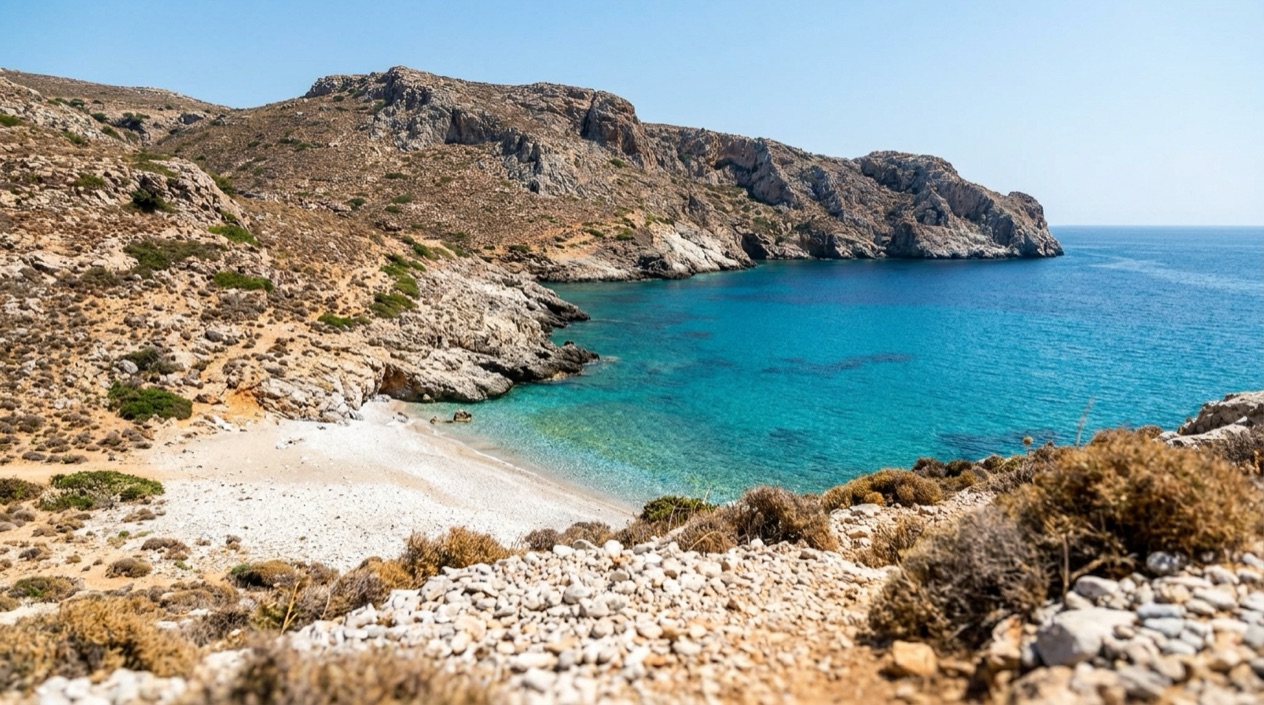
Then there are the coves you reach by boat, where there is no bar and no lounger, only an anchorage. Sailors who want that experience have a whole country to explore, and the later sections return to them.
Which islands have them?
Beach clubs are found on many Greek islands, with the best-known scene in the Cyclades, and the mainland coast has its own share too. The islands below are the ones travelers most often have in mind when they picture lounger-and-cocktail beach days.
Mykonos and the Cyclades
Mykonos is the island travelers associate with beach clubs, with long days of music, cocktails and lunch served on the sand. Its neighbors in the Cyclades, such as Paros, Naxos and Santorini, also have lounger setups on some of their beaches, each with its own character. Antiparos, a small island next to Paros, is also on the list of islands with naturist beaches.
The Cyclades are also one of the most popular sailing areas in Greece. That matters for beach lovers because a boat gives you a second way to reach a bay, rather than depending only on what is built on shore. Whether you stay on land or on the water, the islands reward moving between beaches rather than staying put.
Crete, Rhodes and the southern islands
Crete and Rhodes are large islands with a great deal of coastline, and both appear among the islands popular for naturist beaches. A beach day here can mean a lounger and a plate of grilled fish at a seaside spot, or a quieter stretch away from any club. Gavdos, in the same naturist list, is a very different kind of destination from a club beach, and it suits travelers looking to leave the lounger scene behind.
For anyone building a trip around the sea, the Dodecanese offer both options: a club beach on shore and a boat day on the water.
The Ionian Islands and Zakynthos
The Ionian Islands, including Zakynthos and Corfu, have beach setups of their own, and they are also the area the sailing advice calls ideal for novice sailors, thanks to mild winds and short distances. Zakynthos also appears on the list of islands with naturist beaches.
For travelers who like to mix a lounger day with a day on a boat, the Ionian is the place the sailing guidance points to first for beginners. The Ionian also sits outside the conversation about the Meltemi, which belongs to the Aegean.
The mainland coast
You do not need a ferry to find a beach day. The most famous mainland beaches in Greece are found in Chalkidiki, Epirus and the Peloponnese. Each of these regions has its own coastline, and a car or a bus takes you from one beach to the next without a crossing. Chalkidiki, Epirus and the Peloponnese give mainland travelers a way to combine a beach day with the rest of a trip, whether that means a stay in a coastal town or a stop along a longer route through the country.
How do you reserve a lounger?
A lounger is claimed through the beach club that runs that stretch of sand, because each club sets out and manages its own umbrellas and loungers. How a particular club handles that, and what it asks of its guests, is something each place decides for itself.
What can be said with confidence is how the beach day fits into the season. The best times for sailing in the Aegean are spring and autumn, because July and August can bring strong Meltemi winds, reaching up to 8 Beauforts. On an Aegean island in those summer months, an exposed beach is where the wind makes itself felt most.
Reaching a beach by boat instead
If you would rather skip the lounger system altogether, a boat gives you your own spot on the water. Greece has several well-known sailing areas, including the Ionian Islands, the Cyclades, the Saronic Gulf Islands, the Dodecanese and the Sporades.
The Ionian Islands are the gentle starting point for beginners, with mild winds and short distances. The strong summer winds in the Aegean are more suitable for experienced skippers, which is why sailors planning an Aegean trip tend to look at spring and autumn.
The North Aegean for space
The North Aegean Islands are less known for sailing, but the distances between islands are greater. That means fewer boats are typically present, which makes it easier to find anchorages. For someone who wants a beach with no lounger rows and no neighbors, that is a very different sort of day from a club on Mykonos.
It is a reminder that in Greece the beach day takes many forms. A lounger, a taverna table, a boat anchored in a bay and a naturist cove all sit on the same coastline, and you choose the one that fits the day.
Good to know before you go
Plan the timing around the wind. If your beach days fall in July or August on an Aegean island, the Meltemi can reach up to 8 Beauforts, and spring and autumn are the months the sailing advice prefers.
Bring the habits of a long beach day: sun protection, a hat and a bottle of water for the lounger. For a boat day, the Ionian Islands are the gentle choice, and the Cyclades, Dodecanese, Saronic Gulf and Sporades are other sailing areas to consider.
Sources
- Wikivoyage, Greece, section Do (https://en.wikivoyage.org/wiki/Greece#Do), checked October 12, 2026
To plan your stay
- Best Time to Visit Greece: September and Late May to Early June
- Arachova: Parnassus Mountain Town, Formaela Cheese, Ski Season and Saint George's Day
- American Airlines Flights to Greece: U.S. Cities, Athens Arrivals and Onward Island Flights
- Greece on a Budget: Cash Machines, Cards, Beaches and Ferries