
Somewhere between the Propylaea gate and the first glimpse of the Parthenon, almost every traveler in Athens starts doing sums: one site, two sites, five sites, and one ticket or many. The question is a fair one, because the ancient places of Greece come in clusters, and the Acropolis rock gathers several of them in one spot. What follows sorts out what the combined ticket is, which sites sit together, and how to decide whether a bundle suits your own trip.
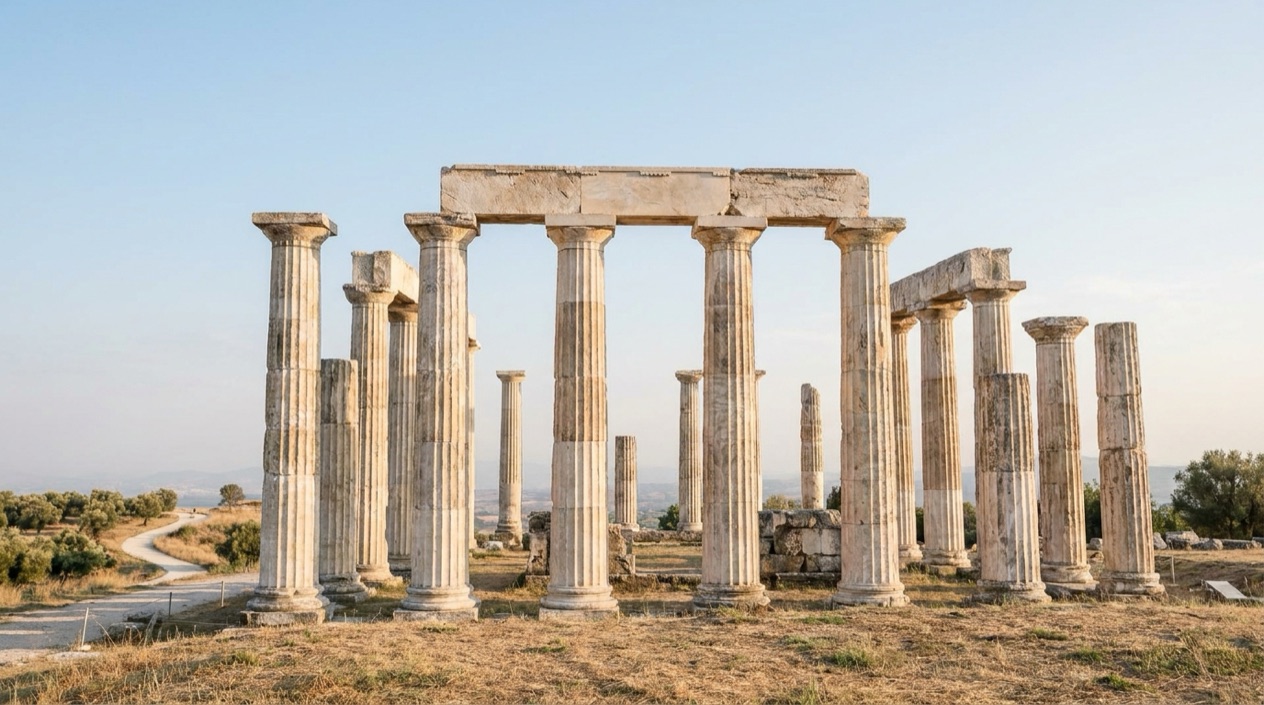
What is the combined ticket for Greek archaeological sites?
The combined ticket is a single ticket that groups visits to several archaeological sites into one purchase, instead of paying at each gate. Behind it stands a state system, and understanding that system explains why the ticket exists at all.
The Greek Archaeological Service oversees all archaeological excavations, museums and the country’s archaeological heritage, and it operates under the Greek Ministry of Culture. It is the oldest institution of its kind in Europe. Every temple, theater and museum you walk into belongs to this wider framework, so a ticket is less a tourist product than a small piece of how the country looks after its past.
Where your money goes
The Archaeological Receipts Fund was established in 1885 and uses proceeds from the sales of tickets, casts and catalogues by museums to fund conservation and restoration of ancient monuments. In plain terms, the admission you pay is recycled into the stones you came to see.
You can see the result on the Acropolis itself. The Acropolis Restoration Project began in 1975 to reverse the decay of centuries of attrition, pollution, destruction from military actions and misguided past restorations. Restoration of the Temple of Athena Nike was completed in 2010, and scaffolding and cranes among the marble are part of the scene on the rock.
Who runs the sites
The Ministry of Culture was established on August 26, 1971, as the Ministry of Culture and Sciences. Lina Mendoni is the current minister, and Iason Fotilas is deputy minister for Contemporary Culture. Olympia Vikatou became director of the Archaeological Service in 2023.
The Acropolis Museum is a child agency of the Ministry, which means it belongs to the same public family as the open-air sites. Foreign archaeological institutes working in Greece also operate within this system, since the archaeological law of 1932 gave the Service the right to issue excavation permits to them.
Other things the sites handle
Tickets are only one use of these places. TAP, the body that manages many of the cultural sites, provides information on applying and paying for photography permits and filming permits at its sites. It also allows cultural or gastronomic events to be organized at archaeological sites and monuments.
If your plans go beyond a camera in your pocket, the Hellenic Heritage platform can be visited at hh.gr. For an ordinary visit, the point is simply that these sites are living public spaces, used for concerts, dinners and exhibitions as well as for walking.
Which sites does it cover?
The sites that matter most to first-time visitors gather around the Acropolis rock in Athens, and knowing how they sit on the hillside tells you which ones belong together in a single outing.
Across the country, the same Archaeological Service oversees the sites, so the names you have heard (Delphi, Olympia, Knossos, Mycenae, Epidaurus) belong to the same network as the Athenian ones. The Athens cluster is the one to picture first, because everything in it sits on or beside one rock.
On top of the rock
The Acropolis of Athens sits on a rocky hill that rises 490 feet above sea level, with an area of 7.5 acres. Visitors enter through a monumental gateway called the Propylaea, and the climb ends on a platform crowded with marble.
The Parthenon stands at the center. The Erechtheion lies east of the entrance and north of the Parthenon, and the little Temple of Athena Nike is the one whose restoration was completed in 2010. Walking among them, you can read the damage as well: the Parthenon was converted into a mosque in the Ottoman period, and it was seriously damaged during the siege of 1687, when gunpowder stored inside it was hit by a Venetian bombardment and exploded.
On the slopes below
The Theatre of Dionysus is located south of the platform that forms the top of the Acropolis, so it belongs to the same hillside rather than to a separate trip. The Odeon of Herodes Atticus lies a few hundred meters from the Acropolis, a stone auditorium whose curved rows you can read from the slope above.
These two give the rock a second story. Up top you see temples to goddesses and gods. On the slopes you see the places where people sat and watched performances, which makes the whole hill feel like a working city center rather than a single monument.
The museum on the same rock
The Acropolis Museum stands on the southern slope of the same rock as the Acropolis. As a child agency of the Ministry of Culture, it is part of the state system described above, and it holds the finds from the hill that you have just walked across.
Seeing the museum before or after the open-air visit changes how the ruins read. The temples are what remains outdoors, and the museum gives a sense of what the hill once carried. Whether you add it is a matter of how much time you want to spend on one single rock.
Is it worth it?
A combined ticket is worth it when your days in Athens are spent on the Acropolis and the sites around it, and less so when you plan to see only one place and move on.
The honest way to decide is to count the places you actually want to stand in. If your list holds the rock, the Theatre of Dionysus and the Odeon of Herodes Atticus, you are already looking at three stops on one hillside, and one purchase for them is a natural idea. If your list holds the Parthenon alone, a bundle gives you little.
A trip built around Athens
Picture a visitor who wants the full hillside. They pass through the Propylaea, circle the Parthenon and the Erechtheion, look down on the Theatre of Dionysus, and then continue to the Acropolis Museum on the southern slope. For this traveler the sites form a single story, and a single ticket matches it.
It also fits people who like to wander without a plan. Once the entry is settled, you can follow the slope wherever your curiosity leads instead of deciding at each gate whether another stop is worth another payment.
A trip that leaves Athens
A traveler who spends one day in Athens and then heads to the islands has a different calculation. The sites in the bundle that lie around the Acropolis may never make it onto the schedule, and a ticket you do not fully use is simply a ticket for one place.
If you plan to travel to sites elsewhere in the country, such as Delphi, Olympia, Knossos, Mycenae or Epidaurus, remember that they all belong to the same Archaeological Service. What you pay at each of them feeds the same fund for conservation, so the choice is about your route and your patience, not about which site deserves more support.
How to decide
- List the sites you want to stand in before you think about tickets.
- If most of them sit on the Acropolis hillside, a combined ticket matches your plan.
- If your list is one site, buy for that one site.
- If you want to photograph or film beyond casual snapshots, look at the permit information TAP provides.
Behind every choice is the same idea: the places are public heritage, and what you spend goes back into keeping them standing. The hillside, with its gate, its temples, its theater and its museum, is the clearest place in Greece to see that at work.
Good to know before you go
The details that matter most are the ones tied to the sites themselves. The Acropolis is a rocky hill with marble underfoot, and scaffolding from the restoration project is part of the scene.
Anyone planning to take photographs for a project or to film should look to TAP for its permit information, and the Hellenic Heritage platform at hh.gr is the address the Service points to. Beyond that, the Archaeological Service and the Ministry of Culture run the sites, and the Acropolis Museum is part of that same public system.
Sources
- Hellenic Archaeological Resources Fund (TAP) (https://www.tap.gr/), checked October 12, 2026
- Wikipedia, Acropolis of Athens (https://en.wikipedia.org/wiki/Acropolis_of_Athens), checked October 12, 2026
- Wikipedia, Greek Archaeological Service (https://en.wikipedia.org/wiki/Greek_Archaeological_Service), checked October 12, 2026
- Wikipedia, Hellenic Ministry of Culture (https://en.wikipedia.org/wiki/Hellenic_Ministry_of_Culture), checked October 12, 2026
To plan your stay
- Best Time to Visit Greece: September and Late May to Early June
- Arachova: Parnassus Mountain Town, Formaela Cheese, Ski Season and Saint George's Day
- American Airlines Flights to Greece: U.S. Cities, Athens Arrivals and Onward Island Flights
- Greece on a Budget: Cash Machines, Cards, Beaches and Ferries