
At a Greek ferry port, women and men holding hand-lettered signs for rooms walk up to the gangway, and the bargaining starts before your bags touch the dock. The same question comes up at a hotel desk in Athens and in an email thread with a small pension: what is the full amount for these nights? Greek lodging has its own habits for pricing a stay, and they are worth knowing before you arrive.
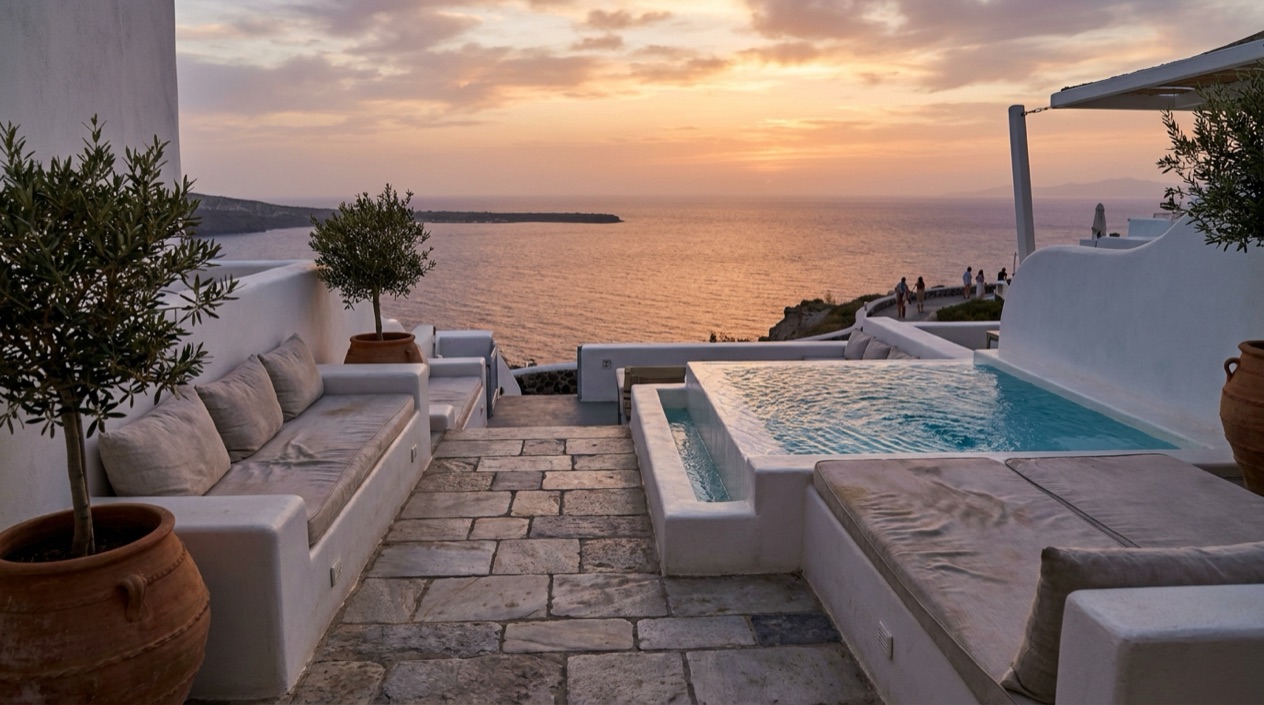
Are there hotel taxes in Greece?
What you meet first in Greece is the price of the room itself, and that price is the thing to pin down, whether you booked it online, by email or on the dock. Greek lodging covers a wide range, from basic rooms to villas, and the way you reach each one shapes the conversation about what a night costs.
Most Greek hotels, even the smaller ones, have websites and will take bookings by email. For a stay on an island, writing to the property directly is a normal way to settle the details of a room before you travel.
Hotels and pensions with websites
A small family hotel on an island often has a simple site and an email address, and the owner answers the questions you send. That is the moment to ask about what matters to you, such as air conditioning. Most Greek rooms have it, but rooms in old traditional buildings with thick stone walls may not need it, so it is a fair question to put to the owner before you book.
Rooms themselves follow a pattern. In Athens, other big cities and on the islands, rooms and bathrooms tend to be small, and showers are often a hand-held sprayer. Closets are often inadequate, and sometimes there is only a wardrobe. Cleanliness is usually good, even in the simpler places, and a balcony or a veranda is typical, sometimes tiny, sometimes a large one shared by all the rooms.
Rooms offered at the port
Walk-in accommodation can usually be found without too much trouble on all but the most crowded islands. On those, rooms can be difficult to find at the peak of the season, and even in the shoulder season on weekends and major holidays. Tourism in Greece typically peaks between May and September, when approximately 75% of all tourist visits happen.
Prices for rooms offered at the port can be negotiated. That is a different world from a hotel with a fixed online rate, and the figure you agree on out loud is the one you hold the owner to, room or studio alike.
Villas and the higher end
A villa rental brings more space and a great view, normally near or on the beach, and it suits a bigger budget. More luxurious lodging can usually be found in cities and on the more popular islands. The quality of a hotel is worth checking in reliable sources before you commit to it.
Because a villa or a luxury hotel is booked well ahead of arrival, the total for the whole stay is something to confirm in writing with the owner or the property. The more items a stay includes, the more useful it is to see the complete amount in one message.
How much are they?
That is the price of a simple room negotiated on the spot, and it tells you how modest the lower end of Greek lodging can be.
Higher up the scale, prices depend on the kind of place. A hotel in a city, a room with a view on a favorite island, a beachfront villa and a stone house all carry their own rates, and a single nightly figure would mislead you. What stays constant is the habit of asking for the whole price of the stay in one sentence.
| Type of lodging | Price |
|---|---|
| Room or studio offered at the port, mid-season | €20-25 |
What shapes the price of a night
Time of year matters most. Tourism peaks between May and September, and the crowded islands are hard to find rooms on at that point, and on weekends and major holidays even outside it. A room found without trouble in a quieter stretch can be a very different proposition in the middle of summer.
The place matters too. Cities and the more popular islands have the more luxurious hotels, while the simplest places keep to the basics, such as a bathroom without a shower curtain. A modest room can still be spotless, since cleanliness is usually good in the simpler places as well.
Questions to put to a host
- Does the room have air conditioning, or is it an old stone building where it may not be needed?
- Is the balcony private, or a veranda shared by all the rooms?
- Is the quoted amount for the room or the studio, and does it cover every night of the stay?
- Is the price the one for the season you are traveling in?
A short list like this gets a host to describe the room as it really is. Small bathrooms and limited closets are common enough that a straight answer about the layout saves a surprise at the door.
Who pays them?
The traveler who books the room and sleeps in it settles the bill for the stay, whether that is a hotel guest, a villa renter or someone who struck a deal on the dock. In every case the amount to count on is the one agreed with the host.
The guest who books ahead
A guest who writes to a hotel or pension by email sees the offered rate in writing. That message is the reference for what the stay costs, and it is where questions about the room, the bathroom or the cooling can be answered before the trip.
Because Greek hotels, even the smaller ones, tend to have a website and take email bookings, a traveler can compare several places in a few messages.
The guest who walks in
Someone arriving without a reservation relies on walk-in rooms, which can usually be found on all but the most crowded islands. Here the price is negotiable, and mid-season rooms at €20-25 are not unusual. The person who negotiates and then sleeps in the room pays the figure they settled on.
On the crowded islands the situation changes. At the peak of the season, and on weekends and major holidays in the shoulder season, rooms can be difficult to find, so a walk-in traveler has fewer options to compare and less room to bargain.
The group renting a villa
A villa is for those with a bigger budget, and the person who rents it handles the booking for the whole group. As with any lodging, ask for a clear written description of what the amount covers, from the number of nights to the layout of the house.
Good to know before you go
Money is in euros. Keep every written quote from a hotel or pension so you can compare it with the amount you pay on departure, and expect small bathrooms and modest closets in most places.
Sources
- Wikipedia, Tourism in Greece (https://en.wikipedia.org/wiki/Tourism_in_Greece), checked October 12, 2026
- Wikivoyage, Greece, section Sleep (https://en.wikivoyage.org/wiki/Greece#Sleep), checked October 12, 2026