
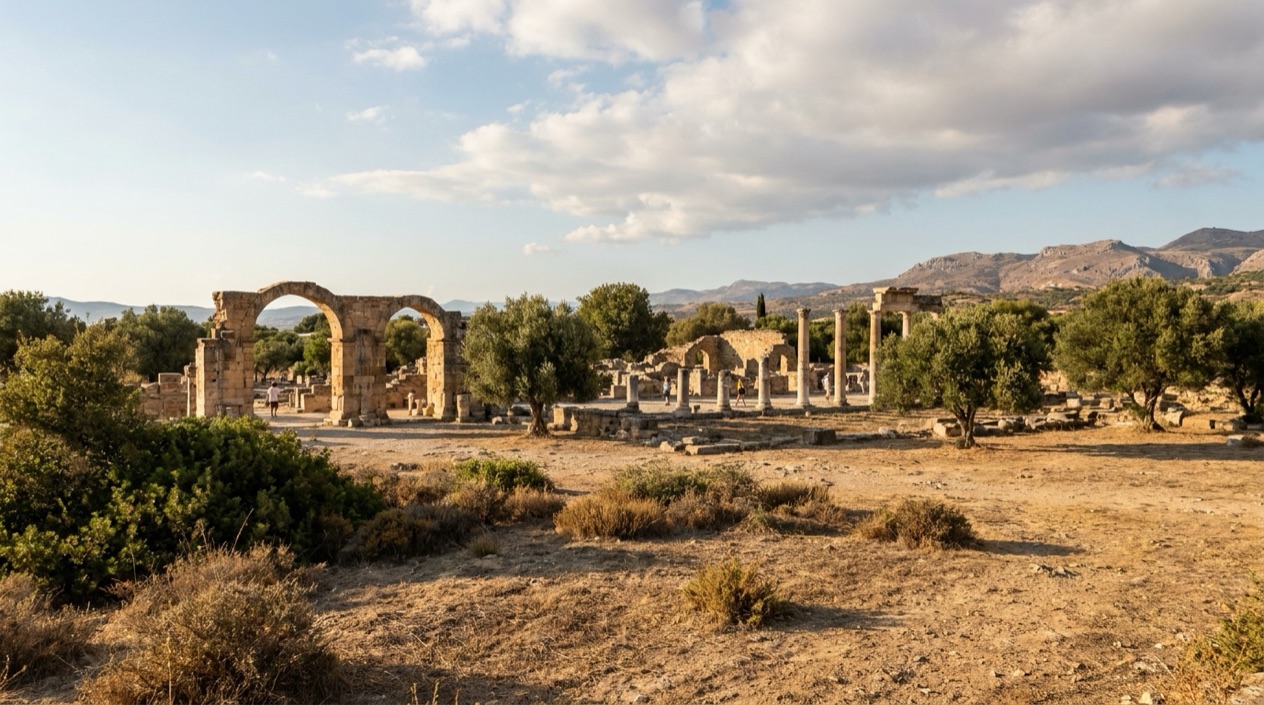
Gortyn does not announce itself with a single great monument. You arrive in the valley of Messara and the ancient city shows itself in pieces: a brick ruin here, a stone wall with carved lines of Greek there, all of it spread out among olive trees. It is an open-air archaeological site on Crete where the Roman capital of the island once stood, and a visit is about reading a city in fragments.
Is visiting Gortyn worth it?
It rewards curiosity. If you want a reconstructed palace with painted walls, Knossos near Heraklion is the Minoan palace on the island. Gortyn offers something different: the working life of a city that later became a Roman capital.
The area was first inhabited around 7000 BC, so the site holds a very long stretch of island history. What you see today is mostly the Roman layer, because Gortyn was the capital of the joint province of Creta et Cyrenaica. That makes it a place where you can picture a governor’s seat, a theater, an Odeon and a great Christian church within one ancient city.
What sets Gortyn apart from other ancient sites on Crete is the writing. The Gortyn Code, discovered in 1884, is described as the oldest and most complete known example of a code of ancient Greek law.
Few places let you stand in front of laws that people actually lived under, cut into stone in their own alphabet. Even if you read no Greek, the sight of those long, orderly lines is the memory visitors keep.
The setting adds to it. Gortyn lies in the valley of Messara, south of the Psiloritis mountain and near the Libyan Sea, and the municipality is run from the village of Agioi Deka. It is a rural corner of Crete, so a visit here is also a look at farmland and village life, a change from the coast and the city of Heraklion.
It will suit history lovers best, along with anyone curious about how the Romans ruled the island. Gortyn asks you to slow down, read the stones and let the pieces add up.
What to see at Gortyn
The ruins of Gortyn are spread across the valley rather than packed into one enclosure, so the visit is a succession of separate stops, each from a different chapter. Law, power, entertainment and religion are all here, and it helps to keep that order in mind as you move from one structure to the next.
The Gortyn Code and the Odeon
The law code is the reason people come. A modern structure at the site of the mostly ruined Odeon houses many of the stones bearing the code, so the shelter protects the inscription while the old Odeon around it lies in ruins. You see the stones as a body of text, line after line, rather than as a single object in a case.
Look at how the lines run. The text is carved in alternating directions, one line left to right and the next right to left, a style often compared to the path of an ox plowing a field. The laws deal with everyday matters such as family, property and inheritance, which is why the code feels so close to ordinary life. Read together with the Odeon’s ruined shape, it makes a good first stop.
The Praetorium
The Praetorium was the seat of the Roman governor of Crete, and it stands at the heart of Roman Gortyn. It was built in the 1st century AD, which places it in the early years of the Roman city. Standing among its remains, you are looking at the administrative center of the whole province, where decisions about the island were made.
What survives are the lower walls and the outline of a large official complex rather than a complete building. Use the Praetorium to get your bearings. Once you know this was the center of Roman power, the other structures fall into place around it, from the theater to the church.
The Roman theater
The Roman theater dates to the 2nd century AD and has two entrances and a half-circular orchestra. The two entrances show how the audience and the performers moved in and out.
A theater like this tells you something about the city’s social life. A Roman capital needed places for gatherings and entertainment as well as courts and offices, and Gortyn had them. Take a moment to sit with the shape of the orchestra and imagine the place full.
The church of St. Titus
The remains of an important Christian cathedral of Crete, dedicated to St. Titus, can still be seen at Gortyn. Titus was the first Bishop of Crete, and the church was erected in the 6th century AD. It shows a later chapter than the Praetorium and the theater, when Christianity had become the faith of the city.
What stands is a ruin of a once large church, with its plan still legible in the surviving walls and arches. For visitors it is the most atmospheric stop at Gortyn, because the church rises above the ground more than most of the other remains. Pair it in your mind with the Roman buildings to see how the city changed over the centuries.
The temple of Pythian Apollo
The temple of Pythian Apollo is another part of the ancient city, with the Agora as its neighbor. It is a reminder that Gortyn had a religious life long before Christian worship, and that the city’s sacred and civic spaces sat close together. Little more than foundations speak for it today, so this stop is about imagining the layout as much as about what is standing.
If you like to connect the dots, the temple and the Agora give you the older Greek side of the story. The Praetorium, theater and church then show how a Roman capital grew over it, and the law code sits in between as the voice of the city itself.
When to visit Gortyn
Gortyn is an outdoor site, so the season shapes the visit more than anything else.
| Month (Heraklion) | Average high (°F) | Average low (°F) | Rain days | Precipitation (inches) |
|---|---|---|---|---|
| January | 59.7 | 48.6 | 11.8 | 2.73 |
| April | 68.5 | 54.1 | 5.9 | 1.43 |
| July | 84.9 | 72.7 | 0.8 | 0.10 |
| October | 75.6 | 63.1 | 6.0 | 1.48 |
July is the hottest of these months, and with an open site of ruins and olive trees, sun protection is the sensible thing to carry. Rain is almost absent in the table, so a dry visit is likely, but the heat is what you plan around. A hat and sunscreen matter more than any rain gear.
April and October sit in the middle. Highs are comfortable for walking between structures, and the rain figures are modest, with several rain days in each month. These are the months when a visit among the stones asks the least of you in terms of heat, and they suit a trip that also takes in villages and the countryside around the valley.
January is the wettest month in the table, with rain on many days. A rain jacket belongs in the bag, and the ground among the ruins can be damp. The ancient stones read just as well in winter, and if you are traveling on Crete in that season, Gortyn is a reasonable outdoor stop for a drier day.
What the climate does tell you is that in the hotter months a site with this much open ground is felt more in the sun, while in the cooler months the main thing to watch is the forecast.
Tips for your visit
Bring sun protection if you go in the warmer months, and a rain jacket for January and the other wet stretches. Wear shoes that cope with uneven ground, since you are walking among ruins and fields rather than on paved promenades. A camera is useful for the law code in particular, because the carved lines are what visitors want to remember.
Go in with a rough order in mind. Start with the law code and the Odeon, move to the Praetorium to understand who ran the city, then take in the theater, the church of St. Titus and the temple of Pythian Apollo. That sequence follows the story from law to power to entertainment to faith, and it keeps the scattered stops from feeling random.
Gortyn pairs naturally with the rest of Crete’s ancient past. Knossos, the Minoan palace by Heraklion, shows the island’s earlier civilization, and Gortyn adds the Roman and Christian layers. Heraklion itself has the Koules Fortress, the Venetian fortress in the harbor that dominates the port with its ramparts and arsenal. Seen together, they cover several very different chapters of Crete.
Heraklion is also the usual gateway to the island by air. Its airport is the second busiest in Greece after Athens, has a single main runway and runs 24 hours a day. It sits east of the city center in the area of Alikarnassos. Urban buses serve Heraklion on 39 different routes, which matters for the city part of your trip.
Read a little about the site before you go, or after. The law code is more moving when you know what kind of matters it governed, and the church of St. Titus means more when you know he was the first Bishop of Crete. A few minutes of background turns the ruins into a story, and that is what Gortyn does best.
Good to know before you go
Greece uses the euro, and small purchases in the villages around the Messara valley are part of the pleasure of a countryside day. Plan for a rural setting, with the village of Agioi Deka as the local center and a landscape of olive groves and farmland around the site. In the hotter months, sun and heat are the main things to prepare for.
Ordinary travel habits apply here as anywhere: keep your plans flexible, carry water and sun protection, and let the pace be set by the heat of the day. Gortyn is a place to take in slowly, and the rest of Crete is waiting beyond it.
Sources
- Wikipedia, Gortyn (https://en.wikipedia.org/wiki/Gortyn), checked October 12, 2026
- Heraklion airport information (https://www.heraklion-airport.info/), checked October 12, 2026
- Visit Greece (GNTO), Heraklion (https://www.visitgreece.gr/islands/crete/irakleio/), checked October 12, 2026
- Wikipedia, Heraklion (https://en.wikipedia.org/wiki/Heraklion), checked October 12, 2026
- Hellenic National Meteorological Service (HNMS), climatological normals 1991-2020 for Heraklion station (https://www.emy.gr/climatic-data), monthly mean daily maximum and minimum; rain from the ECMWF ERA5 reanalysis, 1991-2020, grid cell of Heraklion (Open-Meteo), checked October 12, 2026
- ECMWF ERA5 reanalysis 1991-2020, grid cell of Heraklion (Open-Meteo), checked October 12, 2026
To plan your stay
- Best Time to Visit Greece: September and Late May to Early June
- Arachova: Parnassus Mountain Town, Formaela Cheese, Ski Season and Saint George's Day
- American Airlines Flights to Greece: U.S. Cities, Athens Arrivals and Onward Island Flights
- Greece on a Budget: Cash Machines, Cards, Beaches and Ferries