
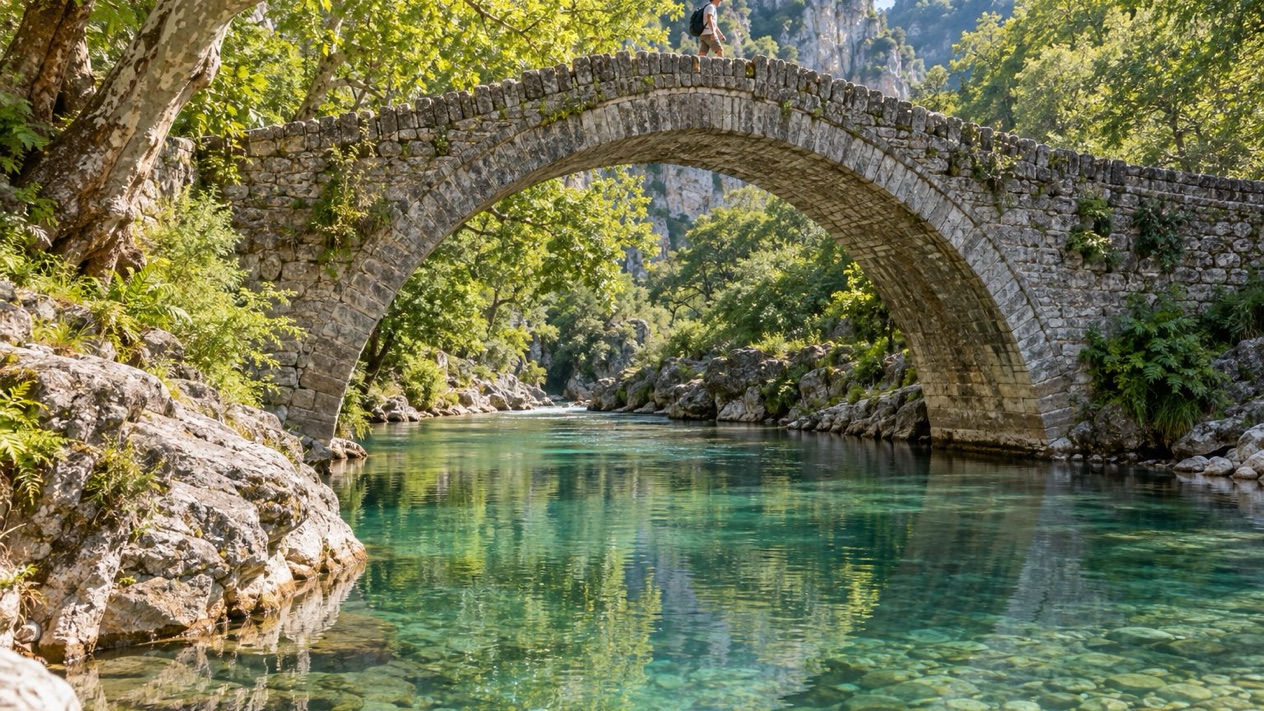
Woodsmoke drifts over the stone roofs of a Zagori village, a path of worn cobbles runs down to an old arched bridge, and somewhere below a river keeps moving through the gorge. Down on the coast the same region turns to harbor cafés and boats nosing into a bay.
Where is Epirus and what is it like?
Epirus is a region in the northwest of Greece, set between the Pindus mountain range and the Ionian Sea, with Albania along its northern edge. Its eastern neighbors are Western Macedonia and Thessaly, to the south lies West Greece, and to the west are the Ionian Sea and the Ionian Islands. The region covers about 3,600 square miles, which is a lot of ground for a place that most trips treat as a detour.
The capital and largest city is Ioannina, spread around Lake Pamvotis, and nearly a third of the region’s people live there. Lake Pamvotis holds a small inhabited island, and the still water and the island together are a natural monument around which the city lives.
From Ioannina the road climbs into the mountains, where Mount Smolikas rises to 8,652 feet, the highest point in Epirus. The villages up there are built of stone, and the sense of being high and far from the coast is part of the appeal.
The other face of Epirus is the Ionian coast, where bathing is a main attraction and the waters are a sailing area. Parga is the resort town best known for it, built around a bay and watched over by a Venetian castle. Igoumenitsa, the port city, handles the ferries to Italy and Corfu.
This is a region for people who like to move between landscapes, a morning among slate-roofed houses and an evening by the water. Travelers who want a single beach base with everything on the doorstep may find the mountain half needs more effort, since in the mountain regions your own vehicle is a prerequisite for reaching the places of interest.
What is there to do in Epirus?
Epirus gives you stone villages and gorge walking, a coast of bays and beaches, a lakeside city and some of the oldest ancient sites in the country. What sets it apart from its neighbors is the mix: you can follow a trail through a national park and sit by the Ionian Sea in the same trip.
Zagori and the Vikos Gorge
Zagori is a cluster of 46 stone villages in the Pindus mountains, and it is a UNESCO World Heritage Site, inscribed as the Zagori Cultural Landscape in 2023. The villages sit at elevations often exceeding 1,000 meters, and the houses have stone roofs. Old stone bridges cross the streams between them, and the cobbled lanes are made for strolling from one square to the next.
Vikos Gorge, the second deepest gorge in the world, lies in the same landscape, within Vikos-Aoos National Park. The park holds deep gorges, lakes, waterfalls, varied vegetation, hiking trails and relatively little tourism, and its restaurants serve good food. Visitors can hike or simply sit and take in the landscape. A car is what gets you between villages.
Parga and the Ionian coast
Parga is built in an amphitheater shape around its bay, with the green islet of Panagia just off the shore. The Venetian fortress, built around 1570, overlooks the rugged coast and is the place to look back over the rooftops and the water. The town is a resort known for its natural surroundings.
Parga’s beaches include Kryoneri, Piso Kryoneri, Valtos and Lychnos, and across the region the main beaches also include Karavostasi, Loutsa Vrachos, Lygia and Preveza. In summer, visitors come to Parga by boat from Paxos, Antipaxos and Corfu. Less frequented stretches, some used by nudists, include Dei Plus, Artolithia, Kastrosykia and Kanali.
Ioannina, its lake and Dodona
Ioannina is a city that lives around its lake. Small motorboats cross to the inhabited island in Lake Pamvotis, with the frequency depending on the season. The waterfront is where the city gathers, with cafés, a fortress district and the lake in view.
Dodona, in the village of Dodoni near Ioannina, is one of the oldest and most important oracle sites in Greece. The village has a cluster of archaeological sites, so a visit means walking among ruins where people once came to ask questions of the gods.
Arta, Preveza and the monasteries
Arta’s main attractions are its old stone bridge and the castle ruins in the center, and the medieval Rogoi Castle stands near the town. Near Preveza are the ruins of the ancient city of Nikopolis and its aqueduct, which make a wide-open archaeological stop on the coastal side of the region.
Monasteries add another layer. The Kipina Monastery is near Pramanta, and Gyromeri Monastery was founded in the 13th century. They are places to see the religious side of Epirus, set in the hills rather than in towns.
How many days do you need in Epirus?
Epirus works best as a trip of a week or so, because its two halves, mountain and coast, are far apart in character and each deserves a stop of its own.
A short stay fits well around Ioannina. You can walk the lake front, cross to the island by motorboat, and visit Dodona, which sits near the city. From there Zagori is within reach for a first look at the stone villages and a stretch of the Vikos landscape. A short stay on the coast would center on Parga: the castle, the bay and a couple of beaches such as Valtos or Lychnos.
With more time, split the trip. Spend the mountain part in Zagori, moving between villages and putting in some hiking in Vikos-Aoos National Park, then drop to the coast for the beaches and sailing. Add Metsovo, a mountain town on the road across the Pindus that is lively through the year, and Tzoumerka National Park for more wild country.
Day trips can be added around your bases. From Parga, boats run in summer to Paxos, Antipaxos and Corfu. From the south of the region you can see Arta with its bridge and Rogoi Castle, or Preveza with Nikopolis. The monasteries near Pramanta give a further reason to wander off the main road.
Where to stay in Epirus
The main places to stay are Ioannina, the Zagori villages, Metsovo and Parga, and each suits a different kind of trip. Ioannina is the city base, with its lake, its island and a position from which Dodona and Zagori can be reached.
The Zagori villages are for people who came for stone, trails and mountain air. Houses with stone roofs, old bridges and walking paths define the area, and its 46 villages give plenty of choice. Because your own vehicle is a prerequisite for reaching the places of interest in these mountains, staying here means planning around the car.
Metsovo is a mountain town below the Katara pass in the Pindus, and it is the largest center of Aromanian (Vlach) life in Greece, serving as a hub for the villages around it.
Parga is the choice for a sea holiday. It is a resort town on the Ionian coast, built around its bay, with beaches close at hand and the castle above. Igoumenitsa, the port, is a place to pass through rather than to stay, tied to the ferries to Italy and Corfu.
How do you get to Epirus and get around?
Travelers come in by sea or by road. Igoumenitsa is regularly served by ferries from the Italian cities of Ancona, Bari, Brindisi and Venice, and it also has connections to Corfu. From the port, the A2 motorway starts and runs to Thessaloniki via Ioannina and Metsovo.
Distances put Epirus in context. Ioannina lies 271 miles northwest of Athens, 180 miles southwest of Thessaloniki, and 56 miles east of Igoumenitsa. Those figures are the reference points for a drive across the north of Greece or a ferry arrival at the coast.
Getting around depends on where you are going. In the mountain regions of Epirus, your own vehicle is a prerequisite to reach the places of interest for tourists, which covers Zagori and the national park. In towns you move on foot, and on Lake Pamvotis small motorboats take you to the island, with the frequency depending on the season. In summer, boats link Parga with Paxos, Antipaxos and Corfu.
When is the best time to visit Epirus?
Epirus has two seasons of interest, and the choice depends on whether you came for the sea or the mountains. Summer is when the coast is at work: boats arrive in Parga from Paxos, Antipaxos and Corfu, bathing is the main attraction along the shore, and the Ionian waters are used by sailors.
The mountains have their own calendar. Metsovo is lively throughout the year, and its tourism flourishes in winter, so the cold months are a time to visit the Pindus towns rather than avoid them. Zagori and Vikos-Aoos National Park are for hiking, with trails and gorges to explore, and the stone villages remain the draw whatever the season.
Lake Pamvotis in Ioannina runs motorboats to its island with a frequency that depends on the season, which is worth knowing if the crossing is on your list. For the coast, summer brings the busiest sea traffic, while the less frequented beaches such as Kanali or Artolithia reward those who want to leave the main strands behind.
Good to know before you go
Plan the mountain half of the trip around a vehicle, since without one the villages and trails of Zagori and the national park are hard to reach. The A2 motorway from Igoumenitsa through Ioannina and Metsovo is the road across the region, and the ferries from Italy arrive at the same port.
Pack for both landscapes: footwear for cobbled village lanes and gorge paths, and swimwear for the Ionian beaches. Boat crossings to the island in Lake Pamvotis and the summer links from Parga depend on the season, so keep your plans open on those days.
Sources
- Visit Greece (GNTO), Epirus (https://www.visitgreece.gr/mainland/epirus/), checked October 12, 2026
- Wikipedia, Epirus (region) (https://en.wikipedia.org/wiki/Epirus_(region)), checked October 12, 2026
- Wikivoyage, Epirus (https://en.wikivoyage.org/wiki/Epirus), checked October 12, 2026
- Visit Greece (GNTO), Ioannina (https://www.visitgreece.gr/mainland/epirus/ioannina/), checked October 12, 2026
- Wikipedia, Ioannina (https://en.wikipedia.org/wiki/Ioannina), checked October 12, 2026
- Visit Greece (GNTO), Zagori (https://www.visitgreece.gr/mainland/epirus/zagori/), checked October 12, 2026
- Wikipedia, Zagori (https://en.wikipedia.org/wiki/Zagori), checked October 12, 2026
- Visit Greece (GNTO), Metsovo (https://www.visitgreece.gr/mainland/epirus/metsovo/), checked October 12, 2026
- Wikipedia, Metsovo (https://en.wikipedia.org/wiki/Metsovo), checked October 12, 2026
- Visit Greece (GNTO), Parga (https://www.visitgreece.gr/mainland/epirus/parga/), checked October 12, 2026
- Wikipedia, Parga (https://en.wikipedia.org/wiki/Parga), checked October 12, 2026
To plan your stay
- Best Time to Visit Greece: September and Late May to Early June
- Arachova: Parnassus Mountain Town, Formaela Cheese, Ski Season and Saint George's Day
- American Airlines Flights to Greece: U.S. Cities, Athens Arrivals and Onward Island Flights
- Greece on a Budget: Cash Machines, Cards, Beaches and Ferries