
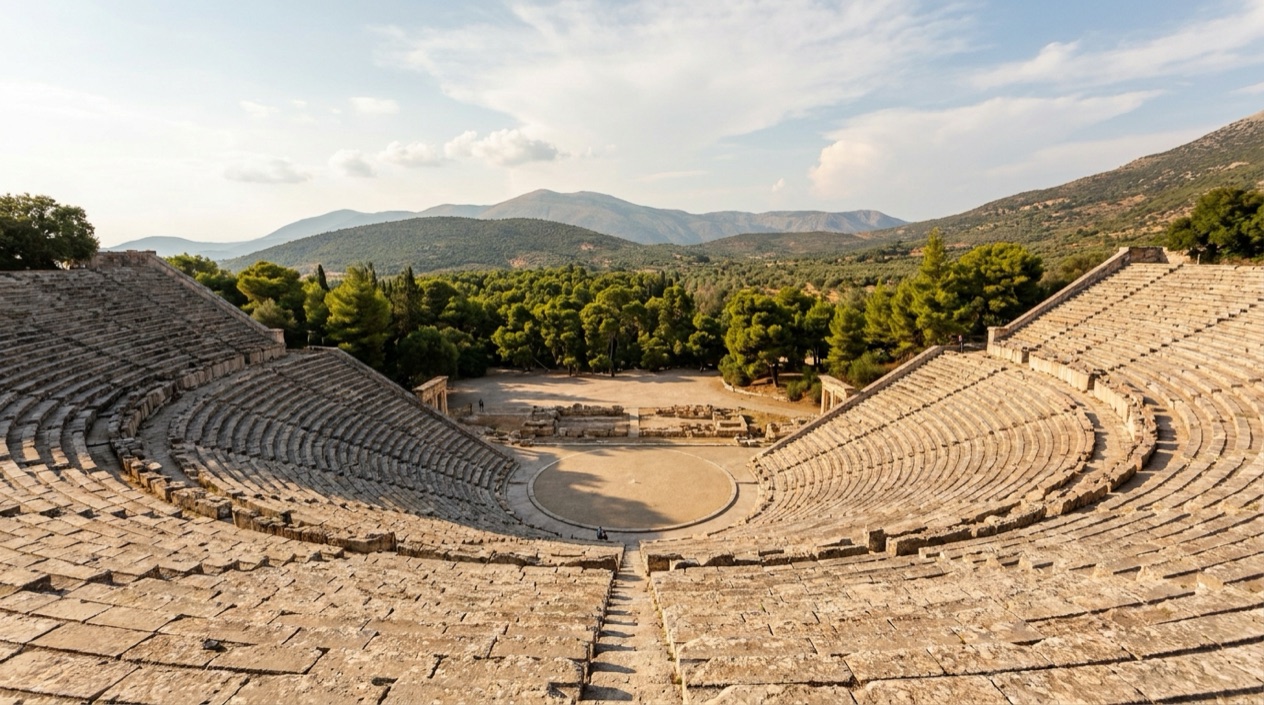
You come up through the trees of the Argolid and the hillside suddenly opens into a great curved bowl of pale stone, tier above tier, around a flat circle of earth. Nothing in the approach prepares you for how complete it looks. This is the Ancient Theater of Epidaurus, a place to sit, listen and look out over the pines, and a stage that still hosts actors in summer.
Is visiting the Ancient Theater of Epidaurus worth it?
Yes, for anyone who enjoys ancient places that you can feel with your ears as well as your eyes, and especially for lovers of theater, music and stone architecture. The theater was built in the years around 340 to 330 BC, and it has never really stopped being a theater. That continuity is the heart of the visit.
Many ancient sites ask you to imagine a building from a few low walls. Here the seating, the circular floor and the hillside setting are still there to read at a glance. The theater seats up to 14,000 people, and you understand the scale only when you stand on the circle and look up at the rows rising behind you.
What sets it apart from other ancient theaters in Greece is the sound. The acoustics are reported to carry unamplified speech clearly to every spectator, which has made the place a reference point for anyone who thinks about how voices travel in open air.
Add the Athens Epidaurus Festival, which stages performances here every summer, and the theater becomes a living venue rather than only a monument. The setting belongs to a wider sanctuary of Asclepius that sits on the UNESCO World Heritage List, so the visit can grow from one building into a small journey through the Argolid.
What to see at the Ancient Theater of Epidaurus
The theater is the centerpiece, but it is part of a larger landscape: a sanctuary, a coastal ancient city, and a second, smaller theater in the modern town. Together they tell how the ancient Greeks mixed healing, religion and drama.
The seating and the circular floor
The seating sweeps up the slope in a wide fan, with the rows set into the hill so that the whole auditorium seems to grow out of the landscape. At the bottom lies the orchestra, the round floor where the chorus once sang and danced. Looking down from the upper rows, you see how the geometry pulls every eye toward that circle.
Walk down the aisles between the sections and notice how the angle changes from the top to the bottom. From the upper rows the circle looks small and the surrounding trees look close. From the floor the stone rows rise around you like the sides of a bowl.
The sound of the theater
The theater has exceptional acoustics, and this is what people talk about long after they leave. The reputation is that the spoken word, with no microphone, can be understood almost perfectly by the whole audience. Sit in a high row, stay quiet for a moment, and listen to how little the open air swallows.
Listen also to the natural sounds: wind in the pines, a voice from another visitor, footsteps on stone. They give you a sense of how the building handles sound, long before any actor steps on the floor.
The small theater in the town of Epidaurus
The town of Epidaurus has a theater of its own, excavated since 1990. It dates from the fourth century BC and has about 2000 seats, a far more intimate scale than the great theater in the sanctuary. It has been renovated and is open to the public.
It makes a good counterpoint. Where the great theater shows you the grand idea, the small one shows how the same form worked for a town. The ancient city of Epidaurus stood on the coast, at the village now called Archaia Epidaurus, so this visit places you in the setting where daily life once happened.
The Sanctuary of Asclepius
The theater belongs to the Sanctuary of Asclepius, inscribed on the UNESCO World Heritage List in 1988. The sanctuary lies about five miles from the town of Epidaurus. Asclepius was the god of healing, and pilgrims came here seeking cures, which helps explain why a place of medicine and ritual also had a theater: drama was part of the experience.
The asclepeion is also described as near the modern town of Lygourio, inland from the ancient city of Epidaurus. Keep that in mind when you read maps, since the sanctuary and the coastal town are separate places with separate stories.
Hours, tickets and rules
The theater works as both a monument and a stage, and that shapes the way the visit is organized: performances are staged every summer as part of the Athens Epidaurus Festival, and the same seats that hold visitors by day host an audience for plays at other times. The site is part of the UNESCO-listed sanctuary, so the theater is looked after as heritage as well as a venue. The small theater in the town of Epidaurus is a separate visit that has been renovated and is open to the public.
Because the theater is still in use for dramatic performances, you should expect it to behave like a working stage. The stone seating, the circular floor and the approach paths are the parts you see, and they give the place its character whether you arrive as a visitor or as an audience member.
When to visit the Ancient Theater of Epidaurus
The moment with the most to offer is the summer, when the Athens Epidaurus Festival stages performances in the theater. Seeing a play in a building made for this purpose changes the experience entirely. You are no longer a spectator of ruins but part of an audience doing what audiences here have done for centuries.
A performance also shows you why the place was built the way it was: the way the rows focus attention on the circle, how the sound carries, how the landscape becomes part of the scenery. Even if you do not speak Greek, the setting speaks clearly. The festival is a recurring summer event, so the exact program changes from one season to the next.
Outside the performances, the theater is a place to visit for its own sake. Any season gives you the architecture, the acoustics and the setting among the trees, and the small theater in town and the sanctuary add to the picture. Since the theater is open-air, the weather becomes part of the visit, so think about how sun or rain might shape your day before you set out.
If you are building a trip around the Peloponnese, the theater fits naturally with the other places of the Argolid: the sanctuary, the coastal village of Archaia Epidaurus and the town of Epidaurus. Together they show a region where ancient religion, medicine and drama sat close to each other.
Tips for your visit
Start at the top of the seating and spend a few minutes just looking. The view of the circular floor with the trees around it explains the design better than any description. Then walk down slowly and stand on the circle itself, where you can look up at the rows you just left.
Bring your attention to sound. Talk to a companion who sits in a high row, or simply listen to the voices of others, and notice how clearly speech travels.
Combine the theater with the other places around it. The small theater in the town of Epidaurus gives you a second, much smaller version of the same idea. The Sanctuary of Asclepius, about five miles from the town, gives you the setting of healing and ritual that surrounded the great theater. At the village of Archaia Epidaurus, on the coast, you stand where the ancient city once lay.
Seating is stone, and the slope is real, so the visit involves walking up and down the rows. Take that into account when you plan the pace of the day, and if you are traveling in summer, think about a performance as part of the trip.
Good to know before you go
Greece uses the euro, and the Argolid is a region of villages and small towns where the theater, the sanctuary and the coastal sites sit in separate places. Plan your movements between them as separate stops, because the sanctuary lies about five miles from the town of Epidaurus and the ancient city lay on the coast at Archaia Epidaurus. In summer, the Athens Epidaurus Festival gives the theater a second life as a stage.
Sources
- Wikipedia, Epidaurus (https://en.wikipedia.org/wiki/Epidaurus), checked October 12, 2026
- Visit Greece (GNTO), Epidaurus (https://www.visitgreece.gr/mainland/peloponnese/epidaurus/), checked October 12, 2026
- Wikivoyage, Epidaurus (https://en.wikivoyage.org/wiki/Epidaurus), checked October 12, 2026