
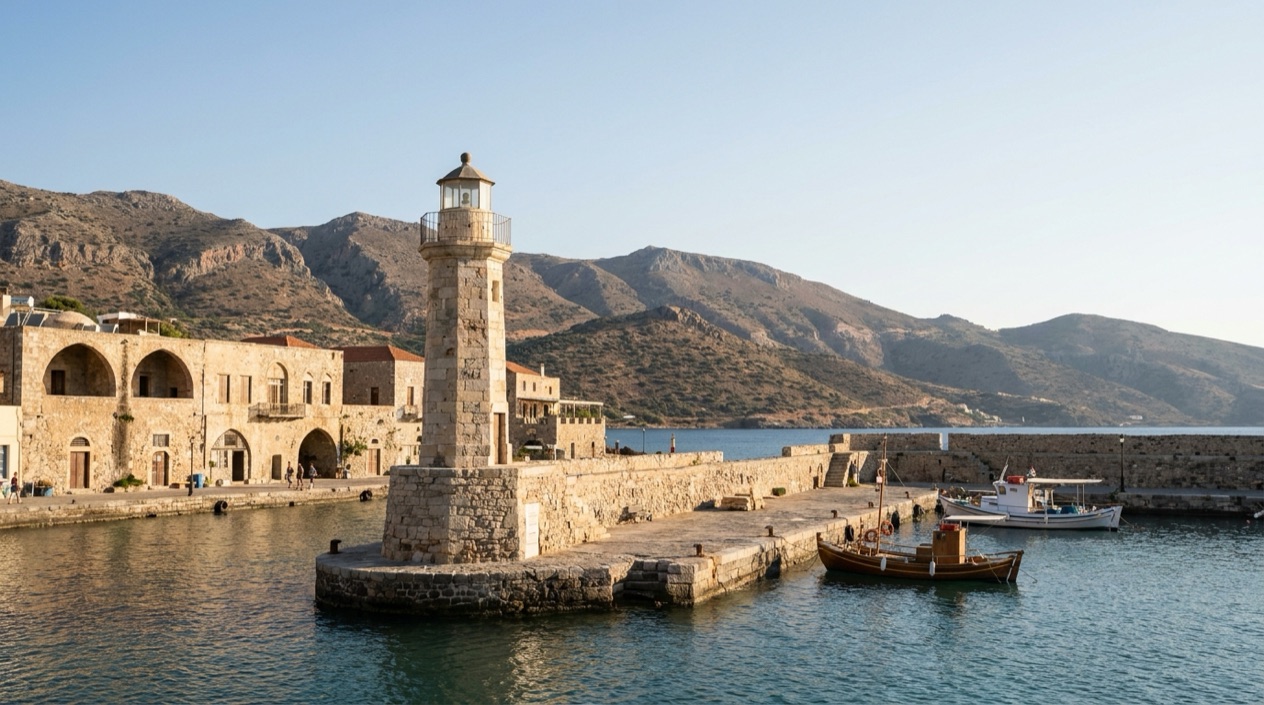
Boats bob in the little harbor at Elounda while the fortress walls of Spinalonga sit on the water just across the bay. Café chairs face the lagoon, and the talk at the tables drifts between the island, the beach and the next boat out.
Where is Elounda and what is it like?
Elounda sits on the north coast of Crete, in the municipality of Agios Nikolaos, in a small harbor on the lagoon between the island of Spinalonga and Mirabello Bay. It is a small town of 2,254 inhabitants by the 2021 census, and the scale shows: a central square, a waterfront, a handful of beaches and a few hillsides with hotels and villas looking over the bay.
The town carries a long past under its present-day calm. Its story begins with the ancient city of Olous, an important commercial and religious center. Later, during the Venetian period, salt pans were laid out here and supplied salt to a part of Europe. The fortress on Spinalonga was built in the same era to guard the bay, and it still defines the view from almost every waterfront table.
What Elounda offers is a sea town with a mix of resort comfort and village scale. Several sandy beaches lie within walking distance of the central square, and the main beach has been awarded the Blue Flag.
Travelers who like to pick a base and spend their days between the beach, the harbor and the boats will find it a good fit. Those who want a big nightlife scene or a long list of museums will find a smaller menu here, and will likely head into Agios Nikolaos, the nearby town, for more of both. Plaka, a small fishing village that overlooks Spinalonga and the Kolikithia Peninsula, lies just up the coast from the main square, heading north away from Agios Nikolaos.
What is there to do in Elounda?
The big reasons to come are the island across the bay, the beaches, the village of Plaka and the harbor itself, with its waterfront tavernas. What sets Elounda apart from its neighbors is how directly all of these sit on one bay: the fortress, the lagoon and the sand are in the same view.
Spinalonga Island
Spinalonga is the island that draws visitors, and it is reached by boat from Agios Nikolaos, Elounda and Plaka. The fortress was built by the Venetians to protect the bay, and the island has a second, more recent story. From 1904, by edict of the State of Crete, it was used as a leper colony, and the hospital there closed in 1957 after a cure for leprosy was found.
A visit means walking among the fortress walls and the empty stone houses of the old community, with the bay all around. Boats from Elounda or Agios Nikolaos take longer and cost more than those from Plaka, where the crossing takes about ten minutes. Anyone going late in the day should check the time of the last boat back from the island.
Beaches and the harbor
Several sandy beaches lie within walking distance of the central square, so a swim needs no vehicle. The main beach carries the Blue Flag, and the children’s play area nearby makes it a natural spot for families who want to alternate sand and playground. The sea itself is the point of the town, so many visits are built around a morning on the beach and a long lunch by the water.
The harbor in the lagoon is where the town’s life gathers. Boats tie up along the quay, and the tavernas and cafés on the waterfront serve Cretan staples such as grilled fish, salads with local olive oil, and dakos, the barley rusk topped with tomato and soft cheese. Ending a day with a glass of raki, the clear Cretan spirit often offered after a meal, is a local habit.
Plaka and the old salt pans
Plaka is a small fishing village facing Spinalonga across the water, and from its edge you look straight at the fortress island and the Kolikithia Peninsula. It is also the departure point for the shortest boat crossing to Spinalonga, and its tavernas make a fine place to watch the boats come and go.
Elounda also carries traces of its older identity. The salt pans of the Venetian period and the memory of ancient Olous belong to the shoreline here, so a walk along the lagoon edge is also a walk through layers of history.
How many days do you need in Elounda?
A long weekend covers Elounda well, and a week lets you slow down and add day trips. The town is small, and its main sights cluster around the one bay.
One day goes to the boat crossing to Spinalonga and the fortress, with time on the island among the old houses. Another day is for the beach and the harbor, with a swim at one of the sandy beaches near the central square, then dinner by the lagoon. A third can go to Plaka, for the village and its view of the island.
With more time, Elounda works as a base for the wider area. Agios Nikolaos, the municipality’s main town, has more shops, restaurants and a wider choice of evening life, and a local bus connects it to Elounda. Longer stays also allow repeat beach days and slow evenings on the waterfront, which is what the town does best.
Travelers arriving by ferry or flight should plan the arrival day as its own, since the road from Heraklion Airport is a drive of about an hour. Beyond that, a longer stay lets you reach other parts of Crete from this base, using a rental car, which is available in Elounda.
Where to stay in Elounda
The main places to stay are the village of Elounda itself, the hillsides above the bay, and Plaka across the water. Each gives a different kind of stay, and all keep the bay and Spinalonga in view.
The village, around the central square and harbor, is the choice for people who want the beaches and tavernas close at hand. Several sandy beaches are within walking distance of the square, and so is the lagoon waterfront, which makes the village a practical base for families and for anyone who prefers to leave the car parked.
The hillsides suit travelers who want a view over the bay. Bungalow hotels are built on a hill with a panoramic view of the bay of Elounda, and Plaka has hillside stays that overlook the gulf and the old Venetian island of Spinalonga. The Plaka properties range from a 3-star hotel facing the island across the sea to villas set into the slope.
At the other end of the scale are private villas. There are small collections of luxury villas with a swimming pool and sea view, for groups who want a house to themselves. Plaka stays are outside the village proper, so those who choose them will want to plan their way into Elounda for dinners and beach days, whether by bus, car or taxi.
How do you get to Elounda and get around?
Visitors reach Elounda from Heraklion Airport, which lies about 50 miles away, a drive of about an hour. The route follows the E74 toward Agios Nikolaos for 43 miles, and from there you turn for Elounda.
By bus, the route goes through Agios Nikolaos: you take a bus there and change to a connecting bus to Elounda. A local bus service with modern air-conditioned buses runs between Agios Nikolaos and Elounda, and public transport in Elounda is provided by the KTEL bus company.
Ferries are another way onto Crete. Major ferry lines serve the port of Heraklion, which connects with buses at the main bus station near the port, and ferries also run to Agios Nikolaos via LANE lines from Piraeus and Rhodes.
Once in town, much of what you want is close together. Several sandy beaches are within walking distance of the central square, and the harbor is where the Spinalonga boats leave. Car rental is available in Elounda for anyone who wants to reach other parts of the coast under their own steam, and the local buses link the town with Agios Nikolaos.
Boats are part of getting around here too. Spinalonga is reached by boat from Agios Nikolaos, Elounda and Plaka, and the crossing from Plaka takes about ten minutes. The boats from Elounda and Agios Nikolaos take longer and cost more.
When is the best time to visit Elounda?
Elounda is a town of the sea, the beach and the boat to Spinalonga, so the months that suit it best are the ones when you want to spend your days on the water and on the waterfront, which on this coast means the warm part of the year. The Blue Flag beach, the sandy shore near the square and the crossing to the fortress island are the heart of a stay.
A trip built around the beach and the boats fits the months of the warm season, and the waterfront tavernas are the setting for long evenings then. If your priority is the history of Spinalonga, the fortress and the old community, the crossing is the same in any month the boats are running, so those interested in the island and the town’s past have a wider choice of dates.
Heat and sun are part of a Cretan summer, so a hat, sun protection and plenty of water suit the island walk on Spinalonga. Anyone going late in the day should check the departure time of the last boat from the island, whatever the month. Ferries, flights and local boat schedules shift with the season, so the dates you choose shape how you arrive as well as what you do.
Good to know before you go
Greece uses the euro, and Elounda is small enough that a stay here is a matter of short outings between the harbor, the beach and the square. For the island, the one habit worth keeping is the check of the last boat back from Spinalonga. For everything beyond the town, a rental car is available locally, and the KTEL bus company handles public transport.
Sources
- Visit Greece (GNTO), Elounda (https://www.visitgreece.gr/islands/crete/elounda/), checked October 12, 2026
- Wikipedia, Elounda (https://en.wikipedia.org/wiki/Elounda), checked October 12, 2026
- Wikivoyage, Elounda (https://en.wikivoyage.org/wiki/Elounda), checked October 12, 2026
- Wikipedia, Spinalonga (https://en.wikipedia.org/wiki/Spinalonga), checked October 12, 2026