
At the rental counter in Athens, the agent slides the key across the desk, and the question every American traveler eventually asks comes up: is your license enough? Out on the road, the same question returns at a toll booth on the motorway or in front of a sign about parking on odd months. The short answer is that Americans can drive in Greece, with a U.S. license and an international driver’s permit, and with a few road habits worth knowing before the first roundabout.
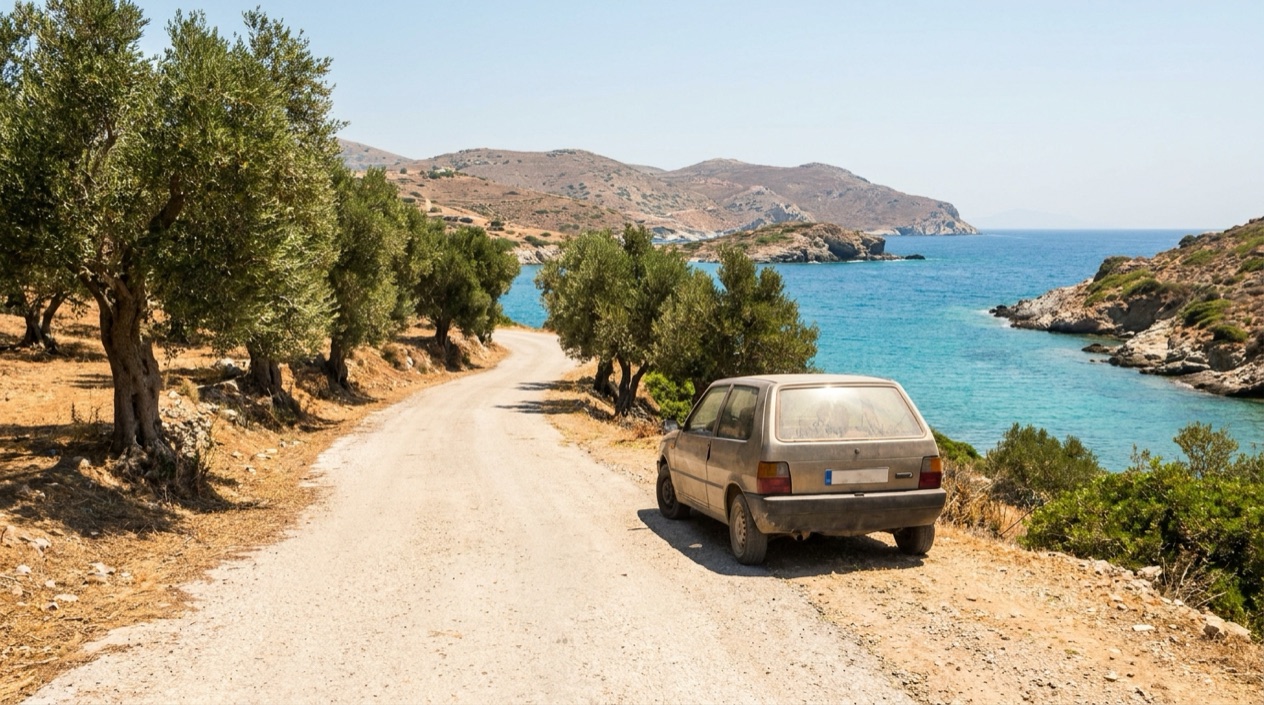
Can Americans drive in Greece?
Yes, Americans can drive in Greece, provided they carry a valid U.S. driver’s license and an international driver’s permit (IDP). The IDP is required even if the rental company never asks to see it. Plenty of travelers pick up the car, hear nothing about the permit and assume it is optional. The rules say otherwise, and the consequences show up when something goes wrong.
The permit and where to get it
The U.S. Embassy in Greece does not issue IDPs. You get yours in the United States, from the American Automobile Association (AAA) or the American Automobile Touring Alliance (AATA). Do it before you leave home, because the paperwork is not something to sort out from a hotel room in Athens.
If you realize the problem too late, AAA has a mail-in option for applying from overseas. It will likely take days or weeks, so it rescues a trip only when you still have time before you want to drive. Keep the permit in the same folder as your license, since the two travel together at the counter, at a police stop and after an accident.
Why the permit matters after a mishap
Drivers who do not hold an EU license must carry an IDP obtained in their home country, and it is certainly required if you are in an accident or pulled over by the police. Most insurance companies also ask for both your valid U.S. license and the IDP before they cover you in Greece. A rental agreement that skips the question does not change what an insurer or an officer will ask later.
Driving without a U.S. license and an IDP can bring high fines of 1,000 Euros or more, and you may be responsible for all expenses if there is an accident. That is the whole case for a small document that costs little to obtain before you travel.
Renting a car: manual or automatic
About 90% of rental cars in Greece are manual. If you want an automatic, which many Americans do before facing hill villages and city traffic, reserve one in advance. A manual is the default on most rental lots, and an automatic is the exception.
Rental terms in Greece often restrict taking the vehicle on ferries. That matters for anyone picturing a car hopping from island to island. On the islands themselves, travelers rent a separate car on arrival, which fits the way the ferry system works, with the spokes radiating from Piraeus to the island groups.
Motorbikes and ATVs
Small motorbike and all-terrain vehicle (ATV) rental firms in Greece frequently carry no insurance and require customers to cover the cost of all damages to their vehicles. Your own insurance company may not cover two-wheel or ATV rentals. Greek law requires all motorcyclists to wear a helmet.
It is a good idea to read the rental agreement line by line before you take a scooter down a coastal road. The picture of a bike on a Greek island is a pleasant one, but the paperwork behind it deserves the same attention as a car contract.
Staying longer
A Greek license is required if you stay more than 185 days in Greece. That is far beyond a vacation, but it is the line between a visitor who drives on a U.S. license with an IDP and a resident who needs local papers.
When a bus makes more sense
Not every trip needs a car. KTEL is the national government-subsidized network of independent businesses that form a dense route system serving almost the entire country. KTEL routes from major cities to islands near the mainland, such as Corfu and Cephalonia, include the ferry crossing in the price of the bus ticket.
Trains are a narrower option. Most rail traffic is in the Athens-Thessaloniki corridor and the suburban railways around the two cities, while lines such as Thessaloniki-Florina, Lamia-Trikala and Thessaloniki-Serres usually have only one or two trains per day. Anyone heading beyond that corridor will find that the road, or KTEL, is how the map fills in.
What are the main rules?
The main rules are the ones you know from home, with different speed limits by road type, strict bans on phones and drinking, and a road culture where lane markings are only a suggestion. Greece has one of the highest traffic fatality rates in the European Union, which is the reason to take the basics seriously from the first kilometer.
Speed limits by road type
Limits step down as the road narrows. Motorways have the highest ceiling in the country, expressways sit below them, and national roads are lower again. The numbers on the signs are in kilometers per hour, so look at the speedometer in the rental car, which will usually show kilometers as well.
On a national road, expect a mix of through traffic, trucks and the occasional village, which is why the lower limit applies.
Lanes, shoulders and passing
On many two-lane highways in Greece, slower traffic drives on the shoulder, and cars pass straddling the center double-yellow line. Do not rely on lane markings to tell you what other drivers will do. The habit looks odd at first, and it is something to watch for in the mirror and ahead before you pull out.
A driver who stays patient, keeps a steady position and watches the shoulder will find the rhythm quickly. The unexpected is more likely to come from a car cutting across the line than from a missing sign.
Phones, alcohol and drugs
Talking or texting on a mobile phone while driving is illegal in Greece, and the police check phone records when investigating accidents. A phone in a holder is not a reason to pick it up at a light. Navigation is best set before you start the engine.
Driving under the influence of alcohol or drugs is also illegal, and police conduct random alcohol testing. A long taverna lunch with a carafe of wine is part of a Greek day. The car keys, in that case, stay in the pocket.
Reading the signs
Road signs in Greece are displayed in both Greek and English, which helps with place names on the highway. Prohibitory signs are round with red borders and white backgrounds, with black pictograms. Mandatory signs are round with blue backgrounds and white pictograms.
On motorways the signs use the DIN 1451 font, and elsewhere the Transport font, which is also used in other European countries.
The big roads
Speed limits by road type. The A2, known as the Egnatia Odos, is the longest motorway in Greece at 416 miles, and it takes its name from the Roman road Via Egnatia. In Thessaloniki, Egnatia Street is something else entirely, a commercial street.
The A3, the Central Greece Motorway or E65, is 112 miles long, and the A7, the Morea Motorway, runs 96 miles. The a map or an older guide may show a gap that has since opened. The Antirrio-Ioannina section of the A5, the Ionia Odos, was inaugurated on 5 September 2017, and the Patras-Pyrgos section opened on 4 December 2025.
What about tolls and parking?
Tolls apply on motorways, and only there, with the sole exception of the Aktio-Preveza Undersea Tunnel, which is also tolled. Parking comes down to reading the signs on the street, including one that bans parking on odd months.
Where you pay and where you do not
Because motorways are the only toll roads, a drive on a national road or through a town costs nothing at a booth. That makes the choice between a motorway and a slower road partly about the road itself, and the booths mark the moment you enter the paid network.
Some motorways are free of charge. The A52, also known as Amvrakia Odos, is fully toll-free, unlike the A5. The A64 and A65, both sections of the Attiki Odos around Athens, are fully toll-free as well. A route that mixes these with the A5 will pass from free to paid and back.
The motorways on a trip
The long north-south and east-west axes, the A1 and the A2, are motorways, so a cross-country drive means passing through toll stations. The national roads connect the same regions at their own pace.
The newer A5 sections show how the network keeps growing. If a map or an older guide shows a gap between Patras and Pyrgos, the road has since opened. Drivers on the Ionia Odos will meet toll stations on the A5 and none on the A52, so the two roads feel different at the booth.
Parking and the odd-months sign
There is a Greek road sign indicating no parking on odd months. It means that a space that is fine in one month can be off limits in the next, so a quick look at the sign before you leave the car is worth the effort. Read the sign on the street where you stop rather than trusting what the car in front of you did.
Prohibitory signs, the round ones with red borders, are the ones to look for when you park. In a village, the road might be narrow and the sign small, which is why it helps to look up before you lock the door.
Cars and ferries
A car and a ferry do not always go together. Rental terms often restrict taking the vehicle on ferries, so a plan that involves driving onto a boat starts with reading the contract. Athens has three ports, Piraeus, Rafina and Lavrio, and for central Cyclades islands such as Tinos and Mykonos it is often better to leave from Rafina.
In the winter off-season, from January to March, weather on the Aegean can be extremely rough and boats are often kept in port for days at a time.
Good to know before you go
A Greek drive rewards patience. The rental agreement, the permit and the insurance are what separate a smooth trip from an expensive one, and the paperwork is cheaper to sort out at home than at a counter in Athens.
Where the plan includes an island, check whether the rental terms allow the car on a ferry, and for a motorbike or ATV, read what the firm covers before you sign. A car is one way across Greece, and the KTEL buses and the ferries from Piraeus, Rafina and Lavrio are the others.
Sources
- U.S. Department of State, Greece travel information, travel and transportation (https://travel.state.gov/content/travel/en/international-travel/International-Travel-Country-Information-Pages/Greece.html), checked October 12, 2026
- Wikipedia, Egnatia Odos (https://en.wikipedia.org/wiki/Egnatia_Odos), checked October 12, 2026
- Wikipedia, Highways in Greece (https://en.wikipedia.org/wiki/Highways_in_Greece), checked October 12, 2026
- Wikipedia, Road signs in Greece (https://en.wikipedia.org/wiki/Road_signs_in_Greece), checked October 12, 2026
- Wikivoyage, Greece, section Get around (https://en.wikivoyage.org/wiki/Greece#Get_around), checked October 12, 2026
To plan your stay
- Best Time to Visit Greece: September and Late May to Early June
- Arachova: Parnassus Mountain Town, Formaela Cheese, Ski Season and Saint George's Day
- American Airlines Flights to Greece: U.S. Cities, Athens Arrivals and Onward Island Flights
- Greece on a Budget: Cash Machines, Cards, Beaches and Ferries