
At Dodona the sound you notice first is leaves. Wind moves through the trees around the old sanctuary, and you start to understand why people once listened to oak branches for answers from Zeus. This is the oldest Hellenic oracle, a ruined sacred place in Epirus that rewards slow walking and a little imagination.
Is visiting Dodona worth it?
Yes, if you are curious about how the ancient Greeks asked the gods for advice, and especially if you are already exploring Epirus and the lake city of Ioannina. Dodona is not a place of towering monuments.
What sets it apart from the other great sanctuaries is its method. Dodona was considered second only to Delphi in prestige, yet it spoke through a tree.
Priestesses and priests in the sacred grove interpreted the rustling of the oak leaves (some accounts say beech) to decide what the right action should be. The site is possibly as old as the second millennium BCE, so you stand in a place whose habits of worship reach back before most of what Greece is known for.
It also tells a human story that Delphi and Olympia tell differently. Ordinary people came with practical questions, and the answers were scratched on small tablets.
Kings made the sanctuary a stage for games and drama, armies burned it, and a later emperor ended its life by cutting down the tree. Few sites let you follow a whole arc from belief to destruction so clearly. Pair it with Ioannina’s museum and lakeside streets, and Epirus makes a rounded trip.
What to see at Dodona
The sacred grove and the vanished oak
Start with the idea that holds the whole place together: the oak. In classical antiquity the priestesses and priests of the sanctuary listened to its leaves and read meaning into the sound. Everything else at Dodona grew around that tree, which was cut down when Theodosius closed the pagan temples and banned pagan religious activities in 391-392 CE.
Today you will not find the original oak, but the setting still carries the sense of a grove. Stand still for a moment, let the wind pass through the branches, and you hear what the questioners heard. It is a quiet exercise in imagination, and it makes the ruins around you easier to read.
The theatre and the festival of Pyrrhus
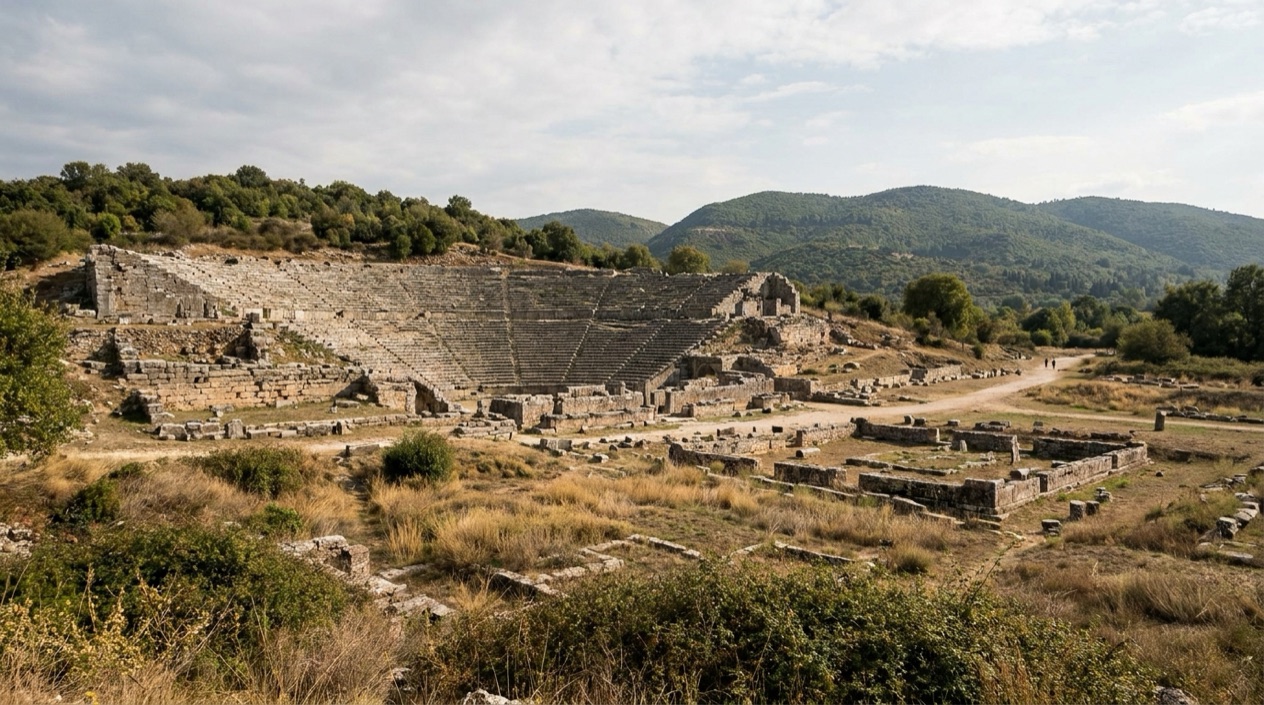
Around 290 BCE, King Pyrrhus made Dodona the religious capital of his domain. He added a festival with athletic games, musical contests and drama performed in a theatre. That changed the place from a site of private consultation into a gathering where whole communities came to compete, listen and watch.
Look for the theatre as the clearest sign of that ambition. Picture the seats filled for a festival, with the grove close by and the sanctuary behind it. The site’s later history, with fire in 219 BCE and reconstruction by Philip V of Macedon, is written in the layers of the same buildings.
The oracular tablets and where to see them
The most touching finds at Dodona are small. More than 4200 oracular tablets have turned up here, written in Greek and dated roughly between the mid-6th and early 2nd centuries BCE. They carry the questions people brought to the god, the kind of private worries every era shares.
The tablets and other finds are not kept on the hillside. Artifacts from the excavations are on display at the National Archaeological Museum of Athens and at the nearby Archaeological Museum of Ioannina. If you are staying in Ioannina, the museum there is the natural companion to the site, because it puts objects in your hands, so to speak, that the ruins can only hint at.
The basilica on the temple of Zeus
One layer of the site is Christian. A basilica occupies the place where the temple of Zeus once stood. It is a quiet end to the story: the old oracle ended, and a church took its ground.
Reading the remains this way helps you see the centuries together. Destruction by the Romans in 167 BCE, the rebuilding that followed, the closing of the temples and the arrival of the basilica all sit within the same sanctuary. You walk through all of it in one visit.
Hours, tickets and rules
Dodona is an archaeological site with a story told in two places: the sanctuary itself and the museums that hold what came out of it. The finds from the excavations are on display at the National Archaeological Museum of Athens and at the Archaeological Museum of Ioannina, and the site and the museum complement each other.
What you see on the ground is the sanctuary of Zeus, the grove, the theatre added in the days of Pyrrhus and the basilica that took the place of the temple. The museum rooms hold the tablets, which are the voice of the oracle, and that is the part you cannot see in the open air.
If you plan a day around Epirus, think of the visit in two parts. One is the open-air site, with its stones and trees, and the other is a museum visit in the city of Ioannina, where the history of the sanctuary becomes tangible. Together they give a fuller picture than either one alone.
When to visit Dodona
The best moment for Dodona is whenever you want to hear the trees. The oracle worked through the sound of leaves, so a visit when the grove is in leaf adds something that a bare landscape cannot. Think of the place as one where weather and wind are part of the experience, not an obstacle to it.
In ancient times the sanctuary had its own calendar of moments. Under Pyrrhus, a festival brought athletic games, musical contests and theatre, and the site filled with visitors and performers. You can imagine that energy as you stand in the theatre, even though today the mood is different and much more contemplative.
Epirus itself is a region of lakes, mountains and old stone towns, and Dodona fits into a longer journey rather than standing alone. Travelers pair it with time in Ioannina, so the season you choose is often shaped by what you want from the city and the lake as well as from the ruins.
Whichever month you choose, give yourself time to stay a while. The site is about atmosphere and story, and a rushed visit loses both. A slow pace lets the grove, the theatre and the basilica each have their moment.
Tips for your visit
Read about the oracle before you go. Knowing that the priestesses and priests listened to oak leaves, and that people left questions on tablets, turns a field of stones into a place with voices. A little background gives every corner of the site a purpose.
Combine Dodona with Ioannina, the city of Epirus sprawled around Lake Pamvotis. The lake has a small island, and visitors reach the inhabited island by small motorboats, with frequency depending on the season. On the island, the monastery of St Panteleimon, where Ali Pasha spent his last days, is now a museum with everyday artefacts and relics of his period.
The city holds more. The Kastro citadel has cobbled streets, and the grave of Ali Pasha lies inside it. Among the remarkable buildings are the Matei Mansion and the Ottoman Mosque of Veli Pasha. The Archaeological Museum of Ioannina is where the finds from Dodona can be seen, so a day spent in the city completes the story of the sanctuary.
Ioannina is also a place of memory. The Romaniote Jewish community of the city was deported to Auschwitz-Birkenau in March 1944, and today fewer than 50 members remain, most of them elderly. Knowing this adds depth to a walk through the old streets.
Ioannina lies 271 miles northwest of Athens, 180 miles southwest of Thessaloniki and 56 miles east of the port of Igoumenitsa on the Ionian Sea. That places Dodona in a part of Greece reached by a longer journey inland, which is part of its appeal.
Good to know before you go
Dodona belongs to the Greece of lakes, mountains and old towns rather than the island coast, so plan it as part of a wider Epirus trip. Bring cash for small purchases and the habits you would use anywhere in a city like Ioannina, which had a population of 112,486 in 2011. Give the site your attention, listen to the trees, and let the museums fill in what the stones leave open.
Sources
- Wikipedia, Dodona (https://en.wikipedia.org/wiki/Dodona), checked October 12, 2026
- Visit Greece (GNTO), Ioannina (https://www.visitgreece.gr/mainland/epirus/ioannina/), checked October 12, 2026
- Wikipedia, Ioannina (https://en.wikipedia.org/wiki/Ioannina), checked October 12, 2026
- Wikivoyage, Ioannina (https://en.wikivoyage.org/wiki/Ioannina), checked October 12, 2026
To plan your stay
- Best Time to Visit Greece: September and Late May to Early June
- Arachova: Parnassus Mountain Town, Formaela Cheese, Ski Season and Saint George's Day
- American Airlines Flights to Greece: U.S. Cities, Athens Arrivals and Onward Island Flights
- Greece on a Budget: Cash Machines, Cards, Beaches and Ferries