
Step through the gate at Daphni and the first thing you notice is the quiet of a laurel grove, with the stone walls of an old Byzantine monastery rising out of it. Inside, the dim light catches on thousands of tiny glass cubes, and a great golden dome seems to glow from within.
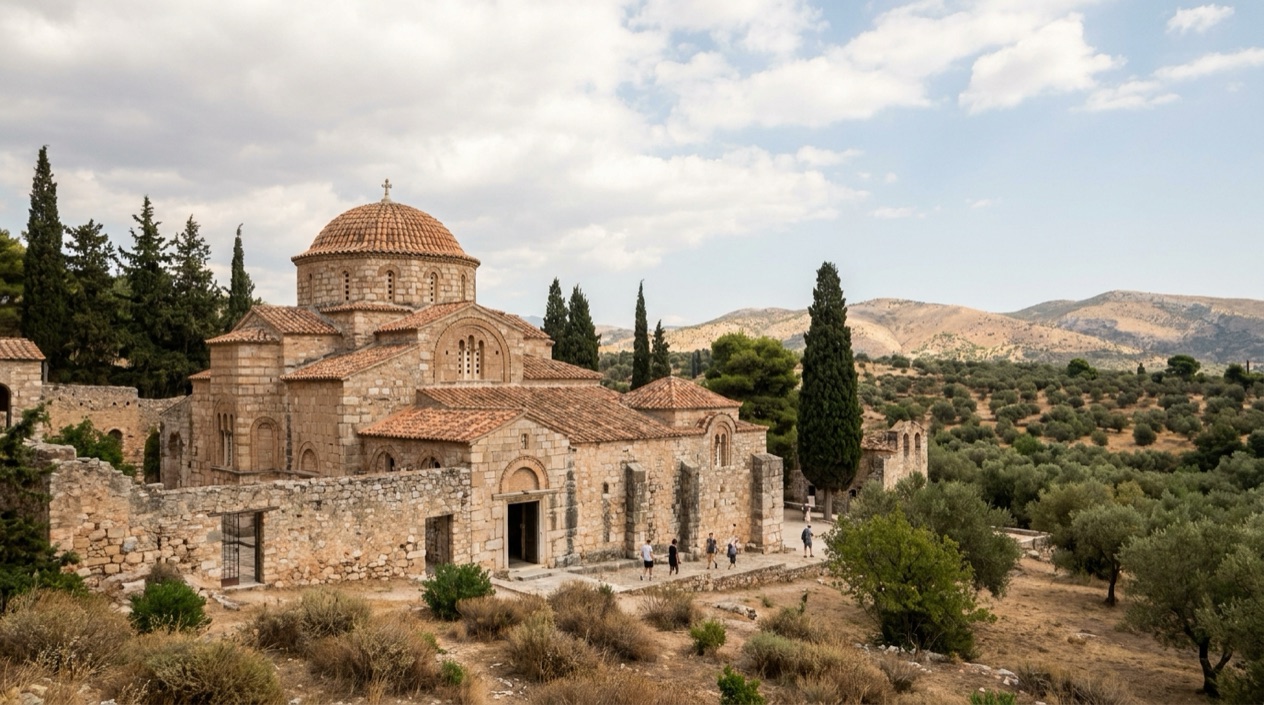
Is visiting Daphni Monastery worth it?
Yes, if gold-ground mosaics interest you even a little, and especially if your Athens days have so far been spent among marble and columns. Daphni is an eleventh-century Byzantine monastery in the suburb of Chaidari, about 6.8 miles northwest of central Athens, and it is one of the places where the Byzantine world, rather than the ancient one, is the story.
It is also a World Heritage Site, listed together with Hosios Loukas near Delphi and Nea Moni on the island of Chios. That grouping tells you something about the place: it is recognized for its historical and architectural value, and the interior is the reason.
What sets it apart from the other sights on an Athens list is the change of mood. The Acropolis and the Plaka are places of crowds and busy streets, and the Plaka in particular gets crowded.
When to go: a slow look upward, at faces and gestures made of glass and gold. The name means laurel grove in modern Greek, and a forest of the same name lies nearby, so the visit has a green edge that the city center lacks.
The monastery also sits on the Sacred Way that once led to Eleusis. You are standing on a road that pilgrims used long before the church was built, which adds a layer of history to a stop that might otherwise feel like a single building.
Anyone who has already seen the big Athens monuments and wants a second kind of beauty will find it here. Travelers with no interest in religious art may find the visit brief, since the interior is the heart of it.
What to see at Daphni Monastery
The mosaics come first, and everything else at Daphni is a setting for them. The glass pieces, called tesserae, are believed to have been made on site, which is not the case at every Byzantine church, where glass may have been brought in from elsewhere.
Christ Pantocrator in the dome
Look up into the crown of the dome and you meet the image the monastery is known for: Christ Pantocrator, the ruler of all, gazing down from a field of gold. It has been described as one of the greatest creations in art, and standing beneath it, you can see why people keep that phrase alive. The face is large and serious, and the gold behind it seems to move as your eyes adjust to the dim interior.
Give your eyes a minute before you judge it. The church is lit softly, and the mosaic reveals more the longer you stand still. Tilt your head back, then step a little to one side and watch how the gold shifts. This is the single image to see if you see only one.
The mosaic cycle and its style
Beyond the dome, the walls and vaults carry a wider cycle of scenes and figures. Art historians place them in the early Komnenian period around 1100, and they are among the best-preserved cycles of their kind. What to look for is the human quality of the figures. They are more naturalistically represented than in earlier Byzantine art, and they blend smoothly into their surroundings rather than standing stiffly apart.
Take your time moving along the walls. Notice the drapery, the faces, the way a figure seems to lean or turn. Compared with the severe, flat images you may have seen in other Byzantine churches, these feel closer to something alive. The gold background ties everything together, reflecting what little light enters the church.
The building and its grounds
The monastery is a middle Byzantine structure from the eleventh century, and its stone walls enclose the church and the area around it. The setting among laurel and other trees gives it a calm that the surrounding suburb does not promise from the road. The name itself comes from that laurel grove.
Walk around the outside before or after you go in. The exterior is plain compared with the glittering interior, and that contrast is part of the experience: a modest shell around a golden core. Because the monastery sits on the Sacred Way to Eleusis, you can also think of the road as part of the site, a route walked by people for centuries.
When to visit Daphni Monastery
Because most of the visit happens indoors, in front of mosaics, weather matters less here than at an open-air ancient site. It still shapes how pleasant the trip out to Chaidari feels, and the walk between the entrance, the grounds and the church.
| Month | Average high (°F) | Average low (°F) | Precipitation (in) | Days with rain (1 mm or more) |
|---|---|---|---|---|
| January | 56.3 | 44.4 | 2.17 | 7.5 |
| April | 68.4 | 53.2 | 1.10 | 5.5 |
| July | 91.8 | 74.1 | 0.28 | 1.6 |
| October | 75.2 | 61.0 | 1.09 | 3.9 |
October and April sit in the comfortable middle. Highs in the mid-70s in October and the upper 60s in April make the walk from the gate to the church pleasant, and rain days are few. Both months suit a day that pairs Daphni with other Athens sights without leaving you tired from heat.
July is the hot month, with highs in the low 90s and almost no rain. If you come in summer, bring sun protection for the grounds, and expect the stone interior to feel like a relief after the outdoor walk. Heat is the main thing to plan around, and a visit to the church fits well between other plans.
January is cooler, with highs in the mid-50s and the most rain of the four months. A rain jacket is the practical answer, and a wet day suits Daphni well, since the best part of the visit is under a roof. The grounds will be damp, but the mosaics look the same whatever the sky is doing.
Tips for your visit
The most useful thing to bring is time to stand still. Mosaics reward slow looking, so a visit that rushes from the door to the dome and back out misses most of what makes Daphni special. This is the single image to see if you see only one.
Daphni sits about 6.8 miles northwest of central Athens, in the suburb of Chaidari. Check the official Athens tourism guide for how to get there.
Pair Daphni with the rest of Athens by contrasting it with the busy sights. The Plaka has picturesque streets, historic landmarks and lively shops, though it gets crowded. In Koukaki, the Acropolis Museum and a pedestrian walkway link ancient monuments, and the neighborhood has become fashionable. After the hush of Daphni, either makes a lively change of pace.
Think too about the larger Byzantine picture. Daphni belongs to a small trio of World Heritage monasteries with Hosios Loukas near Delphi and Nea Moni on Chios, so travelers who enjoy it may want to follow the thread to the others on a longer trip through Greece. The official tourism guide of the city, This is Athens, is a good place to start for what else is on in town.
Good to know before you go
Daphni is a working piece of religious heritage as well as a sight, so the habits of any Orthodox church apply: a quiet voice, and attention to what is happening around you. Carry some euros for the day, since small purchases around a suburban stop tend to be simple ones. Carry some euros for the day, since small purchases around a suburban stop tend to be simple ones before you set out, because they can change.
Sources
- Wikipedia, Daphni Monastery (https://en.wikipedia.org/wiki/Daphni_Monastery), checked October 12, 2026
- OASA, Athens urban transport (https://www.oasa.gr/en/), checked October 12, 2026
- Athens Transport, public transport guide (https://www.athenstransport.com/english/), checked October 12, 2026
- This is Athens, the official Athens tourism site (https://www.thisisathens.org/), checked October 12, 2026
- Hellenic National Meteorological Service (HNMS), climatological normals 1991-2020 for Elliniko station (https://www.emy.gr/climatic-data), monthly mean daily maximum and minimum; rain from the ECMWF ERA5 reanalysis, 1991-2020, grid cell of Athens (Open-Meteo), checked October 12, 2026
- ECMWF ERA5 reanalysis 1991-2020, grid cell of Athens (Open-Meteo), checked October 12, 2026
To plan your stay
- Best Time to Visit Greece: September and Late May to Early June
- Arachova: Parnassus Mountain Town, Formaela Cheese, Ski Season and Saint George's Day
- American Airlines Flights to Greece: U.S. Cities, Athens Arrivals and Onward Island Flights
- Greece on a Budget: Cash Machines, Cards, Beaches and Ferries