
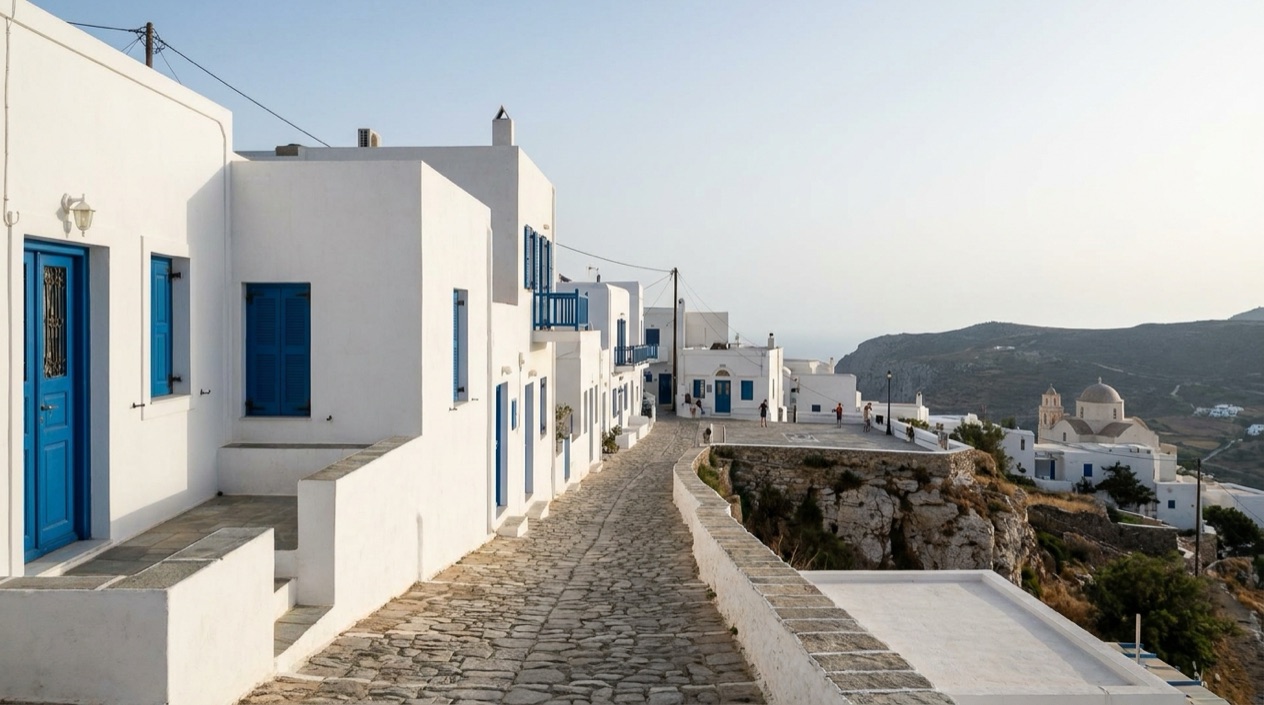
The road from the port of Karavostasis climbs away from the water, and then the island’s capital appears along the rim of a great cliff, with the Aegean dropping away beneath it. Chora of Folegandros is a village of lanes, squares and a church set high above the rooftops. It is a place to wander on foot, to sit over a long meal and to look out over open sea.
Is visiting Chora of Folegandros worth it?
Chora is the capital of Folegandros, and it sits on the edge of a cliff that rises 660 feet above the sea. That position gives the village its character: you walk through its lanes and suddenly the ground ends and the Aegean opens up.
Folegandros is a small island in the Cyclades, part of the southern group that also includes Sikinos, Ios, Anafi and Santorini. Its land is barren, with a rocky coastline and almost sheer cliffs, and that austerity is what you notice when you compare it with its better-known neighbors.
Here the village itself is the attraction. There is no long waterfront strip and no sprawl, only a capital perched at the edge of the island, a church above it and the sea in every direction.
The island has three villages, Chora, Karavostasis and Ano Meria, joined by a paved road. Chora is the one that gives a visit its shape: a place to arrive in, stay in or return to after a day spent exploring the rest of the island. Anyone drawn to stone lanes, tavernas, sea views and a slow evening will find the village rewarding.
What to see at Chora of Folegandros
The cliff edge and the view over the Aegean
The defining feature of Chora is its position on the lip of the cliff, 660 feet above the water. From the edge of the village the land simply stops, and the sea fills the view. The island is bare and rocky, so the scene is one of stone, sky and water rather than green slopes.
Wander the village with that edge in mind. Some lanes lead you toward the drop, others turn inward among the houses, and the contrast between the enclosed village and the open horizon is the pleasure of the place. Take your time here, since the view changes as you move from one side of the village to another.
The Church of Panagia above the village
The Church of Panagia stands above Chora and is a landmark of the island. Panagia is the Greek name for the Virgin Mary, and churches dedicated to her are found all over the Greek islands, usually placed so that they can be seen from far away. This one rises over the village rooftops and is the first thing the eye picks out when you look up from the lanes.
Looking up at the church from the village, and looking back down at Chora from its height, gives you a sense of how the settlement is laid out against the cliff. Orthodox churches are living places of worship, so a visit is a matter of quiet manners rather than sightseeing at speed.
The lanes and squares of the village
Chora is a village you explore without a list. Its lanes wind between houses, open into small squares and lead toward the tavernas and cafés where the evening unfolds. Greek island villages tend to be organized around these small public spaces, where people sit with a coffee, a glass of ouzo or a plate of meze, the small dishes shared at the table.
Look for the local dishes on the menus: grilled fish, a plate of fresh tomatoes with feta, a pan of moussaka, or a plate of souvlaki, meat grilled on a skewer. Kafenio, the traditional coffeehouse, is where a slow morning begins. Keep your plans loose, since the village rewards drifting from one corner to the next.
Ano Meria and Katergo beach, beyond the village
Chora is the base for the rest of the island, and the paved road connects it to Ano Meria, the third village. Ano Meria holds a small Ecological and Folklore Museum, a place to learn how islanders lived on this rugged land. It rounds out a day spent in the capital with a look at the island’s everyday history.
Katergo beach is reached only on foot or by boat from Karavostasis, and it is used by naturists. That detail matters if you are planning a swim, since it shapes who you will find there and how you get to the water. The sea is a part of any visit to Folegandros, but access to this beach is limited to those two routes.
How to get to Chora of Folegandros
You reach Chora by first reaching the island, and the island’s port is the small village of Karavostasis. This is where boats arrive, and from there you continue to the capital. Folegandros has no sprawling harbor town, so the port is a modest village that serves as the doorway to the rest of the island.
Folegandros lies on the western side of the Cyclades, in the southern group alongside Sikinos, Ios, Anafi and Santorini. That position places it among a chain of islands, and travelers who are moving through the Cyclades can think of it as one stop in a larger island route. The sea is what connects it to its neighbors and to the mainland.
From Karavostasis to Chora, a paved road links the island’s three villages: Karavostasis, Chora and Ano Meria. The road is how the capital connects to the port and to the farming village at the far end of the island. Chora itself is built on a cliff, so the approach climbs from the sea toward the village above it.
The island is small, with an area of about 12 square miles, so the three settlements sit within a compact stretch of land. Once you are in Chora, the village is where you begin your explorations. The paved road is the thread that ties the island together, running between the port, the capital and Ano Meria.
When to visit Chora of Folegandros
Chora suits any time you want to see a cliff-top Cyclades village, and the village itself is the draw rather than a particular event. Folegandros is a small, barren island with a rocky coastline, and the character of its capital comes from its landscape: stone, sea and a sheer drop beneath the houses. That is what you come for, whichever month you choose.
Think about what you want from the trip. If you want to spend your days walking the lanes of the village, looking out from the cliff and eating on a terrace, then the village gives you that. If you want to add the sea, remember that Katergo beach is reached only on foot or by boat from Karavostasis, so a beach day takes some planning.
The Cyclades are an Aegean group, and travelers heading there plan around the sea, the sun and the ferries. Folegandros fits into that picture as a quieter island in the southern Cyclades, one that you can pair with its neighbors. Because the island is small, a visit centers on the village and a few outings rather than a long list of sights.
Whenever you go, spend time at the cliff edge and in the lanes. The village is built to be seen from above and from within, and a slow wander covers both. The Church of Panagia, high over the rooftops, stays in view and gives you a point to orient yourself by as you move through Chora.
Tips for your visit
Plan to treat Chora as a village to wander rather than a site to tick off. The pleasure is in the lanes, the squares and the edge of the cliff, so leave room in your day for sitting, eating and looking. A sturdy pair of shoes suits stone lanes and the climb that comes with a village built against a cliff.
Combine the capital with the rest of the island. The paved road runs to Ano Meria, where the small Ecological and Folklore Museum shows how people lived here. Karavostasis, the port, is the arrival point and the starting place for the boat or the walk to Katergo beach, which is used by naturists.
If the sea is part of your plan, bring a swimsuit and sun protection, since the island is barren and offers little natural shade on its rocky slopes. Folegandros is a small island, so a visit with a mix of village time, a museum stop and a beach outing fills the stay comfortably.
When you step into the Church of Panagia or any other church on the island, treat it as a place of worship. Keep your voice low and your manner respectful. At the table, order a few meze to share and let the meal stretch, as islanders do, with a glass of ouzo or a cold drink and a view of the sea.
Good to know before you go
Greece uses the euro, and a small island village like Chora is a place to keep a little cash alongside your card for the corner café or the bakery. Folegandros is a quiet island, and the village goes about its life at an unhurried pace, so plan your days with room to spare. The Aegean is an open sea, and a cliff-top village faces it directly, so bring a layer for the wind that can come off the water.
Sources
- Wikipedia, Folegandros (https://en.wikipedia.org/wiki/Folegandros), checked October 12, 2026
- Visit Greece (GNTO), Folegandros (https://www.visitgreece.gr/islands/cyclades/folegandros/), checked October 12, 2026
- Wikivoyage, Folegandros (https://en.wikivoyage.org/wiki/Folegandros), checked October 12, 2026
To plan your stay
- Best Time to Visit Greece: September and Late May to Early June
- Arachova: Parnassus Mountain Town, Formaela Cheese, Ski Season and Saint George's Day
- American Airlines Flights to Greece: U.S. Cities, Athens Arrivals and Onward Island Flights
- Greece on a Budget: Cash Machines, Cards, Beaches and Ferries