
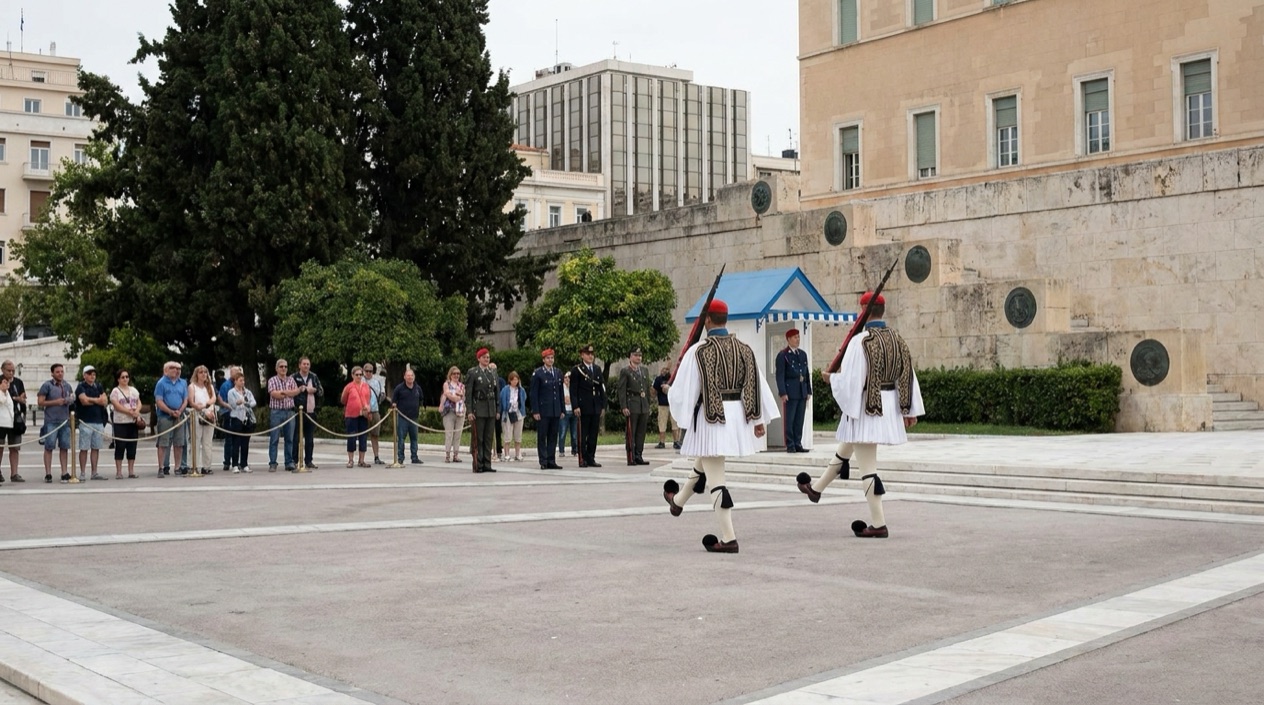
Two soldiers in pleated white kilts and red caps with long black tassels move across the stone in slow, deliberate steps, one leg lifted high, the shoes swinging with heavy pompoms. Around them, a small crowd holds up phones and falls quiet. This is the Grand Change of the Guard at Syntagma Square in Athens, a ceremony of the Presidential Guard that turns a busy square into a stage for a few minutes, and it suits anyone who likes a ritual with costume and choreography.
Is visiting the changing of the guard in Athens worth it?
Yes, if you enjoy ceremony and watching something performed with total seriousness, and especially if you are already in the center of Athens and have the time to stand and look. It asks very little of a day: you do not travel out to it, you simply arrive at Syntagma Square and let the ritual unfold in front of you.
What sets it apart from other guard ceremonies you may have seen, in London or Copenhagen for instance, is the clothing and the movement. The soldiers are the Evzones, and their uniform is built around the fustanella, a pleated kilt.
A story that is repeated about it says the number of pleats matches the length of the Ottoman occupation, which is given as four hundred. Whether or not you take the legend literally, it tells you that the costume is meant to carry memory, not just decoration.
The ceremony is also unusually physical. Instead of marching and stamping on the spot, the guards perform a slow, stylized step, with sharp turns, raised knees and a stillness in between that makes each gesture look carved. Watching it, you notice details you would miss in a quick photo: the tassel swaying a beat behind the head, the way the pompoms on the shoes follow the foot, the perfect alignment of the pair.
It is less rewarding if you expect a long show or a place to sit. It is a moment, not an attraction you spend a day on, and it works best folded into a larger walk through the center, where Plaka and the museum quarter of Koukaki are close by in the same part of the city.
What to see at the changing of the guard in Athens
The Evzones and their uniform
The Evzones belong to the Presidential Guard, and they are the reason people stop. Look first at the fustanella, the white pleated kilt that gives the whole figure its swing. The legend of its pleats, said to equal the years of the Ottoman occupation, gives the garment a story that guides and locals like to tell.
Then look lower: the tights, the garters and the shoes topped with large pompoms, which move with each lifted step. The red cap with its long tassel completes the outfit. Photographs flatten all this, so give yourself a minute simply to watch how the cloth falls and sways as the soldiers turn.
The Grand Change of the Guard at Syntagma Square
The Grand Change of the Guard is the larger ceremonial version of the ritual, held at Syntagma Square and involving the Presidential Guard. It is the form of the event that gives the square its draw for visitors, and it feels more like a small performance than a routine handover.
What to watch for is the choreography: the slow walking step, the pauses where the guards freeze, and the way the pairs meet and part. A little patience pays off, because the stillness between movements is half of the effect.
The square and its surroundings
Syntagma is a working crossroads of the city, with the tramway back at the square since 19 November 2020 and the metro beneath your feet. That mix of traffic, commuters and ceremony is part of the charm: the guards perform in the middle of ordinary Athens life, not behind a fence or in a museum.
Once the ceremony ends, the crowd breaks up and drifts toward the old streets. Plaka, with its picturesque lanes, historic landmarks and lively shops, is a natural next step, though it gets crowded. The Koukaki neighborhood, fashionable and linked by a pedestrian walkway and the Acropolis Museum to the ancient monuments, gives a calmer second chapter to the morning.
When to visit the changing of the guard in Athens
The ceremony is outdoors, so the season decides how pleasant the wait is. Your standing time is short but the square has little cover, which makes temperature the thing to plan around. The shoulder months give the most comfortable conditions, and the height of summer asks for some care.
Spring is gentle for standing in a square. April brings highs in the upper 60s and lows in the low 50s, with a handful of rainy days. October is a little warmer, with highs in the mid-70s, and rain is light and infrequent. Both months let you stay for the whole ceremony and then walk on without feeling worn out.
July is a different proposition. Highs reach the low 90s and nights stay warm, with almost no rain.
You can still go, but you will feel the sun while you wait, so a hat, sunglasses and water are sensible, and shade near the edges of the square is worth looking for. Winter is cooler and wetter: January has highs in the mid-50s and a good number of rainy days, so a rain jacket is the plain consequence.
| Month | Average high (°F) | Average low (°F) | Precipitation (in) | Days with rain |
|---|---|---|---|---|
| January | 56.3 | 44.4 | 2.17 | 7.5 |
| April | 68.4 | 53.2 | 1.10 | 5.5 |
| July | 91.8 | 74.1 | 0.28 | 1.6 |
| October | 75.2 | 61.0 | 1.09 | 3.9 |
As for the time of day, the ceremony is a fixed event rather than something you drop into at random, so the useful habit is to arrive at the square a little before it begins and settle in. If you reach it by metro, remember that trains run from early morning until just after midnight, and on Friday and Saturday nights lines 2 and 3 stay open later, which helps if you pair the ceremony with an evening in the center.
Tips for your visit
Bring a hat and water in the warm months, comfortable shoes for the walk afterward, and a camera or phone ready before the soldiers start to move. In the cooler, wetter months a rain jacket is the useful addition, since you will be standing outdoors.
Getting to Syntagma is straightforward for anyone staying in the center. The metro stops at the square, and the tramway has returned to it. If you take a bus, note that passengers cannot use the front door to get on or off.
Metro trains run from 5:30 a.m. to 00:30 a.m., with lines 2 and 3 open later on Friday and Saturday nights. Line 3 between the airport and Douk. Plakentias has trains every 30 minutes, which matters if you are heading out after the ceremony.
From the square you can continue into Plaka, whose streets and shops are among the most visited in the city, or head to Koukaki, where the Acropolis Museum and the pedestrian walkway connect the ancient monuments. Both give you something to eat, drink or browse once the crowd thins.
With children, the costume does most of the work: the pompoms and the slow, exaggerated steps tend to hold young attention for the length of the ceremony. Because you will stand on open paving, it helps to plan a place for a snack or a rest in a nearby cafe afterward. For travelers who find standing difficult, the open square gives room to position yourself at the edge, and the metro and tramway stops sit at the square itself.
For planning, think of the ceremony as one stop in a day, then add the places that suit your pace: a long lunch of souvlaki or meze in a taverna in Plaka, a coffee in a kafenio, or a visit to the museum in Koukaki.
Good to know before you go
The ceremony is free to watch from the square, and nothing about the visit asks for money beyond what you spend on a coffee or a meal in the streets around it. Plaka gets crowded, so give yourself room to move there, and keep an eye on your belongings in any busy place as a general travel habit.
In summer the heat is the main thing to plan around, so carry water and pick the shaded edges of the square while you wait. For the official picture of the city beyond this ceremony, This is Athens is the city’s own tourism guide.
Sources
- Wikipedia, Evzones (https://en.wikipedia.org/wiki/Evzones), checked October 12, 2026
- OASA, Athens urban transport (https://www.oasa.gr/en/), checked October 12, 2026
- Athens Transport, public transport guide (https://www.athenstransport.com/english/), checked October 12, 2026
- This is Athens, the official Athens tourism site (https://www.thisisathens.org/), checked October 12, 2026
- Hellenic National Meteorological Service (HNMS), climatological normals 1991-2020 for Elliniko station (https://www.emy.gr/climatic-data), monthly mean daily maximum and minimum; rain from the ECMWF ERA5 reanalysis, 1991-2020, grid cell of Athens (Open-Meteo), checked October 12, 2026
- ECMWF ERA5 reanalysis 1991-2020, grid cell of Athens (Open-Meteo), checked October 12, 2026
To plan your stay
- Best Time to Visit Greece: September and Late May to Early June
- Arachova: Parnassus Mountain Town, Formaela Cheese, Ski Season and Saint George's Day
- American Airlines Flights to Greece: U.S. Cities, Athens Arrivals and Onward Island Flights
- Greece on a Budget: Cash Machines, Cards, Beaches and Ferries